2007 Fire Season Monkeywrenching forests Politics and politicians The 2008 Fire Season The 2009 Fire Season The 2010 Fire Season
by admin
2 comments
Letter to the Salt Lake Tribune Re the Twitchell Canyon Fire
Dear Sirs and Madams,
Your reportage of the Twitchell Canyon Fire leaves out some important facts and context.
The Twitchell Canyon Let It Burn Fire has been burning on the Fishlake National Forest since July 20th [here].
It was declared a Let It Burn fire from the get go, without any NEPA process or public oversight. In the words of the USFS:
The fire is being managed for multiple objectives, which included providing for the safety of the public and firefighters, to increase structural diversity in forest and shrubland ecosystems through use of fire, reducing fuels in a mosaic pattern to effectively manage future fires, and to manage the fire for a scenic vegetation mosaic effect in the Manderfield Reservoir viewshed.
Get that? The “purpose” of this wildfire is to create a scenic “mosaic” of incinerated forest with “structural diversity”. Those are environmental “objectives” but without any sort of environmental analysis or EIS as required by law.
A barebones crew of 26 were assigned to “monitor” the fire. They watched while the fire grew and grew. By August 14th the fire had grown to 4,128 acres and a real fire crew was called in. Over 200 personnel fought the Twitchell Fire for a week, but then they went home. By August 26th the fire was 4,508 acres and a “monitoring” crew of 20 was all that were left. By that date $2.5 million had been spent to “achieve objectives”.
On Sept. 3 the Twitchell Fiasco Fire blew up to 5,400 acres. Two days later the fire was 7,000 acres and the Kimberly Mining District was evacuated. The Great Basin Type 2 Incident Management Team was been called in. $3.2 million had been spent on “suppression” by that date.
Again, no effort was made to contain the fire, but it settled down at around 11,000 acres on Sept. 7. For a week. Then on Sept. 14 it blew up again. As of last night the fire was over 20,000 acres and was impinging on I-70 and the adjacent power line corridor.
Over $6 million has been spent not suppressing this Let It Burn fire to-date. Aerial firefighting has been undertaken with the attendant ratcheting up of costs.
Rather than “creating a scenic mosaic” the fire has displayed flame lengths of over 200 feet. Historically high ERC’s (Energy Release Components, an index that measures fire intensity) have been recorded. This fire is burning VERY HOT. It is not a lazy or light “mosaic” burn. It is total incineration. Nothing is left alive withing the perimeter, animal or vegetable.
Numerous historical structures have been burned. More are threatened. I-70 has been closed. Smoke has poured to points east for two solid months.
The watershed being incinerated contains a number of reservoirs. $Millions are being spent to turn that watershed into a moonscape. Flash floods are sure to follow this winter. The government functionary directly responsible is Fishlake NF Supervisor Allen Rowley. No NEPA process was followed. This Let It Burn fire is patently illegal.
Wildfire Benefits or Damages?
The “fire community” makes a lot of noise about the “benefits” of wildfire, but when issue gets to court (as it sometimes does), the “benefits” magically turn into enormous damages and losses.
UP pays $17.3 in damages for Rich Fire
By Delaine Fragnoli, The Plumas County News, August 27, 2010 [here]
Union Pacific Railroad Co. has agreed to pay more than $17 million for damages and suppression costs related to the 2008 Rich Fire [here] on the Plumas National Forest.
The payment, announced by government officials, settled a federal claim after a Forest Service investigation concluded a crew of railroad workers negligently ignited the fire by cutting and welding rail without using tent shields.
The fire, which started July 29, 2008, in the Feather River Canyon, burned 6,500 acres, destroyed four structures, led to evacuations and temporarily closed Highway 70, the rail line and the Pacific Crest Trail.
The settlement amount includes the $10 million* it cost to suppress the fire and another $7 million for destroyed timber, reforestation costs and other environmental and resource damages.
* The suppression expenses reported at the time were $13,233,637 [here]. But those accounts were confounded by the numerous other fires burning on the Plumas NF at the time, including the Belden Fire and the Canyon Complex Fires [here]. There were 45 to 50 fires in the Canyon Complex (37,831 acres, $45,501,474) all ignited by lightning.
We can safely assume that all those fires damaged the environment. After all, the Rich Fire was no different than all the other fires, and the U.S. Judicial System has determined that damages (in excess of suppression costs) were in the order of $7 million on the Rich Fire alone.
That determination was based on the pleadings of the US Forest Service, which (as it turns out) maintained in court, under oath, that wildfires inflict severe and very expensive damages to bugs, bunnies, and other environmental values.
Let’s reiterate the main point here. Wildfires do not provide benefits, they inflict damages, very expensive damages, according to the USFS contentions made under oath in Federal Court and agreed to by the Judiciary.
As it turns out, when the USFS deliberately incinerates forests, as they did this summer again in numerous places, they KNOW they are not doing anyone any favors, but rather they KNOW they are inflicting severe and costly damages to the environment.
So the next time some obsequious bureaucrat from the USFS, or one of the fawning supporters of Let Burn, tries to tell you that they are doing you a favor by destroying your forests with catastrophic holocausts, that pro-holocauster can be dismissed as a lying sack of manure, an arsonist, and an eco-terrorist, and if the pro-holocauster wants to, he (or she, as in the case of our Regional Forester) can tell their sick lies to a judge and see where that gets them.
According to the USFS, that is, and to the Courts, who completely agree that when push comes to shove, wildfires inflict environmental damages (which can be measured in dollars).
More from the Plumas County News article:
Union Pacific agreed to pay the bill in full in exchange for a release from damages claims.
The settlement comes two years after a record-setting agreement on the August 2000 Storrie Fire, which scorched 52,000 acres on the Plumas and Lassen national forests. That fire was also sparked by a UP crew repairing track.
In 2004, the Forest Service billed UP $63.9 million for damages. The company refused to pay that bill, and the United States filed suit.
After two years of litigation, Union Pacific settled that case for $102 million [here].
It remains the largest settlement ever in a case about the origin of a wildfire.
It also set precedent by including, not only suppression costs, but also damages to natural resources.
Settlement funds representing resource losses from fire are dedicated by federal statute to support restoration projects on the damaged national forests. A substantial portion of the Rich Fire settlement funds will go to the Forest Service to help remedy damages caused by the fire.
A fire restoration team on the Plumas National Forest will spend approximately the next year assessing needs and developing a plan said forest spokeswoman Lee Anne Schramel. …
The Eastern District of California has special Fire Recovery Litigation teams that focus solely on these types of cases.
That’s right, sports fans. The US Dept. of Justice has special Fire Recovery Litigation teams whose job it is to sue the bejabbers out of anyone (with deep pockets) who can be held negligent for causing some of the severe environmental damages that accrue from wildfires, damages that will be assessed by the Federal Court to the tune of many, many $millions.
Benefits? Tell it to the judge.
No word yet on whether the special Fire Recovery Litigation teams will be prosecuting Regional Foresters, Forest Supervisors, Incident Commanders, and other government functionary perpetrators of Let It Burn fires that inflict many, many $millions in damages to the environment.
We encourage such prosecutions. Go get ‘em, USDOJ. Bring the perps to justice. In orange jumpsuits and shackles. Throw the book at them.
Because if private companies and individuals are held negligent and financially responsible for inflicting severe environmental damages via fire, then public servants must be treated in exactly the same manner.
Because in the USA the law applies to everybody. There is not one set of laws for the peasantry and another set of laws for government functionaries. That might have been the case in the Soviet Union and Red China, but it is not the case here.
Capice?
Ninth Court Upholds Restoration in Spotted Owl Forest
In a stunning and precedent-setting decision yesterday, the Ninth Circuit Court of Appeals reversed a lower court and upheld the Five Buttes Project on the Deschutes National Forest.
The Project [here, here] is planned for the Five Buttes area (near Odell and Davis Lakes) in the Crescent Ranger District approximately 50 miles south of Bend, Oregon. It includes 4,235 acres of commercial thinning, with an estimated volume of 14.4 million board feet; 4,235 acres of fuels treatments associated with commercial harvest units; 3,931 acres of fuels treatments in units (including 368 acres in Unit 435) that will not have commercial harvest at this time; and 5.9 miles of temporary road construction and rehabilitation of temporary roads when they no longer are needed.
The Five Lakes Project has been in the planning process since 2004, in part in response to the 2003 Davis Fire (21,000 acres). The League of Wilderness Defenders, Blue Mountains Biodiversity Project, Cascadia Wildlands Project, and the Sierra Club sued to halt the Five Lakes Project, winning an injunction [here] from Michael R. Hogan, U.S. District Court for the District of Oregon in 2008. The US Forest Service appealed, and Hogan’s decision was reversed [here] yesterday by Richard A. Paez, Richard C. Tallman, and Milan D. Smith, Jr. of the Ninth Circuit Court. Smith wrote the majority opinion, and Paez wrote a dissent.
Attorneys for Daniel Kruse, Cascadia Wildlands Project [here] and Christopher Winter and Ralph Bloemers, Crag Law Center [here] argued that another large fire in the Five Buttes Project area was highly unlikely. Interestingly, less than a week after the Hogan decision in 2008, the Royce Butte Fire [here] erupted in the Five Lakes Area, forcing evacuations of Crescent Junction.
While Judge Paez, in his dissent, argued that the risk of catastrophic fire in the Project area was “inconsistent,” the majority disagreed. Judge Paez cited John Muir, God, and Uncle Sam in his dissent:
Old-growth forest is the end result of an ancient and intricate process. Its ecosystem is rich and complex, and because we do not fully understand the inner workings of the relationships between the plants and species that inhabit them, human harm to old-growth forests remains irreversible. In the words of John Muir, a preservationist and the man largely credited for the creation of Yosemite National Park:
“It took more than three thousand years to make some of the trees in these Western woods,—trees that are still standing in perfect strength and beauty. … God has cared for these trees, saved them from drought, disease, avalanches, and a thousand straining, leveling tempests and floods, but he cannot save them from fools,—only Uncle Sam can do that.” John Muir, American Forests, Atlantic Monthly, Aug. 1897, at 145, 157.
But fortunately the other judges were not so full of it. Everything Paez (and Muir) states above is false. The interjection of religious myth into judicial decisions is a clear violation of the separation of Church and State as established in the U.S. Constitution. It is kind of amazing that Federal Judge, especially a Ninth Circuit liberal judge like Paez, would base his judgment on (clearly racist) religious claptrap nonsense. But it doesn’t matter. Paez was out-voted by the rest of the judicial panel.
The Pantiffs argued that “commercial” harvest for “profit” is a terrible thing and should never be allowed. While not saying so expressly, the goal of shutting down the economy by eliminating “profit” is part of Marxist doctrine. It is remarkable how many people bad mouth “profit” these days. They prefer losses, evidently, except in their own personal finances. But that is neither here nor there.
The fanciful idea that spotted owls cannot abide thinning is debunked by numerous situations where owls have thrived in thinned forests. It is good to see that myth dashed on the rocks of reality.
The idea that removing fuels has no effect on fire risk was also debunked in this ruling. Obviously it does.
The pro-holocaust, anti-forest, super-litigious “enviros” were thumped by this precedent-setting ruling. It’s nice to see the bad guys lose once in awhile.
2007 Fire Season Forestry education Saving Forests The 2008 Fire Season
by admin
12 comments
Clearcuts Don’t Burn
By Derek Weidensee
I’d like to share with readers of W.I.S.E. and SOS Forests several photographs I’ve taken of seven different Montana wildfire burns — of a phenomenon I call “clearcuts don’t burn”!
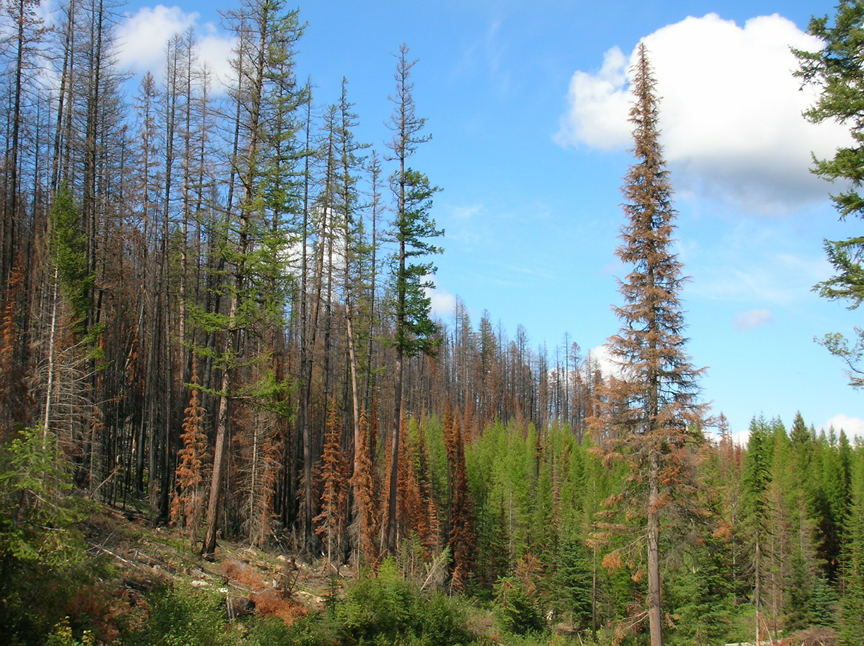
Unburned area on the right is a 25-year-old regenerated clearcut. Photo by Derek Weidensee. Click for larger image
In fairness, I should say clearcuts seldom burn. The “green islands” in a sea of burned old forest are often “regenerated” clearcuts.
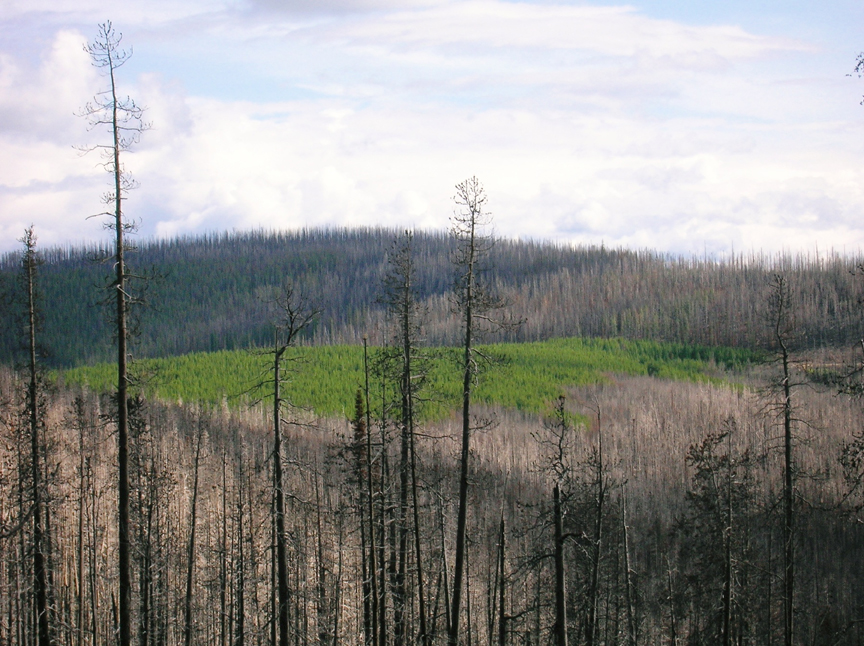
The Rat Creek Fire (2007) Burn west of Wisdom, MT, in 2009. Photo by Derek Weidensee. Click for larger image
This is a hobby of mine. I’ve spent my last four summer vacations going to Montana to study and photograph this phenomenon. I think it’s the best kept secret of forestry.
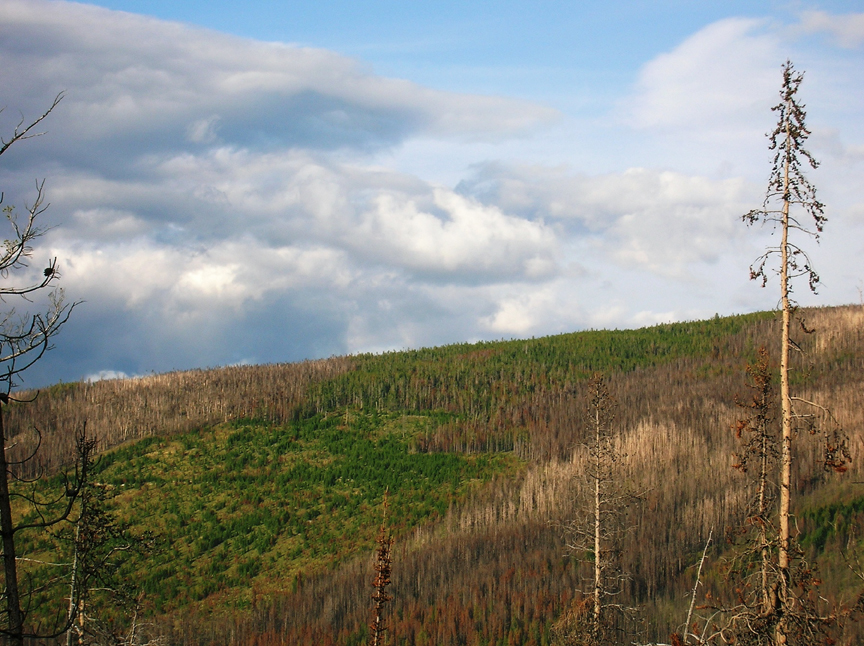
A 30-year-old regenerated clearcut surrounded by burned forest. Photo by Derek Weidensee. Click for larger image
2007 Fire Season Climate and Weather Restoring cultural landscapes The 2008 Fire Season The 2009 Fire Season The 2010 Fire Season
by admin
leave a comment
The True Crisis
The LA Times spit out an editorial today that missed the mark by a mile.
Climate change is the true crisis
LA Times Editorial, May 10, 2010 [here]
West Virginia’s mining disaster and the Gulf of Mexico oil spill were disastrous and investigations are justified, but the real threat is much worse. …
Blah, blah, blah…
… beaches are going to vanish within half a century (along with much of Miami) under the worst-case scenarios presented by climate modelers.
Blah, blah, blah…
Lawmakers today aren’t seeing the forest for the trees; that will change when the forest has burned or been destroyed by bark beetles, but by then it will be too late.
It may be too late for the LA Times, and for “climate modelers”, but you can be assured the beaches of Florida are not disappearing. Global sea level rise since 2005 is a whopping 1 millimeter per year, down from 2 millimeters per year over the last century or so. And now that global ice caps are growing again, it is likely that sea levels will fall; over the next 30 years at least. In fact, sea levels may have peaked in this interglacial (the Holocene) and could fall for the next 100,000 years or thereabouts.
More important to the principal theme of SOS Forests, we must point out (yet again) that even the most generous estimates of US temperature change indicate that over the last 130 years temperatures have risen no more than 1 deg C.
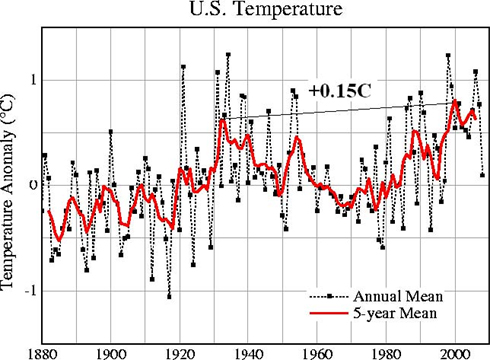
That’s 2 deg F. On a day when it might have been 90 deg F 130 years ago, today it might be 92 deg F. That change is so small as to be largely undetectable, unnoticeable, and of no significant consequence to forests.
We have been experiencing a forest fire crisis, however, and bark beetle infestations, but they are not due to temperature change.
Federal forest policy Forestry education Politics and politicians The 2008 Fire Season Useless and Stupid
by admin
leave a comment
Cost-Plus-Loss, the Tea Fire, and Al Gore
In the previous post [here] we discussed the concept of cost-plus-loss as it relates to wildfire damage assessment. Specifically we noted that a recent GAO report FAILED to consider potential damages from wildfires in its advice to the Wildland Fire Leadership Council (WFLC) “Cohesive Strategy” planning process.
All the GAO cares about, and by inference and extension all that Congress and the WFLC care about, is fire suppression expenses. They wish to minimize the amount spent on firefighting. Among their cost-saving strategies: Let It Burn wildfires and a “Leave Early Or Stay And Defend” policy that calls for homeowners to run for their lives or else defend their own properties from wildfires.
To the Federal Government “cost containment” means reducing fire suppression costs.
But to the real world, the costs of wildfires include the economic damages (losses) of the resources destroyed by the fire.
Allow me to segue for a moment. Hot off the news wire: Al and Tipper have just purchased a home in Montecito, CA.
Al Gore, Tipper Gore snap up Montecito-area villa
by Lauren Beale, Los Angeles Times, April 28, 2010 [here]
Former Vice President Al Gore and his wife, Tipper, have added a Montecito-area property to their real estate holdings, reports the Montecito Journal.
The couple spent $8,875,000 on an ocean-view villa on 1.5 acres with a swimming pool, spa and fountains, a real estate source familiar with the deal confirms. The Italian-style house has six fireplaces, five bedrooms and nine bathrooms.
Sounds swanky, eh?
Montecito just happens to be the site of the Tea Fire [here] in 2008. The Tea Fire burned up a mere 1,940 acres. Suppression costs were $5.7 million. That’s nearly $3,000 per acre, way too steep for the GAO. They’d like suppression costs down around $100 per acre.
The GAO fails to consider resource losses to wildfires, however, which in the case of the Tea Fire were in the $500 million ballpark.
2007 Fire Season Federal forest policy Politics and politicians Private land policies The 2008 Fire Season The 2009 Fire Season The 2010 Fire Season Useless and Stupid
by admin
1 comment
The GAO Let It Burn Policy
The newly reconstituted Wildland Fire Leadership Council (WFLC) has embarked on a “Cohesive Strategy” planning process [here, here, here].
The “Cohesive Strategy” was mandated by the Federal Land Assistance, Management and Enhancement or FLAME Act [here, here, here].
National Blueprint on Wildfire Management
by Phil Leggiere, HS Today, 26 April 2010 [here]
On Wednesday April 21 at the Wildland Fire Leadership Council in Washington, DC, Department of Homeland Security (DHS) Secretary Janet Napolitano, Secretary of Agriculture Tom Vilsack, and Secretary of the Interior Ken Salazar jointly announced a blueprint for the first comprehensive national strategy for wildfire management. …
The new strategy will analyze three key components: landscape restoration, fire-adapted communities, and response to wildfire and is scheduled to be completed this fall in accordance with a recent act of Congress.
The FLAME Act of 2009 requires the Forest Service and Department of Interior to submit to Congress a report that contains a cohesive wildfire management strategy consistent with recommendations in recent General Accountability Office (GAO) reports regarding management strategies. Following its formal approval by the Secretary of Agriculture and Secretary of Interior by October 2010, the Cohesive Wildfire Management Strategy is to be revised at least once during each five year period to address any changes with respect to landscape, vegetation, climate, and weather conditions.
According to the legislation the Cohesive Strategy is required to provide for the identification of the most cost effective means for allocating fire management budget resources. This includes the reinvestment in non-fire programs by the Secretaries of the Interior and Agriculture, employing the appropriate management response to wildfire, assessing the level of risk to communities, allocation of hazardous fuels reduction funds based on the priority of hazardous fuels reduction projects, and assessing the impacts of climate change on the frequency and impact of wildfire. …
Note two key points. First, the “Cohesive Strategy” is to be consistent with recent General Accountability Office (GAO) reports regarding fire management strategies. Second, the goal is “cost effective” fire management budgeting.
2007 Fire Season Federal forest policy The 2008 Fire Season The 2009 Fire Season The 2010 Fire Season
by admin
3 comments
DOI Responds to W.I.S.E. Letter to Salazar re WFLC
On March 6, 2010, in my capacity as Executive Director of W.I.S.E., I wrote an Open Letter to Ken Salazar regarding the reconvening of the Wildland Fire Leadership Council (WFLC) [here]. In that letter I observed that in the past the WFLC:
… did not work with stakeholders but instead was a closed door, exclusionary, non-transparent Federal advisory group that violated various laws with impunity. The laws repeatedly violated by the WFLC include the Federal Advisory Committee Act (FACA), the National Forest Management Act (NFMA), the Endangered Species Act (ESA), the National Historic Preservation Act (NHPA), the National Environmental Protection Act (NEPA), and the Administrative Procedure Act (APA).
I also observed that:
The WFLC excluded the public and the press from their meetings. They did however seat deep-pocket lobby groups including the Nature Conservancy and the Wilderness Society. Federal funds were passed to these lobby groups through the WFLC. The lobby groups also provide a “revolving door” of high-paying positions to former government employees formerly seated on the WFLC.
and furthermore:
During closed door meetings in 2008 the WFLC directed the five Federal land management agencies under their purview to adopt Appropriate Management Response (AMR) and Wildland Fire Use (WFU). The agencies did so without implementing any NEPA process, without public comment or review, and in violation of the laws listed above.
As a result, numerous wildfires were allowed to burn without aggressive suppression actions. Tremendous destruction and degradation of natural resource values occurred.
Finally, I advised Sec. Salazar that:
The WFLC in its prior manifestation violated transparency and the rule of law with disastrous consequences.
Please be advised that if you reconvene the WFLC under the previous format and model, you will be doing a great disservice to America.
Yesterday I received a response from DOI, a very nice letter from Pamela Haze, Deputy Assistant Secretary for Budget, Finance, Performance and Acquisition acting on behalf of Ms. Rhea Suh, Assistant Secretary for Management & Budget and CFO.
That letter in its entirety follows:
Federal forest policy Private land policies Saving Forests The 2008 Fire Season
by admin
2 comments
The Smoke-Tainted 2008 Wine Vintage
Back in November, 2008, I predicted that the winegrape crop in California would be tainted by the smoke from all the fires [here].
A number of sources are reporting that the smoke from this summer’s wildfires in California may have tainted the 2008 winegrape crop. Megafires from Santa Barbara to the Oregon border poured smoke into the prime Cal winegrape growing regions for three solid months, with probable deleterious effect to this year’s wine vintage. …
The Cal wine industry is a $100 billion per year affair. …
It is not yet known what the economic impact is of wildfire smoke on the 2008 winegrape crop. What is known is that smoke can taint the taste of wine, adding a tinge of “ashtray” flavor.
The wine growers were furious with me. They did not appreciate any bad-mouthing of their product before it even hit anybody’s taste buds.
Many wine growers consider themselves to be “environmentalists” and support organizations that sue, sue, sue to stop forest management and fire-resiliency forest health treatments. They do not make the connection that banning forestry could end up in megafires that emit smoke that ruins winegrapes. Too many dots to connect.
But lo and behold, the Wall Street Journal has reported that the 2008 wine vintage tastes like wet ashtrays:
Sipping These Wines Is Like Smoking and Drinking at the Same Time
Forest Fires Taint the Pinot Noir; Eliminating the ‘Wet Ashtray’ Effect
By BEN WORTHEN, WSJ.com, March 31, 2010 [here]
PHILO, Calif.—In wine vernacular, “smoky bacon” is a prized flavor for pinot noir. Not so is “wet ashtray,” which is where the powdered sturgeon bladders come in.
The 2008 pinot noirs from here in California’s Anderson Valley are starting to show up in stores. But severe forest fires during the growing season hit the grape crop that year. The fires left much of the resulting wine with “smoke taint,” according to many local winemakers, a condition similar to that in a “corked” bottle in which one unwanted taste overwhelms everything else.
Sturgeon-bladder powder, called isinglass, is what winemaker Larry Londer added to a few gallons of his 2008 pinot noir to try to fix it. Isinglass has long been used to clear wine of unwanted elements, and Mr. Londer hoped it would remove what he and other vintners call the wet-ashtray taste.
It didn’t. …
The 2008 vintage is one some winemakers are ready to stick a cork in. Many say they are only releasing a small percentage of their wine or are reducing prices to ensure good value for consumers. …
The trouble started June 20, 2008, when a lightening [sic] storm struck. Within hours, the sky was filled with smoke. Over the next weeks, the air in Anderson Valley remained dense with soot. …
Mr. Londer, however, wasn’t satisfied with the techniques he tried. He was able to get rid of the smoke if he ran his wine through a pump with a charcoal pad at the end, but says “it left us with a one-dimensional, uninteresting wine.”
So he sold 5,600 of his 8,000 gallons of wine for about $10 each on the bulk market—which collapsed from $30 to $40 per gallon—where it will be blended with wine from across the state. He ran the rest through a reverse-osmosis machine.
He plans to produce 1,000 cases of his Anderson Valley blend, which he will sell for under $35 a bottle. He typically charges $48 or $54 for higher-end products. “There will be some real bargains out there,” he says.
Winemaker Toby Hill from Phillips Hill Vineyards, meanwhile, decided to have some fun. He blended 2008 pinots from two Anderson Valley vineyards and called the finished product “Ring of Fire.”
Recently, a couple stopped by his tasting room in Philo and asked to try it. The wife thought that it was overwhelming, but the husband liked it. “It tastes smoky,” he said.
Fires burned in Northern California for three months in 2008. Some grew to mega-size. When the fire season ended, over 650,000 acres of forest had gone up in smoke in western Northern California alone. Communities and vineyards were inundated with chocking smoke for three solid months.
In Zybach, Bob, Michael Dubrasich, Gregory Brenner, and John Marker. 2009. U.S. Wildfire Cost-Plus-Loss Economics Project: The “One-Pager” Checklist. Wildland Fire Lessons Learned Center, Advances in Fire Practices, Fall 2009 [here], we wrote:
What are the actual costs of a wildfire?
Large wildfires consume more than just suppression expenses (“costs”) – they also do measurable short- and long-term damages (“loss”) to public and private equity and resources. …
Recently analysts, government officials, and the media have drawn increasing attention to the escalating frequency, severity, and costs over and above fire suppression associated with large-scale forest wildfires – including losses of human lives, homes, pets, crops, livestock and environmental damage. …
To date, our own findings paint a far different picture than that commonly reported by the media or understood by the public. We have found that total short-term and long-term cost-plus-loss attributed to wildfires typically attains amounts that are ten, 20, or 30 times reported suppression expenses. …
Using standard cost-plus-loss methods, our initial estimates are that total damages for the 2008 California wildfires will likely be at least $10 billion, and may eventually total $30 billion, or even more — and that is just one state, for just one year! …
[P]reliminary research indicates that wildfire agencies’ suppression costs may represent only 2% to 10% of the total cost-plus-loss damages to burned forests – that is, recent public losses attributable to major forest wildfires may likely, and more accurately, total anywhere from $20 billion to more than $100 billion per year. …
On private land vegetation losses include timber and agricultural crops burned or impacted by wildfire smoke, such as winegrapes…
In a post at SOS Forests in 2009, Wildfire ‘Benefit’ Double Talk Jive Is Over [here], I noted that the U.S. Dept. of Justice, representing the USFS, had been awarded over $100 million in a lawsuit against the Union Pacific Railroad Company, for a fire that the USDoJ said damaged the “grandeur” of the forested landscape. The courts set a precedent in that case: “grandeur” is now a compensable loss due to forest fires.
That’s on top of all the more tangible losses, such as tainting a multi-billion dollar wine vintage, jamming hospitals with smoke-inhalation victims, and devastating vegetation, soils, habitat, wildlife, watersheds, airsheds, scenery, recreation, heritage, public health and safety, and the economy on public and private lands.
Next time you hear somebody make the claim that “re-introducing fire” to forests is a necessary thing, or that wildfires can used to benefit resources, or that we should burn our forests today because global warming is going to burn them later anyhow, stop and think it through.
It is not “necessary” to inflict $100 billion a year in damages via forest fires. There are better ways to manage our forests than burning them down in megafires. Certain “externalities” can be avoided if we encourage science-based forest stewardship rather than Let It Burn catastrophic disasters.
We might even save the winegrape crop at the same time. You can drink to that.
2007 Fire Season Politics and politicians The 2008 Fire Season Useless and Stupid
by admin
11 comments
Yellow Journalist Lies Again
Noted extreme lefty journalist Rocky Barker of the Idaho Statesman yesterday accused Congressional Republicans of delaying a forestry bill:
Republican protest holds up Risch’s beetle bill
Submitted by Rocky Barker on Fri, 03/26/2010 [here]
Idaho Senator Jim Risch’s efforts to protect forests against the ravages of pine bark beetles hit a snag this week.
It wasn’t radical environmentalists who opposed the bill, co-sponsored by Colorado Democrat Mark Udall, because it would make some logging easier on national forests. No, the bill that would speed up thinning of beetle-threatened timber near communities to reduce the threat of wildfire was held up this week by Republicans.
It’s all about the health care bill and their anger that the Democrats passed it over their objections. In response Senate Republicans used a rule to stop hearings from occurring more than two hours after the start of the Senate’s daily session.
That stopped a hearing on Risch’s and Udall’s bill cold. That leaves logging contractors waiting to get into the woods across the West cold.
Hold on there, Rocket. It’s the Democraps who control Congress. How can a tiny of minority of Republicans stymie the majority party?
Didn’t we just witness the specter of one-party rule with the $trillion dollar grab of the health care industry? Even though every single Republican opposed Obamacare, it didn’t matter one iota to the jackbooted Democraps, who marched through Congress like Hitler’s Brownshirts at a beerhall putsch.
But now it’s Republican recalcitrance holding up a beetle thinning bill? Rocky, Rocky, Rocky. Everybody knows the Democraps don’t give one about forests. Your party is the Arsonist Party. Your party favors megafire destruction of forests.
Rocky Barker himself is the author of “Scorched Earth: How the Fires of Yellowstone Changed America,” a (poorly written) book that extols the virtues of million-acre holocausts and prescribes wholesale forest destruction for the entire country. Rocky is famous for defending the incineration of Idaho in 2007. He spit on the 10 Oregon firefighters who died in in 2008, before their families even had a chance to bury their dead. Rocky wants to ban fire retardant so even more firefighters get killed.
Rocky Barker has never seen a forest he didn’t wish to burn to the ground for his own sick, twisted, homicidal pleasure.
Just to set the record straight, there are no “logging contractors waiting to get into the woods”, sitting in their pickups with the engines idling while they wait for Risch’s bill to pass. It isn’t going to pass. Not because the Republicans have stymied Congress, but because the Democraps control the Hill and Democraps are arsonistic forest-haters.
No pack of lies from an anti-forest, anti-forestry, pro-holocaust jerk like Rocky Barker is going to change that fact.
2007 Fire Season Federal forest policy Politics and politicians The 2008 Fire Season The 2009 Fire Season
by admin
2 comments
A Short History of the WFLC
Questions have arisen regarding my Open Letter to Open Letter to Ken Salazar Re WFLC [here]. By way of clarification, I have prepared the following.
Note: this essay refers to the Wildland Fire Leadership Council, not the Western Forestry Leadership Coalition, which shares the same initials but is an entirely different organization.
The Wildland Fire Leadership Council (WFLC) was established in April 2002 by the Secretaries of Agriculture and the Interior to provide an intergovernmental committee to support the implementation and coordination of Federal Fire Management Policy. [here]
The Wildland Fire Leadership Council (WFLC) was established in April 2002 to implement and coordinate the National Fire Plan, the Ten-Year Strategy (a component of the National Fire Plan) and the Federal Wildland Fire Management Policy. WFLC consists of senior level department officials, federal, state, tribal and county representatives, including all five federal wildland firefighting agency heads. WFLC was established to address interagency, interdepartmental differences to ensure seamless delivery of a coordinated fire protection program. The Council brings together wildland firefighting organizations to implement the 10-Year Comprehensive Strategy and Implementation Plan. WFLC meets regularly to monitor progress of the Ten-Year Strategy, to discuss current issues, and to resolve differences among wildland firefighting agencies.
Authority. The Departments of Agriculture and the Interior are authorized to enter into cooperative agreements by the Protection Act of 1922 (42 Stat 857; 16 U.S.C. 594) and the Public Land Administration Act of 1960 (74 Stat 506; 43 U.S.C. 1361-1364).
In addition, the Secretaries entered into a Memorandum of Understanding dated January 28, 1943, and February 21, 1963, to provide adequate wildfire management and protection to the lands under their respective jurisdictions. State representation is authorized by the Clarke-McNary Act of June 7, 1924, Sec. 1 (43 Stat 653, 16 U.S.C. 564). [here]
In Fall of 2006 it came to my attention that lobbying groups, specifically the Nature Conservancy (TNC) and the Wilderness Society (TWS), were participating in WFLC meetings. I made an inquiry to the Committee Management Secretariat (CMS) of the GSA which oversees the Federal Advisory Committee Act (FACA). They informed me that the incorporation of registered lobbyists on Federal Advisory Committees was a “gray area” of the law, and that I could file a lawsuit if I so desired.
I consulted with my attorney and he asked me how much money I had. That killed that idea.
In the meantime the WFLC received some sort of communication from the CMS regarding my inquiry, and in early 2007 they asked Federal attorneys to draw up a Memorandum of Understanding that would declare them NOT to be a Federal Advisory Group and to allow registered lobbyists to continue to participate. From the WFLC minutes of February 22, 2007 [here]:
WFLC MOU
* Request Secretaries to extend MOU
* Revise MOU language for NGO participation consistent with WFLC goals. WFLC should not become a Federal Advisory Committee. Consider addition of a fire chief’s representative as WFLC member, in a manner consistent with FACA. Confer with legal counsel. Draft business rules for review.
* Circulate draft, convene conference call to discuss. (WFLC Staff)
* New MOU at June meetingTNC and other NGOs will assist with communication plan for wildland fire use as part of TYIP Goal 3, Task 2.
On April 3, 2007 I reported all this at SOS Forests [here]. As a direct result, on April 5, 2007 the WFLC removed the Feb. 22 minutes and their entire directory at http://fireplan.gov, a URL that no longer exists.
2007 Fire Season Federal forest policy Politics and politicians Saving Forests The 2008 Fire Season The 2009 Fire Season
by admin
6 comments
Open Letter to Ken Salazar Re WFLC
Letter in pdf format may be downloaded [here]
To: The Honorable Ken Salazar
Secretary of the Interior
1849 C Street NW
Washington, DC 20240
Re: Reconvening the Wildland Fire Leadership Council
Dear Secretary Salazar,
In a letter to western governors dated February 19, 2010, you indicated your desire to reconvene the Wildland Fire Leadership Council (WFLC). You also stated in that letter that you are committed working closely with “key stakeholders at all levels” to address wildfire issues.
Please be advised that the prior manifestation of the WFLC did not work with stakeholders but instead was a closed door, exclusionary, non-transparent Federal advisory group that violated various laws with impunity. The laws repeatedly violated by the WFLC include the Federal Advisory Committee Act (FACA), the National Forest Management Act (NFMA), the Endangered Species Act (ESA), the National Historic Preservation Act (NHPA), the National Environmental Protection Act (NEPA), and the Administrative Procedure Act (APA).
The WFLC excluded the public and the press from their meetings. They did however seat deep-pocket lobby groups including the Nature Conservancy and the Wilderness Society. Federal funds were passed to these lobby groups through the WFLC. The lobby groups also provide a “revolving door” of high-paying positions to former government employees formerly seated on the WFLC.
During closed door meetings in 2008 the WFLC directed the five Federal land management agencies under their purview to adopt Appropriate Management Response (AMR) and Wildland Fire Use (WFU). The agencies did so without implementing any NEPA process, without public comment or review, and in violation of the laws listed above.
As a result, numerous wildfires were allowed to burn without aggressive suppression actions. Tremendous destruction and degradation of natural resource values occurred. Some examples:
* South Barker WFU Fire (2008, Sawtooth NF, 38,583 acres) – The South Barker WFU Fire escaped and burned 38,583 acres. The fire eventually cost over $7 million to suppress. It incinerated miles of riparian zones, stripped erodable hillsides of vegetation, and destroyed forest plantations that had been carefully tended for 50 years.
* Gunbarrel WFU Fire (2008, Shoshone NF, 67,141 acres ) – The Gunbarrel WFU Fire was allowed to burn until it blew up. The fire eventually cost over $11 million to suppress. An estimated 420 residences, 11 commercial buildings, and 149 outbuildings were threatened and 7 buildings destroyed. The highway leading to Yellowstone Park was closed, and numerous residents were evacuated. During the fire USFS officials proudly declared that the MMA (Maximum Manageable Area, or desired incineration zone) was 417,000 acres (652 sq miles) and included public and private properties north and south of Highway 14.
* East Slide Rock Ridge WFU Fire (2008, Humboldt-Toiyabe NF, 54,549 acres) – The ESRR WFU Fire was allowed to burn unchecked until it blew up and threatened the community of Murphy Hot Springs, ID, as well as numerous rural ranches and farms. The fire eventually cost over $9 million to suppress. Riparian zones adjacent to stream habitat for endangered bull trout were incinerated.
* Mill Flat WFU Fire (2009, Dixie NF, 12,607 acres) – The Mill Flat WFU Fire was monitored until it blew up. The fire roared into New Harmony, Utah, forced the evacuation of 170 New Harmony residents, destroyed three homes and damaged eight buildings. The fire eventually cost over $6.5 million to suppress.
* Iron Complex AMR Fire (2008) – Including this fire, 650,000 acres were incinerated in Northern California on the Shasta-Trinity, Six Rivers, and Klamath National Forests. The fires were allowed to burn vast tracts for three months in implementation of “Appropriate Management Response.” Building firelines miles away from the fires and backburning hundreds of thousands of acres of private and public land alike, including habitat for two endangered species, Salmon and Spotted Owl, were deemed “appropriate.” Despite the indirect firefighting techniques, ostensibly intended to save money and protect firefighters, over $400 million was spent on suppression and 12 firefighters were killed.
* Basin/Indians AMR Fire (2008) – 244,000 acres of the Los Padres National Forest and private lands were incinerated in 3rd largest fire in California history. Despite indirect AMR methods, more than $120,000,000 was spent on fire suppression, making the Basin/Indians AMR Fire the most expensive fire in California history, and the 2nd most expensive in U.S. history (the Biscuit Fire in Oregon in 2002 cost $150,000,000). In addition, 26 private residences were destroyed.
Numerous other disastrous AMR and WFU fires could be cited. The suppression costs noted above do not begin to account for the cost-plus-loss damages inflicted, which were 10 to 30 times the nominal suppression expenses. Nor do they express the tragic loss of human life.
Both Secretary of Agriculture Vilsack and US Forest Service Chief Tidwell have recognized (in public speeches) that an increasing number of catastrophic wildfires are plaguing the Nation, and that a collaborative management approach to restoration and conservation are needed.
The secretive and non-collaborative WFLC has been the cause, not a source of solutions, of our ongoing forest fire crisis.
The Obama Administration has promised transparency, accountability, and tougher restrictions on lobbyists. In his 2009 State of the Union address, President Obama said, “Let me say it as simply as I can – transparency and the rule of law will be the touchstones of this presidency.”
The WFLC in its prior manifestation violated transparency and the rule of law with disastrous consequences.
Please be advised that if you reconvene the WFLC under the previous format and model, you will be doing a great disservice to America.
Sincerely,
Mike Dubrasich
Executive Director, the Western Institute for Study of the Environment
cc: Secretary of Agriculture Thomas Vilsack
Chief of the US Forest Service Tom Tidwell
Bureau of Land Management Director Bob Abbey
National Park Service Director Jon Jarvis
Governor Brian Schweitzer, Chairman, Western Governors Assoc.
Governor C. L. “Butch” Otter, Vice Chairman, Western Governors Assoc.
Ann M. Walker, Forest & Rangeland Health Program Director - WGA
NM State Forester Arthur Blazer, Chair, Western Forestry Leadership Coalition
AK State Forester Chris Maisch, Chair-Elect, Western Forestry Leadership Coalition
Congressman Doc Hastings (WA-04)
Congressman Greg Walden (OR-02)
Congresswoman Cynthia Lummis (WY)
Congressman Wally Herger (CA-02)
Congressman Denny Rehberg (MT)
Congressman Norm Dicks (WA-06)
Congressman Raúl M. Grijalva, (AZ-07)
Congressman Peter A. DeFazio, (OR-04)
Congresswoman Stephanie Herseth Sandlin, (SD)
Senator Ron Wyden (OR)
Senator Maria Cantwell (WA)
Senator John Barrasso (WY)
Senator James E. Risch (ID)
Senator Robert Bennett (UT)
2007 Fire Season Federal forest policy Politics and politicians The 2008 Fire Season The 2009 Fire Season
by admin
2 comments
The Grandeur of the WFU
by bear bait
The legal situation in the US concerning WFU fire and the Feds is this: they don’t have any financial responsibility for the fire when it leaves Federal Land, unless they are in an agreement with the other public and private land firefighting entities to assist in a cooperative agreement.
On the other hand, the US Attorney General has three teams of US Attorneys, one in Sacramento, one in LA, and one in SLC, whose sole job is to litigate and secure damages when fire from other than Federal origins damage the Federal Estate. They can sue you for your fire and its damages to Federal land and assets, but you can’t sue them if their fire crosses onto your property and damages your land and assets. In two cases [here] that have gone to trial, Pacific Gas and Electric paid $14.75 million due to a right-of-way ponderosa pine that fell across power lines, starting a fire during a wind event. The issue was that PGE was negligent in not removing a tree that was damaged or rotten. I do imagine that a phalanx of utility attorneys have given instructions to lay waste to any possible vegetation that might fall across a power line.
The other case involved the Union Pacific RR, and the judgment against them was for $102 million, due to a broken rail repair fix that resulted in sparks into duff in the right-of-way and the confusion of who did what to suppress the fire and how. You have to know that five barely literate railgang crewmen are not the best witnesses, and they were led into various traps by the Ivy League US Attorney swells, who used their language skills and reasoning skills to baffle, confuse, and demean the blue collar workers. Poofs from law school dazzling a judge. Whoopee. It was established that the fire fighting effort was not that of Hot Shots, and therefore the Railroad was liable. So they ended up paying 102 million bucks for damage to trees that would never be logged, ever, due to specific area protections, but the trespass by fire garnered double stumpage. And then there were estimates of wildlife damage, and habitat damage, and watershed damage (in the Feather River, a river that sends zero water to the ocean, all of it claimed for irrigation and potable water use, and dammed to keep salmon out of it almost in the river’s entirety), and the best one of all “loss of the grandeur of the landscape.”
So if “loss of the grandeur of the landscape” is a compensable damage, where in the hell is it in the WFU, “fire for resource use” handbooks? Where is the NEPA document that so states that wildland fire can result in “loss of grandeur of the landscape?”
I would like the ODF to mention to the Feds that they have the right as a State to petition the Feds to control their freaking fires, and keep them off the non-Federal lands, as we are losing the “grandeur of our landscape” along with other compensable damages as are now recognized in Federal case law by precedent of trial results and judicial opinions.
The tyranny of the Federal Court is upon us, and the irresponsible actions of Federal land managers need to be addressed. If the US Military is not permitted to wage war on its own people, how is it that the Federal land managers can loose fire on the private estate without penalty or Congressional oversight???
The flaming liberals that Oregon elects to Congress need to answer these questions on the campaign trail, and since all but two have been there for a decade or longer, it isn’t like this is something new. This is something blue, and the blue state reps and senators need to go to the firelines and have their feet held to the very same fires.
When Tom Brokaw was still a news anchor, and I believe it was the Derby Fire that threatened his Montana ranch and hideaway, there was no end to the resources the Feds put forth to make damned sure his ranch was not consumed as were so many others. The Derby was a WFU that blew up, and was in “dangerous” terrain (are they not all?), and it was not worth the risk or time and effort to contain in the wilderness, so there was little effort until it was a full fledged fire front. But no public complaints were ever aired on the evening news because the effort to contain it was right where it was supposed to be: at the doorstep of the leading US news anchor.
It is not a world of equality. Never was, never will be. But at the least we can implore the ODF Board to flex some muscle and talk tough to the USFS about the WFU deal, and the impacts on Oregon private resources, for after all, fire protection is paid for by a property tax assessment in most cases. If you don’t have a protection agreement with the state, your fire does not get fought. By ODF or the Feds.
The other question should be, of course, is why does a private person have to insure or pay to protect himself from fire from the Federal estate? Aid to Haiti? Sure. Aid to Iraq? Sure. Aid to New Orleans? Sure. But have the conflagration from the Feds run over your land, where is the aid? Ha ha ha ha……
Federal forest policy Private land policies The 2008 Fire Season The 2009 Fire Season
by admin
leave a comment
ODF Slams Let It Burn
Last November the Oregon Department of Forestry issued a “perspective” on the Let It Burn policies of the US Forest Service. The short story: ODF has big problems with federal wildfire policy.
Rather than give a synopis, here is the ODF “perspective” in full (unfortunately I can’t supply a link because I can’t find this document on the ODF website):
Oregon Department of Forestry
Perspective on 2009 Federal Wildfire Policy Guidance
November 29, 2009
Background
The Oregon Department of Forestry (ODF) provides fire protection on 16 million acres of private, state, local government and federal lands. ODF’s protection jurisdiction borders, and is intermingled with, thousands of miles of US Forest Service and other federal ownership. ODF’s fire protection system is funded through a combination of landowner assessments and state general fund (roughly 50/50). Both federal and state protection systems have been well coordinated at both the local and regional levels. Each agency maintains fire fighting resources and cost effectively shares contract resources such as contract crews, engines and helicopters based on established priorities and the availability of the resources.
ODF is supportive of the USFS and the other federal agencies. We strive to maintain the established high level of cooperation that we have between the agencies. ODF is also supportive of the role of fire to help meet resource management goals. However, ODF and the landowners we provide protection to prefer forest management tools other than wildfire to treat unhealthy fuel loads. ODF does understand that with the limitations imposed on the federal lands, by a variety of factors, available federal forest management options are limited. ODF does not want the federal agencies to lose the effective use of fire as a management tool.
However, current and past guidelines for federal wildfire policy that allow wildfires to grow large over peak burning conditions during the summer months without full suppression efforts impact the state. These impacts include loss of ODF protected landowner’s resources, increased state preparedness costs, the possibility of increased suppression costs, competition for firefighting resources, and increased safety risks for all firefighters through additional exposure.
Federal Wildfire Policy guideline changes made in 2009 further complicate the issues by allowing the use of multiple resource objectives within one fire. Actions such as these further complicate state fire management activities, cost share agreements, and the use and coordination of firefighting resources.
ODF Federal Wildfire Policy Issues
* Transfer of risk to ODF and other firefighters. Ability/willingness of USFS to cover suppression costs associated with fires that impact others due to their activities.
* Transfer of risk and damage to non-USFS landowners. Ability/willingness of USFS and federal government to compensate for damages.
* During a heavy fire season firefighting resource shortages:
- Impacts firefighter and public safety and increases resources lost
- Continues to drive up the agencies costs for the availability of limited resources
* Reliability of national federal fire models to help make predictions
- 2008 Bridge Creek WFU – predicted high Haines, wind shift, poor humidity recovery, were the primary drivers in the fire blowing up and burning 1,963 acres of ODF protection.
- 2009 Big Sheep Ridge WFU – fire ignited in wilderness on August 29, on September 28, fire blows up with a dry, cold front passage, resulting in wind shifts and low humidity’s – fire burns 136 acres of ODF protection.
* Safety and least cost objectives seem to be used synonymously for resource benefit. However, what may be least cost for the jurisdictional agency that has the fire may be most costly for the neighbor. For true “least cost”, the focus should be on increased and aggressive initial attack.
* Increased preparedness and coordination cost to ODF to prepare in the event one of the federal fires comes onto ODF protection regardless of who pays the suppression costs. Increasingly, the threat to ODF jurisdiction exists nearly anywhere a federal wildfire is being managed for other than full suppression.
* Federal WFU and non-aggressive suppression fires impact on air quality and global warming through carbon emissions.
* Impact on habitat for threatened and endangered species.
* When the federal fire management objective is to increase the amount of wildfire acres burned across the landscape, through the use of multiple resource objectives, it becomes unclear what decision making is driving when aggressive initial attack is implemented. In other words when is the agency really trying to catch the wildfire at IA versus increasing the amount of wildfire acres burned across the landscape.
* The use of federal emergency wildfire suppression funds to accomplish land management resource objectives.
Summary
Federal fire suppression policy guidelines have undergone significant change since the shift from the “10 a.m. policy” of the 1970’s and before. In an effort to address the hazardous fuels issue on National Forests, variations of “let it burn” guidance with differing descriptors has been used over the years on an increasing number of fires that have escaped initial attack. Through discussions last spring and this fall, Forest Service managers have been communicating their intent to continue, and to expand their use of indirect attack and encourage the use of fire for resource benefit to accomplish land management objectives. It is ODF’s opinion this will result in larger, more expensive fires with the likelihood of increased impacts to the Oregon Department of Forestry and Oregon’s forest landowners.
2007 Fire Season Federal forest policy Saving Forests The 2008 Fire Season The 2009 Fire Season
by admin
1 comment
The real cost of wildfires
by Bob Zybach, guest opinion, the Oregonian, 09/14/2009, [here]
The tab for U.S. wildfires as commonly reported by the news media is only a fraction of the full costs experienced by the public.
Darrel Kenops’ recent commentary in The Oregonian (”Balancing protection with beneficial use,” Aug. 25) makes the point that we export our environmental impacts to international destinations when we cannot find ways to locally meet our nation’s needs for forest products. Excellent point. But lost in this discussion are the year-in-and-year-out costs that citizens must bear each time a wildfire scorches mile after square mile of Oregon’s forests.
Real costs for wildfires are stupendous and insidiously invisible. It isn’t just the billion dollars or more diverted each year from other useful programs in federal and state budgets to stamp out fires as typically reported by the media. Most expenses are never assigned to the bottom-line costs of wildfire.
For example, less tangible values such as damaged wildlife habitat, degraded soil and lost recreational opportunities are difficult to value monetarily; yet, these are greatly valued by the public, as are clean air, clean water and beautiful scenery.
With co-authors Michael Dubrasich, Gregory Benner and John Marker, we have published a one-page checklist of real costs [here] that also should be tallied when the news media covers wildfire.
On this list are property costs, including damage to federal, state, private, utility and municipal facilities; public health, including asthma, emphysema and coronary disease; indirect firefighting costs, including crew training, equipment and inventories of supplies; and post-fire costs, including timber, agriculture and home losses. The checklist goes on to detail air and atmospheric, soil-related, recreation, aesthetic and energy effects, plus the loss of cultural and historic resources.
We estimate that, nationwide, the true costs of wildfire, over and above seasonal fire-fighting expenses, range between $20 billion and $100 billion a year — or between ten to fifty times what is typically reported to simply put out fires.
So what can be done? There are those who think that passive management of our publicly-owned forests is the correct path: those that espouse the “naturally functioning ecosystem” and “let-it-burn” school of forest management.
I doubt the public has much appetite for the kind of fires that occurred in the past, as described by Kenops, before we began excluding fire from the landscape. The massive fires of the past - extinguished only when winter weather arrived - are not acceptable today. Also not acceptable is the status quo. In effect, public policy for the past 20 years has been to fight nearly every fire that ignites, yet do nothing to manage the consequences of insect-infested, diseased, wind-thrown and overstocked forestlands.
There are successfully tested alternatives to passive management. Actively removing excess woody biomass, thinning stands of trees for beneficial use, and selectively employing prescribed fire are among them. These activities all have costs but some can be done profitably: creating long-term jobs, reducing risks for severe fire, beautifying our forests, protecting our resources, and offsetting our international dependence on energy and forest products.
These activities will have their own environmental impacts. But then, so does doing nothing. And, in the long haul, doing nothing is proving to be much, much more expensive.
Bob Zybach is the program manager for Oregon Websites and Watersheds Project Inc. [here]. Also see the U.S. Wildfire Cost-Plus-Loss Economics Project website [here].