Salmon Scientists Blind to Record Fraser River Salmon Runs
by Ken Schlichte
An article entitled “Study Tracks Salmon Coping with Warming River” in the January 13th Oregonian [here] begins with the following statements:
Scientists working with wild sockeye salmon struggling to cope with warming temperatures in British Columbia’s Fraser River have identified broad genetic signatures that can predict which fish will live or die before spawning a new generation.
Oregon State University salmon geneticist Michael Banks, who did not take part in the study, said Thursday it represents a breakthrough in tracking how salmon are surviving new stresses from global warming. …
This article suggests that sockeye salmon are struggling to cope with warming temperatures in British Columbia’s Fraser River because of global warming, but Pacific Northwest temperatures have been trending downward for the last 25 years [here].
The 25-year downward temperature trend in the Pacific Northwest indicates that, if there is reliable data indicating that the Fraser River is actually warming, this river warming is not due to global warming. If the Fraser River is actually warming, this warming would have to have been produced by the Fraser River reservoirs or by land-use activities in the Fraser River Basin, not by global warming.
While the Oregonian article suggests that sockeye salmon are struggling to cope with warming temperatures in the Fraser River, Columbia River sockeye salmon runs in 2009 and 2010 were very large in comparison with the 10-year average.
In 2010 256,996 returning adult and jack Spring Chinook were counted at Bonneville Dam, 1.42 times the 2009 count and 1.39 times the 10-year average.
In 2010 531,864 returning adult and jack Fall Chinook were counted at Bonneville Dam, 1.33 times the 2009 count and 1.25 times the 10-year average.
In 2010 386,525 returning adult and jack Sockeye were counted at Bonneville Dam, 2.17 times the 2009 count and 4.09 times the 10-year average.
The size of sockeye salmon runs and other Pacific Northwest salmon runs is strongly influenced by the Pacific Decadal Oscillation that has been in a cool phase for the last few years. The cool phase of the Pacific Decadal Oscillation increases the size of our Pacific Northwest salmon runs by increasing salmon food resources and by decreasing salmon predators in offshore waters.
Editor’s Note: the article did not present any evidence, or even make the direct claim, that the Fraser River is warmer. Substantial evidence exists, however, that Fraser River salmon are thriving. For instance, the Seattle Times reported [here] that the Fraser River sockeye salmon run in 2010 was the largest since 1914:
Fraser River whopper sockeye salmon run even bigger
A forecast released Tuesday by the Pacific Salmon Commission predicts some 34 million fish will return to spawn in the Fraser River, a substantial jump from last week’s estimate of 25 million.
By Hal Bernton, Seattle Times, September 1, 2010
A forecast released Tuesday by the Pacific Salmon Commission predicts some 34 million fish will return to spawn in the Canadian watershed. That forecast is a substantial jump from last week’s estimate of 25 million.
This year’s run, the largest since 1914, is expected to provide a bounty for Canadian and U.S. fishermen whose harvest openings continue this week on both sides of the border. The erratic Fraser sockeye run has frequently been a bust in recent years, and last year’s meager return forced harvest closures.
Commercial fishermen joining in this year’s harvest have enjoyed some of the best Fraser sockeye landings in memory. …
Related reports:
Huge [Fraser River] salmon runs bring cash bonanza for U.S. and Canadian fishermen [here]
Huge sockeye run filling up Whatcom County fishing boats [here]
Fraser River sockeye salmon returns among highest recorded [here]
Record Sockeye Run in B.C. [here]
Thank You for Your Generosity
We at W.I.S.E are deeply grateful for your generous donations that have helped to make our multi-site web institute the premier online library and source for cutting-edge science in forestry, fire, wildlife, and other environmental sciences.
Nearly fifty book reviews and original articles have been added this year, including works by Stephen J. Pyne, William Woods, William Denevan, Charles E. Kay, Roger Underwood, Bob Zybach, Charles C. Mann, Ken Schlichte, M. Kat Anderson, Travis C. Cork, and many others.
Once again we tracked large fires at W.I.S.E. Fire Tracking and posted news clippings at W.I.S.E. Forest, Wildlife, and Climate News. We have three Commentary sub-sites now, SOS Forests, Wildlife and People, and News From the Salmon Front, and we posted many voices discussing responsible, scientific stewardship of forests and wildlife.
We are very appreciative to all those who have provided news tips and content for our subsites, including the authors of the books and papers reviewed in the Colloquia and the numerous guest authors of posts in the Commentary sub-sites.
Please join us [here] in a New Years resolution to ask your friends who have not donated to do their part.
Thank you very much for all your help. We couldn’t do it without you.
Best Wishes to You and Yours,
Mike Dubrasich, Exec Dir W.I.S.E.
The Western Institute for Study of the Environment is a 501(c)(3) non-profit educational corporation and a collaboration of environmental scientists, resource professionals and practitioners, and the interested public.
Our mission is to further advancements in knowledge and environmental stewardship across a spectrum of related environmental disciplines and professions. We are ready, willing, and able to teach good stewardship and caring for the land.
W.I.S.E. provides a free, on-line set of post-graduate courses in environmental studies, currently fifty topics in eight Colloquia, each containing book and article reviews, original papers, and essays. In addition, we present three Commentary sub-sites, a news clipping sub-site, and a fire tracking sub-site. Reviews and original articles are archived in our Library.
Are Overpaid Fish Biologists Stuck On Stupid?
Note: To be fair, the fish biologist bafflement reported by the MSM may be in the minds of science-challenged enviro-journo-listas only. — Editor and headline writer Mike D.
by Ken Schlichte
Why Did Salmon Return After Declining for 20 Years?, reposted from The Environmental Magazine into the Tacoma News Tribune [here], includes the following statements:
The miraculous sockeye salmon run in western Canada’s Fraser River watershed in the summer and fall of 2010 — indeed the biggest run in 97 years — still has fishers, researchers and fishery managers baffled. Just a year earlier only one million fish returned to spawn. No one seems to be able to say for sure what caused the massive 2010 run, but most agree that it probably had to do with the very favorable water conditions that were present in 2008 when the sockeyes were juveniles. “They’re very vulnerable at that stage of their life,” reports John Reynolds, a salmon conservation expert at Canada’s Simon Fraser University.”
-and-
Generally speaking, scientists and environmentalists are well aware of why wild West Coast salmon runs have been declining over the past century: namely pollution at almost every inch along the thousand mile river-to-sea-and-back underwater journey, overfishing in both rivers and the ocean, and man-made obstructions to fish passage. But environmentalists are now optimistic that the huge 2010 sockeye run is a sign of better times ahead. Perhaps improved logging practices, a resurgence in organic farming, new protections for upstream habitat or restrained commercial fishing catch limits — or some combination thereof — has begun to make a difference in salmon survival.
This article has suggested reasons for the large 2010 Fraser River sockeye salmon run and also suggested the reasons (namely water pollution, overfishing and dams) for the declines in West Coast salmon runs over the past century. Throughout this article, however, there is no mention of the Pacific Decadal Oscillation, the natural cycle of temperature shifts in the Northeast Pacific that has significant influences on West Coast salmon runs. The influence of the Pacific Decadal Oscillation on West Coast salmon runs is discussed in the statements and the figure referenced below from the NOAA Northwest Fisheries Science Center [here]
Dr. Nathan Mantua and his colleagues were the first to show that adult salmon catches in the Northeast Pacific were correlated with the Pacific Decadal Oscillation (Mantua et al. 1997). They noted that in the Pacific Northwest, the cool PDO years of 1947-1976 coincided with high returns of Chinook and coho salmon to Oregon rivers. Conversely, during the warm PDO cycle that followed (1977-1998), salmon numbers declined steadily.
-and-
Adult spring Chinook runs have declined recently, beginning with returns of fish that went to sea in 2003 and experienced warm ocean conditions, indicated by the positive PDO signal during 2003 to 2007. Forecasts for returns in 2010 are for large numbers of fish, and again, these anticipated returns are associated with the strongly negative PDO (and cold ocean) in effect for juvenile Chinook and coho that entered the ocean in spring 2008.
Please see [here] Figure 2. Time series of shifts in sign of the Pacific Decadal Oscillation (PDO), 1925 to 2009. Values are averaged over the months of May through September. Red bars indicate positive (warm) years; blue bars negative (cool) years. Note that 2008 was the most negative since 1956.
Environmentalists and environmental publications like The Environmental Magazine tend overemphasize the effects of human activities (including water pollution, overfishing and dams) on the environment, while ignoring the significant effects of natural variations including the Pacific Decadal Oscillation and variations in solar activity on the environment.
Note 2: Nothing has changed vis alleged “water pollution”, logging practices, organic farming, or “protections for upstream habitat”, yet salmon returns have expanded to record levels. None of those returning fish were killed by fresh water conditions, because they have been in the ocean for years. Nor were prior “changes” in fresh water conditions responsible for the expanded returns, because the salmon survived those conditions when they were smolts years ago. It is obvious and common sense that ocean conditions are the key factor in salmon return numbers.
The tweaky enviros have a political agenda that includes decimation of the economy. They use bizarre pseudo-science regarding salmon as a “justification” for their Luddite-itude, which has strong anti-prosperity roots. Oh the guilt they suffer! Or rather, false guilt is the poison they wish to inflict on the rest of society, for the most despicable reasons. — Ed. again
Record Fall Chinook Run Occurring
by Ken Schlichte
The Pacific Decadal Oscillation created cool ocean conditions and favorable ocean salmon habitat conditions in 2008 and 2009 (shown below in Figure 2 from the Northwest Fisheries Science Center) that have resulted in 2010’s large Columbia River Spring Chinook run and are now resulting in an even larger 2010 Columbia River Fall Chinook run.
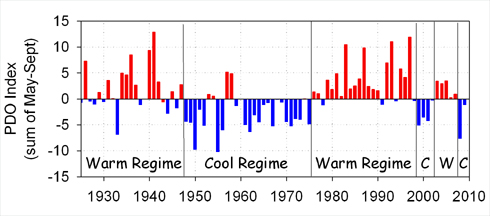
Figure 2. Time series of shifts in sign of the Pacific Decadal Oscillation (PDO), 1925 to 2009. Values are averaged over the months of May through September. Red bars indicate positive (warm) years; blue bars negative (cool) years. Note that 2008 was the most negative since 1956.
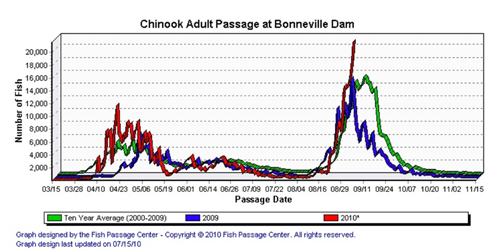
This year’s Fall Chinook passage at Bonneville has already surpassed 2009 and the run has not even peaked yet.
Record Sockeye Run in B.C.
by Ken Schlichte
Sockeye Returns Best in Nearly a Century
By Tracy Sherlock, Vancouver Sun, August 25 2010 [here]
B.C. is now reaping the biggest sockeye salmon return in nearly a century, just a year after one of the smallest returns on record. Fishery officials estimated Tuesday that more than 25 million sockeye salmon will return to the Fraser River this year, the largest number since 1913. Last year’s return was 1.7 million.
The estimate could yet go higher, Barry Rosenberger, area director for the Department of Fisheries and Oceans, said as Tuesday’s test catch was the largest all year. The department has approved another set of openings for commercial fishing and expanded the fishery based on the record returns.
The huge bounty is causing challenges for supplier and retailer 7 Seas, where they’re turning fishermen away due to a surplus of sockeye.
People have fish going rotten in their boats; it’s really bad,” said 7 Seas president George Heras. “The fish is overwhelming everyone right now because there is way more than anyone expected.” …
The huge salmon run, ironically, comes during the $15-million Cohen commission of inquiry into the disappearance of Fraser sockeye.
The federal commission is going through a transformation of its own. It initially created a scientific advisory panel composed of six fisheries scientists, but this panel has now been scrapped in favour of a model that focuses on peer review. An Aug. 17 press release announced the change along with the establishment of 12 research projects “to study aspects of the decline of Fraser River sockeye salmon, as well as the cumulative effects of the decline.” …
The recent dismissal of the panel follows the July resignation from the panel of Brian Riddell, a 30-year scientist with the federal fisheries department who is now chief executive officer of the Pacific Salmon Foundation. Riddell quit over concerns the commission wasn’t keeping politics and science separate.
Eidsvik said the fact that this year’s run is so large, but last year’s run was drastically small, means many possible causes for the salmon fishery’s decline can be discounted, including global warming. …
Last year’s drastically small Fraser River sockeye salmon run contrasts with last year’s Columbia River Bonneville Dam sockeye salmon run, illustrated [here], which was larger than the Ten Year Average (2000-2009) sockeye salmon run. We have seen the information indicating that last year’s above average Columbia River sockeye salmon run and this year’s huge Columbia River sockeye salmon run occurred because of the favorable offshore ocean habitat conditions created by the Cool Regime of the Pacific Decadal Oscillation. Those conditions should also have favored Fraser River sockeye salmon runs. It appears that 2009’s drastically small Fraser River sockeye salmon run was due to poor management of that fishery.
Sockeye salmon run sets record for Columbia River
The Oregonian, August 01, 2010 [here]
Although there are 100 or so stragglers every day and it will only be “official” in a week or so, the run of sockeye salmon up the Columbia River this summer is the highest since Bonneville Dam started operating in 1938. …
About 250 miles upstream, the sockeye count over Priest Rapids Dam is more than 350,000. That is significant because Priest Rapids is the first Columbia River dam past the Snake River and means hundreds of thousands of sockeye are headed to rivers and spawning lakes in north central Washington and British Columbia. … [more]
Record Salmon Return Explained
This year’s record salmon returns are a mystery to some folks, such as wildlife agency functionaries, but not to us.
Sockeye Count Easily Surpasses 1947
Record Run; ‘Unexpected And Hard To Explain’
The Columbia Basin Bulletin, July 09, 2010 [here]
Sockeye salmon continue to zoom up and over the lower Columbia River’s Bonneville Dam where they are now setting records daily.
The 2010 sockeye count at Bonneville’s fish ladders through Thursday had climbed to 364,019. Before this year, the record sockeye return to the Columbia, which includes fish caught in non-Indian commercial fisheries in the 146 river miles below Bonneville and the dam count, was 335,300 fish in 1947.
Note: as of July 25th the Bonneville sockeye count was 386,071.
The 2010 Bonneville count passed that 1947 mark on Independence Day.
Gill netters harvested 164,200 sockeye (574,000 pounds) in 1947 and 171,139 were counted passing Bonneville, according to data compiled by the Oregon and Washington departments of fish and wildlife. The two agencies co-manage mainstem fisheries on the mainstem Columbia.
The Technical Advisory Committee updated its 2010 sockeye run-size forecast last week to 375,000 fish. The preseason forecast was for a return of 125,000 sockeye to the mouth of the Columbia, but skyrocketing daily counts at Bonneville pushed the forecast to 250,000 and then to 375,000.
This year’s count also exceeds the record Bonneville count, which was 237,700 fish in 1955. Counts have been under way since 1938.
Virtually all Columbia River sockeye are wild-origin fish, originating predominantly from Osoyoos Lake in Canada, with a smaller proportion from Lake Wenatchee. In the Snake River, only a small number of sockeye have returned each year over the past two decades. But their number spiked in 2008 and 2009 when 909 and 1,219 were counted passing the lower Snake River’s Lower Granite Dam, the eighth hydro project the sockeye pass on their way to central Idaho’s Stanley Basin.
Already this year (through Thursday) 938 sockeye have been counted at Lower Granite. The daily counts there rose steadily to a peak of 162 Tuesday. That count was followed by a tally of 143 on Wednesday and 104 on Thursday. Most of the returning Snake River sockeye are the product of a captive broodstock program.
Note: as of July 25th the Lower Granite sockeye count was 1,925.
The Bonneville sockeye counts peaked from June 20-25 when more than 160,000 climbed over the fish ladders. The counts during that period ranged from 25,011 on June 20 to 30,690 on June 24. The latter count is the highest ever, breaking a record set the previous day (30,374).
The record run is “unexpected and hard to explain,” said the Oregon Department of Fish and Wildlife’s Kathryn Kostow, who also chairs TAC. The committee is made up of federal, state and tribal officials. TAC typically would investigate such “odd events” at season’s end. …
Hard for some people to explain. But the abundantly obvious and evident reason for record salmon runs is the Pacific Decadal Oscillation shift that occurred in 2008, when cool waters replaced warmer waters in the eastern Pacific. Upwelling of cold, nutrient-rich water feeds plankton and subsequently the entire food chain, including salmon.
Ken Schlichte predicted the record salmon runs here at NFTSF [here, here], and so did I [here]. No offense to Ken, but it didn’t take a genius to recognize the obvious, especially after record salmon runs in 2009.
The PDO shift was also predicted at W.I.S.E. in 2008 [here].
Maybe the Oregon Department of Fish and Wildlife ought to read this site. They could learn a lot here, and dispel some of their confusion and misapprehension.
Salmon Report July 25th
As of yesterday (July 24th) 244,384 adult spring Chinook salmon, 94,628 adult summer Chinook salmon, 385,950 Sockeye salmon, and 148,567 Steelhead have passed the Bonneville Dam, heading upstream in the Columbia River system to spawn.
That number (873,529 total) is nearly twice the number of adult salmon and steelhead passing Bonneville last year by July 24th (457,119), and more than twice the ten-year average to-date (423,794).
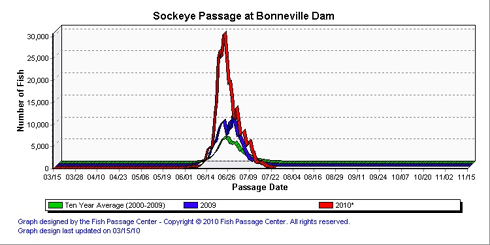
See [here] for more salmon graphs.
See [here] for more salmon statistics.
Another Bubbleheaded Salmon Lawsuit
The usual suspects have filed another lawsuit to force water spillage over the dams of the State of Washington. The ostensible purpose is to “save salmon” but in fact water spillage kills salmon smolts. The practical result, if the lawsuit is successful, will be to reduce renewable energy production, increase electricity rates, and kill fingerling salmon on their way to the ocean.
Groups sue for more water over dams for salmon
By PHUONG LE, Seattle PI, June 3, 2010 [here]
SEATTLE — Conservation and fishermen’s groups sued the state Department of Ecology on Thursday to get more water to spill over dams along the Columbia and Snake Rivers, protecting salmon and steelhead.
The groups want the state to change its water quality standards so more water can be spilled over federal dams. They say releasing more water over the dams - rather than running it through turbines - improves salmon’s chances of surviving their migration.
Earthjustice filed the lawsuit in Thurston County Superior Court on behalf of the Northwest Sportfishing Industry Association, the Association of Northwest Steelheaders, the Pacific Coast Federation of Fishermen’s Associations, the Institute for Fisheries Resources and Idaho Rivers United.
“We think this standard is badly needed to help imperiled salmon and steelhead, and we want Washington to do the right thing,” said Amanda Goodin, an Earthjustice attorney.
Ecology denied the groups’ latest petition in May, citing concerns about possible harm to other aquatic life. The state said at the time that the change may provide a small benefit to salmon but may also harm other animals.
In response to Thursday’s lawsuit, Ecology said it follows federal clean water rules and noted that it already allows more water to spill over dams in certain situations.
“Ecology does not believe the overall benefits of additional spill versus detrimental effects to aquatic life is clear or sufficient to justify a rule revision of the water quality standards,” the agency said in a statement.
The U.S. Army Corps of Engineers and the Bonneville Power Administration control the level of spill at federal dams along the Snake and Columbia Rivers, but they must also meet state water quality standards, according to the lawsuit.
The dispute here involves limits on dissolved gases. Water spill can cause high levels of gases in the river. … [more]
Water spillage means water to the hydroelectric turbines will be shot off and the downstream flow forced over the tops of the dams. That increases the air in the water (dissolved gas supersaturation) below the dams and causes “gas-bubble disease” in the salmon smolts (those that survive the fall). Spill mortality is at least twice the mortality of smolts that pass through turbines. Furthermore, the dams now have smolt diversion systems that direct the smolts away from the turbines and into bypass spillways.
This issue is old. Spillage was first proposed in the early 1990’s and has been proven to kill smolts at high rates. Spillage is expensive, too. The water that does not go through turbines does not produce electricity.
Moreover, returns of adult salmon are achieving record rates due to the cool ocean conditions (caused by the Pacific Decadal Oscillation) [here].
The usual sue-happy groups do not actually represent fishermen or their interests. Their agenda is to destroy the economy of the Pacific Northwest for the usual Marxist revolutionary reasons. The bubbleheads also hope to garner $millions in free handouts from the Federal Government in the form of Equal Access to Justice Act (EAJA) funds.
As so it goes. The anarchists use the Justice System to monkeywrench the entire region, cut off renewable energy, kill baby salmon, and line their pockets from the Federal Treasury. Congress sits there dumbfounded, or worse, fully complicit in the anarchists’ strategy.
In the end it’s the public that’s bubbleheaded for allowing these destructive actions to continue.
Spring Chinook Report June 2nd
As of yesterday (June 2nd) 244,362 adult spring Chinook salmon have passed the Bonneville Dam, heading upstream in the Columbia River system to spawn.
That number is more than twice the number of adult salmon passing Bonneville last year by June 2nd (114,525), and 1.5 times the ten-year average to-date (167,834).
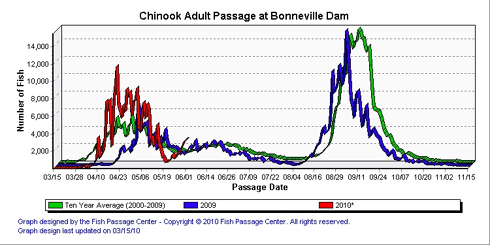
See [here] for more salmon graphs.
See [here] for more salmon statistics.