Climate and Weather Forestry education Politics and politicians Useless and Stupid
by admin
leave a comment
The Decline and Fall of Forest Science
The failures of the environmental sciences in our day and age are not confined to climatology. Universities and forest research institutions have squandered $billions pursuing the wrong answers to the wrong forest science questions.
The decline and fall of Western forest science can be traced back to the Cultural Revolution of the 1960’s when rigorous application of the Scientific Method was abandoned along with most of the prior advancements of the 20th Century. And after 50 years of substituting mythology and political ideas for scientific ones, the forest science establishment has hit rock bottom.
Nowhere is the incompetence of modern forest science more striking than the current fad of blaming non-existent “global warming” for every forest phenomenon large and small. Case in point:
Researchers cite climate change in forest decline
AP, the Washington Examiner, 02/19/11 [here]
Aspens and white pines in the West will face worsening devastation because climate change will make them more susceptible to diseases and bugs, including an infestation of bark beetles that has already killed some 33,000 square miles of forests, researchers say.
Jim Worrall, a U.S. Forest Service plant pathologist who studies aspen deaths, told a conference Friday that “overwhelming circumstantial evidence” indicates climate change has left aspens stressed and vulnerable. …
White pines, common in Montana and parts of Wyoming, aren’t as resilient and have begun to fall victim to bark beetles because warmer temperatures allowed the bugs to move north, said Diana Six, professor of forest entomology and pathology at the University of Montana.
Previously, they were protected by temperatures too cold for bark beetles, but when temperatures rise, the trees have few defenses, Six said. …
Phillip van Mantgem, a research ecologist with the U.S. Geological Survey, said 87 percent of old growth stands that he and others on a research team are monitoring have shown increasing mortality rates, and that the rate doubled in the past 18 years.
“The ultimate cause behind it is probably warming,” van Mantgem said. …
Former Vice President Al Gore addressed the conference, defending climate researchers from criticism about their motives, the Aspen Daily News reported.
“I hear from some quarters that the scientists who are presenting this information to us are interested in making money and that they are making stuff up and hyping it in order to get research grants,” he said. “It is an insult to these men and women who were on this stage today.” …
The problem with all those theories are that they are demonstrably false. Winter temperatures in Colorado have been falling for 20 years.
From the National Climatic Data Center, Climate Services and Monitoring Division, Climate At A Glance [here]
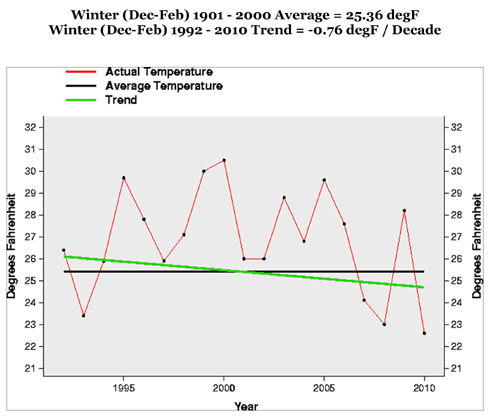
Winter (Dec-Feb) Temperatures, Colorado, 1992-2010, with trend line (1901 - 2000 Average = 25.36 degF).
Note that average winter temperatures in Colorado have been below freezing in every year on record since record keeping began in 1895. Over the last 20 years winter temperatures have declined -0.76 degF per decade. In January 2011 (last month) the average temperature was 23.4 degF, one-tenth of a degree below the 1901-2011 January average and 2 degF below the 1901-2011 winter average.
Winter temperatures in Colorado have not changed significantly over the last 115 years, and they have fallen slightly over the last 20 years, the very period that the researchers above cite as so warm as to cause aspen to die off, beetle infestations to irrupt, and old growth stands to experience increased mortality.
Al Gore presents a strawman argument. Some “quarters” allegedly claim that Colorado forest scientists are “making stuff up” for mercenary reasons, according to Al (who, by the way, has made over $100 million on carbon trading and other global warming alarmism scams).
But Colorado forest scientists are not making up aspen decline, beetle epidemics, or old growth mortality increases. Those phenomena are occurring. No one disputes that.
What Colorado forest scientists are fabricating are bogus theories as to why those things are happening. They blame global warming, and specifically increasing winter temperatures in Colorado, but there have been NO increases in said temperatures.
Colorado forest scientists posit a causal link between something that has not occurred (winter temperature increase) and forest decline phenomena. If the causal factor does not exist, it cannot cause anything.
That’s basic science, indeed basic logic, upon which the Scientific Method relies. Colorado forest scientists might as well say that little green men from outer space caused Colorado forests to decline.
Wait, you say, there are no little green men from outer space. You are correct. Likewise there has been no winter temperature increase. The latter is as imaginary as the former.
Science seeks to understand cause-and-effect phenomena based upon measurable factors that exist in the real world, not on imaginary myths and illusions that do not exist.
The real world foundations of science are extremely important. Without them science becomes a fairy tale, an exercise in fiction, a joke, a waste of time, money, and effort.
If science is done by staring at the blank walls of a cubicle in some institution and making up imaginary folk tales without basis in the real world, then it is not science at all.
We pay people to do exactly that, however. We place them in cubicles in institutions and pay them to make stuff up whole cloth, and call it “science”, and to make presentations at conferences in Aspen alongside politicians, and to give off airs as if they were doing real science, and walk around and tell journo-listas that they are scientists, and generally hoax the place up.
Meanwhile forests continue to decline, and the “scientists” have no more of a clue why than your average wino living in a dumpster, who unfortunately does not get paid the big bucks to make up fanciful tales whole cloth. I say unfortunately because your average wino is an expert at delusion, self and otherwise, and would be as good or better at it than your average forest scientist in a cubicle in an institution.
Wait a second, you say, if you’re so smart tell us why forests are declining.
What? For free? On a free blog accessible by anybody (well, perhaps not by the wino in the dumpster)?
For your information, that’s exactly what we have been doing at W.I.S.E. for 3+ years. Maybe you haven’t been paying close attention.
One thing is for sure, we haven’t been offered any paid vacations to Aspen to present non-imaginary facts about forest decline. Which, by the way, has nothing to do with imaginary global warming.
Forest science is not dead. It hangs on in remote locales like W.I.S.E. But it is reeling and gasping for breath in the USFS, the University of Montana, the USGS, and other establishment government institutions.
What those outfits produce is nothing like science. It’s demonstrably false gibberish masquerading as science.
The Truth About Climate Change Open Letter
Open Letter to the United States Congress
February 8, 2011
To view a pdf file of this letter [click here]
To the Members of the U.S. House of Representatives and the U.S. Senate:
In reply to “The Importance of Science in Addressing Climate Change”
On 28 January 2011, eighteen scientists sent a letter to members of the U.S. House of Representatives and the U.S. Senate urging them to “take a fresh look at climate change.” Their intent, apparently, was to disparage the views of scientists who disagree with their contention that continued business-as-usual increases in carbon dioxide (CO2) emissions produced from the burning of coal, gas, and oil will lead to a host of cataclysmic climate-related problems.
We, the undersigned, totally disagree with them and would like to take this opportunity to briefly state our side of the story.
The eighteen climate alarmists (as we refer to them, not derogatorily, but simply because they view themselves as “sounding the alarm” about so many things climatic) state that the people of the world “need to prepare for massive flooding from the extreme storms of the sort being experienced with increasing frequency,” as well as the “direct health impacts from heat waves” and “climate-sensitive infectious diseases,” among a number of other devastating phenomena. And they say that “no research results have produced any evidence that challenges the overall scientific understanding of what is happening to our planet’s climate,” which is understood to mean their view of what is happening to Earth’s climate.
To these statements, however, we take great exception. It is the eighteen climate alarmists who appear to be unaware of “what is happening to our planet’s climate,” as well as the vast amount of research that has produced that knowledge.
For example, a lengthy review of their claims and others that climate alarmists frequently make can be found on the Web site of the Center for the Study of Carbon Dioxide and Global Change (see Carbon Dioxide and Earth’s Future: Pursuing the Prudent Path [click here]). That report offers a point-by-point rebuttal of all of the claims of the “group of eighteen,” citing in every case peer-reviewed scientific research on the actual effects of climate change during the past several decades.
If the “group of eighteen” pleads ignorance of this information due to its very recent posting, then we call their attention to an even larger and more comprehensive report published in 2009, Climate Change Reconsidered: The 2009 Report of the Nongovernmental International Panel on Climate Change (NIPCC). That document has been posted for more than a year in its entirety [click here].
These are just two recent compilations of scientific research among many we could cite. Do the 678 scientific studies referenced in the CO2 Science document, or the thousands of studies cited in the NIPCC report, provide real-world evidence (as opposed to theoretical climate model predictions) for global warming-induced increases in the worldwide number and severity of floods? No. In the global number and severity of droughts? No. In the number and severity of hurricanes and other storms? No.
Do they provide any real-world evidence of Earth’s seas inundating coastal lowlands around the globe? No. Increased human mortality? No. Plant and animal extinctions? No. Declining vegetative productivity? No. More frequent and deadly coral bleaching? No. Marine life dissolving away in acidified oceans? No.
Quite to the contrary, in fact, these reports provide extensive empirical evidence that these things are not happening. And in many of these areas, the referenced papers report finding just the opposite response to global warming, i.e., biosphere-friendly effects of rising temperatures and rising CO2 levels [click here].
In light of the profusion of actual observations of the workings of the real world showing little or no negative effects of the modest warming of the second half of the twentieth century, and indeed growing evidence of positive effects, we find it incomprehensible that the eighteen climate alarmists could suggest something so far removed from the truth as their claim that no research results have produced any evidence that challenges their view of what is happening to Earth’s climate and weather.
But don’t take our word for it. Read the two reports yourselves. And then make up your own minds about the matter. Don’t be intimidated by false claims of “scientific consensus” or “overwhelming proof.” These are not scientific arguments and they are simply not true.
Like the eighteen climate alarmists, we urge you to take a fresh look at climate change. We believe you will find that it is not the horrendous environmental threat they and others have made it out to be, and that they have consistently exaggerated the negative effects of global warming on the U.S. economy, national security, and public health, when such effects may well be small to negligible.
Signed by [click here]
Federal forest policy Monkeywrenching forests Politics and politicians Private land policies
by admin
1 comment
Ninth Court Drops ‘Federal Defendant’ Rule
In a decision filed January 14, 2011, the Ninth Circuit Court of Appeals abandoned their “federal defendant” rule.
The rule, which had been established in prior court cases, categorically prohibited private parties and state and local governments from intervening in cases and claims brought under the National Environmental Policy Act (NEPA) before the Ninth Circuit Court.
In their Jan 14 decsion the Ninth Court threw that rule out because it is at odds with the Federal Rule of Civil Procedure 24(a)(2) and the standards applied by federal judges in all other intervention of right cases.
The case the Court ruled on is The Wilderness Society and Prairie Falcon Audubon, Inc., Plaintiffs-Appellees, v. the United States Forest Service; Jane P. Kollmeyer; Scott C. Nannenga, Defendants.
The entire text of the decision is [here].
Represented by Intervenors and amicus briefers were the Magic Valley Trail Machine Association, Idaho Recreation Council, the Blue Ribbon Coalition, Inc., the Motorcycle Industry Council and Specialty Vehicle Institute of America, the Alaska Oil and Gas Association, Coos County, Grant County, Harney County, and Wallowa County of Oregon, the American Petroleum Institute, the Chamber of Commerce of the United States, Croplife America, National Association of Manufacturers, the National Petrochemical and Refiners Association, the Western States Petroleum Association, the Steens Mountain Landowner Group, the Oregon Cattlemen’s Association, Oregon Cattlemen’s Public Lands Committee, Oregon Farm Bureau Federation, the Public Lands Council, and National Cattlemen’s Beef Association, Safari Club International, Southern Nevada Water Authority (Las Vegas, Nevada), Western Urban Water Coalition, the Kootenai Tribe of Idaho, the Confederated Salish and Kootenai Tribes, the Coquille Indian Tribe, the Kalispel Tribe, the Shoshone-Bannock Tribes, the Confederated Tribes of Siletz Indians, the Metlakatla Indian Community, the Idaho Governor’s Office of Species Conservation, C.L. “Butch” Otter, Governor of Idaho, the State of Alaska, the American Forest Resource Council, the Alaska Forest Association and Douglas Timber Operators (OR).
The opinion, written by Judge Barry G. Silverman on behalf of an eleven judge panel, states:
Today we revisit our so-called “federal defendant” rule, which categorically prohibits private parties and state and local governments from intervening of right on the merits of claims brought under the National Environmental Policy Act of 1969 (”NEPA”), 42 U.S.C. §§ 4321 et seq. Because the rule is at odds with the text of Federal Rule of Civil Procedure 24(a)(2) and the standards we apply in all other intervention of right cases, we abandon it here. When construing motions to intervene of right under Rule 24(a)(2), courts need no longer apply a categorical prohibition on intervention on the merits, or liability phase, of NEPA actions. To determine whether a putative intervenor demonstrates the “significantly protectable” interest necessary for intervention of right in a NEPA action, the operative inquiry should be, as in all cases, whether “the interest is protectable under some law,” and whether “there is a relationship between the legally protected interest and the claims at issue.” Sierra Club v. EPA, 995 F.2d 1478, 1484 (9th Cir. 1993). Since the district court applied the “federal defendant” rule to prohibit intervention of right on the merits in this NEPA case, we reverse and remand so that it may reconsider the putative intervenors’ motion to intervene.
This action arises out of the Forest Service’s adoption of a travel plan that designated 1,196 miles of roads and trails for 796 THE WILDERNESS SOCIETY v. USFS use by motorized vehicles in the Minidoka Ranger District of Idaho’s Sawtooth National Forest. Two conservation groups, the Wilderness Society and Prairie Falcon Audubon, Inc., claim that the Forest Service violated NEPA by, among other things, failing to prepare an Environmental Impact Statement and failing to consider reasonable alternatives to the travel plan that would protect certain ecologically sensitive watersheds and wildlife habitats within the District. Their complaint seeks declaratory and injunctive relief invalidating the travel plan, limiting motorized vehicles to previously authorized routes, and prohibiting off-road vehicles from traveling outside designated routes, pending compliance with NEPA and other environmental statutes.
The issue central to this appeal arose when three groups representing recreation interests, the Magic Valley Trail Machine Association, Idaho Recreation Council, and Blue Ribbon Coalition, Inc., moved to intervene to counter the conservation groups’ contention that the Forest Service’s plan was too accommodating to users of to users of motorized vehicles. The conservation groups opposed intervention, and the Forest Service took no position on the issue. Applying our Circuit’s “federal defendant” rule, the district court denied intervention of right. The district court also denied permissive intervention on the grounds that the recreation groups had not adequately participated in the administrative process and “would not add any further clarity or insight” to the litigation.
The recreation groups appealed, arguing that the district court erred in failing to consider limited intervention and abused its discretion in denying permissive intervention. They also urged us to consider modifying or eliminating the “federal defendant” rule. A three-judge panel of our court ordered the parties to brief whether the court should review the case en banc to consider abandoning the rule. The recreation groups again urged the court to do so. The conservation groups took no position on the propriety of the rule. We granted en banc review. …
The upshot is that states, counties, and other affected groups and individuals may now intervene when an enviro-litigious group attempts to use the courts and NEPA law to inflict their own twisted policies on federal agencies.
Before this ruling states, counties, and others had to sit on the sidelines while high-paid enviro attorneys argued with US Dept. of Justice attorneys. Very often, terrible rulings were issued that significantly harmed people and entities who were categorically excluded from the courthouse.
“No day in court for you,” said the Ninth Court. But now that (court invented) exclusion from justice has been lifted.
Thank you, Ninth Circuit Court, for lifting ever so slightly your boot heel off the necks of Americans.
By the way, other federal District Courts either don’t recognize the “federal defendant” rule or have yet to confront it.
Also by the way, Obama’s U.S. Justice Dept. opposed lifting the rule. In case you were wondering.
Irony Update
This item is almost too ludicrous to post. The most tampering Sec DOI ever, the plutocrat who brought us Magic Wilderness, Spotted Foul, Gulf Spoil, Monument-al Surprise, the GloWarm Hoax, Wolf Dodging and countless other bastardizations of pseudoscience, has declared a “scientific integrity” policy. It’s a wonder he didn’t choke on his own doubletalking forked tongue.
Salazar Announces New Scientific Integrity Policy and Designation of Departmental Science Integrity Officer
DOI Press Release, February 1, 2011 [here]
Washington, D.C. – Secretary of the Interior Ken Salazar today announced the establishment of a new policy to ensure and maintain the integrity of scientific and scholarly activities used in Departmental decision making. The policy follows on the Memorandum to the Heads of Departments and Agencies on Scientific Integrity issued in December [here] and includes the designation of a Departmental Science Integrity Officer.
“Because robust, high quality science and scholarship play such an important role in advancing the Department’s mission, it is vital that we have a strong and clear scientific integrity policy,” said Secretary Salazar. “This policy sets forth clear expectations for all employees — political and career — to uphold the principles of scientific integrity, and establishes a process for impartial review of alleged breaches of those principles.” … [more]
Federal forest policy Monkeywrenching forests Politics and politicians
by admin
leave a comment
A wild surprise from Salazar
Secretary failed to consult with states - Community Perspective
By Stan Leaphart, The Fairbanks Daily News-Miner, January 30, 2011 [here]
Note: Stan Leaphart is executive director of the 12-member Citizens’ Advisory Commission on Federal Areas (CACFA), which monitors federal land management actions and assists Alaskans affected by them. Administratively, the commission lies within the state Department of Natural Resources. Its website is [here]
“My administration is committed to creating an unprecedented level of openness in government. We will work together to ensure the public trust and establish a system of transparency, public participation, and collaboration.”
This is the opening paragraph of a memorandum signed January 21, 2009, by President Barack Obama, one day after his inauguration.
The memorandum goes on to state: “Executive departments and agencies should offer Americans increased opportunities to participate in policymaking and to provide their government with the benefits of their collective expertise and information.” Many Americans applauded this as proof that “hope and change” wasn’t just a beguiling campaign slogan.
Some 23 months later, on December 23, 2010, Secretary of the Interior Ken Salazar unveiled a secretarial order establishing a new policy for lands managed by the Bureau of Land Management. This policy directs the BLM to inventory all lands it manages for their wilderness characteristics and creates a new classification of lands known as “Wild Lands.”
Salazar’s announcement was the first anyone outside the Department of the Interior knew about the Wild Lands policy, even though it was nearly two years in the making.
Governor Parnell’s office was informed of the program only hours before it was announced.
Utah Governor Gary Herbert, whose state in 2003 reached a settlement with Interior on new wilderness study areas, was afforded a similar courtesy.
In a letter to Salazar, Governor C.L. “Butch” Otter of Idaho declared: “Without any state or public input, the Interior Department has circumvented the sovereignty of the states and the will of the public by shifting from the normal planning process of the Federal Lands Policy and Management Act (FLPMA) to one that places significant authority in the hands of unelected federal bureaucrats.”
Secretary Salazar’s decision to unilaterally create and implement this policy contradicts both the President’s memorandum and the Department of the Interior’s own “Open Government Plan.” …
Salazar’s failure to allow the American public and the governments of the 43 states in which the BLM manages lands to participate in developing this policy or provide “their collective expertise and information” calls into question the department’s commitment to an open and transparent government.
One doubts Salazar would have ignored such a snub during his tenure as a U.S. senator or, prior to that, as Colorado’s attorney general. … [more]
Federal forest policy Monkeywrenching forests Politics and politicians Useless and Stupid
by admin
leave a comment
Tampering With Science
In a previous post we noted the Christmas “order” by Ken Salazar to declare 200+ million acres of the BLM Empire “wilderness” [here]. And we noted that immediately thereafter the BLM followed through and declared 11,000 acres of Mendocino County, CA, to be Designated Wilderness [here, here].
And we noted that the BLM had determined “scientifically” that the 11,000 acres had magically transformed from a cultural landscape, occupied by human beings for 10,000+ years, into untrammeled wilderness in five short years. From the BLM press release [here]:
The area was designated as a potential wilderness area by the 2006 Northern California Coastal Wild Heritage Wilderness Act. This interim designation provided time for the BLM to assess and, if necessary, restore 1,565 acres of private lands acquired for public ownership shortly before the Act’s passage. The Act required that the area be designated as wilderness once conditions were compatible with the Wilderness Act, or no later than five years after the Act’s passage.
The BLM determined no additional restoration of the Elkhorn Ridge area was necessary as the area had naturally rehabilitated itself over the five years. Consequently, a publication in today’s Federal Register announces that the interim designation has been lifted and the area is now designated wilderness.
We have to ask, what kind of science is that? Some possible answers:
1. BLM scientists are dumber than rocks, or
2. BLM scientists are not stupid but were paid under the table to pervert science, or
3. BLM scientists receive no bribes but were threatened with termination if they did not toe the pseudo-science line.
I suspect #3. I have no proof, just suspicions. I mean, how stupid could they really be? And I doubt they got any reward for perverting science. No, my best guess is that threats, direct or indirect, convinced the BLM scientists to throw up their hands and say whatever.
That’s called “tampering”. Recall that during Salazar’s first days in office as Sec DOI, he threw out the Spotted Owl Recovery Plan because, as he claimed, politicians had tampered with the science [here]. From the DOI press release of July 16, 2009:
U.S. Dept. of the Interior Press Release, July 16, 2009
Interior Withdraws Legally Flawed Plan for Oregon Forests, Presses For Sustainable Timber Harvests
WASHINGTON, D.C. – Because the previous Administration failed to follow established administrative procedure before leaving office, its plan to intensify logging in western Oregon – known as the Western Oregon Plan Revisions (WOPR) – is legally indefensible and must be withdrawn, Secretary of the Interior Ken Salazar said today.
Moreover, Assistant Secretary for Fish, Wildlife and Parks Thomas Strickland said that the federal government will ask the District Court to vacate the Fish and Wildlife Service’s 2008 revision of the critical habitat for the spotted owl, on which the WOPR was in part based, because Interior’s Inspector General determined that the decisionmaking process for the owl’s recovery plan was potentially jeopardized by improper political influence. …
The charge was “improper political influence” in matters of science. The science was tainted because politicians had unduly “influenced” scientists. That charge was made not just by Salazar, but by Obama’s Dept. of Justice [here]. In March 2009 Obama himself issued a Presidential Memorandum calling for “restoring scientific integrity” [here].
That is why today, I am also signing a Presidential Memorandum directing the head of the White House Office of Science and Technology Policy to develop a strategy for restoring scientific integrity to government decision making. To ensure that in this new Administration, we base our public policies on the soundest science; that we appoint scientific advisors based on their credentials and experience, not their politics or ideology; and that we are open and honest with the American people about the science behind our decisions. That is how we will harness the power of science to achieve our goals — to preserve our environment and protect our national security; to create the jobs of the future, and live longer, healthier lives.
Can you say “snow job”? Obama’s Memorandum was utter crap. He didn’t mean it; he meant just the opposite. No Administration in history has tampered with science more than Obama’s. Case in point: magic wilderness, where under pressure from politicians BLM scientists flushed their scientific integrity down the toilet.
Some might say, well, that’s okay because the important thing is Obama has “protected” these special lands. It’s just white lies, for a higher purpose.
Except that the magic wilderness areas are NOT protected. They will erupt into catastrophic fires that will be Let Burn and will destroy all the environmental values therein. And those fires will leap across legal boundaries and destroy farms, ranches, homes, and businesses far away from the magic wildernesses, and even burn right into cities. It’s happened before. It will happen again.
That’s not “protection”; it’s wholesale destruction.
The tampering, the lies, the phony science all have real world consequences. Bad consequences. Death and destruction consequences.
The Obama Administration has declared war on America [here].
The BLM scientists should be ashamed of themselves. How could you? What did America ever do to you that you would cast your integrity aside for bellicose and belligerent purposes? Why have you perverted science in an act of war upon your own nation? We understand the corruption and extreme animosities that smolder beneath the surface of grasping politicians. What we don’t understand is why you have joined with them in support of their insanity.
The Piñon Canyon War
At Fort Carson [here] south of Colorado Springs, the U.S. Army occupies 236,800 acres of El Paso County’s scenic high-prairie Piñon Canyon, which it uses for large-scale, force-on-force mechanized brigade combat exercises involving tanks and armored units. Since 2006 the Army, along with their “partner” The Nature Conservancy (the real estate branch of Goldman Sachs) has been grasping to acquire at least 418,000 acres more.
The land the Army covets is private property, mainly ranches, between the towns of La Junta, Trinidad, and Walsenburg. The proposed annexation would create a contiguous Army-owned area of 650,000 acres, more than 1,000 square miles. In fact, the Army has stated in the past that they wish to seize 7 million acres (more than 10,000 square miles) through eminent domain.
The family ranchers who own that land are adamantly opposed. The land seizure would devastate the local economy as well as destroy the land with mortars, bombs, and other munitions. The residents formed a group called Not One More Acre! to fight the Piñon Canyon expansion.
Their combined efforts were enough to gain a congressionally ordered reprieve in 2007, when Reps. Marilyn Musgrave (R-Colo.) and John Salazar (D-Colo.) pushed through a one-year congressional ban on funding for eminent domain acquisitions or expansion activities in Piñon Canyon. In 2008 Congress extended the ban through the end of fiscal 2009.
Not One More Acre! also sued the U.S. Army over its 2007 “transitional” environmental assessment. The plaintiffs were victorious when in September 2009 U.S. District Judge Richard Matsch’s ruled that the Army’s EA was “severely inadequate”:
Ranchers: Ruling topples Army dominoes on Pinon Canyon
by Peter Roper, the Pueblo Chieftan, September 10, 2009 [here]
… Not One More Acre! filed its lawsuit over that study, saying it failed to meet the federal requirements in many areas, including looking at training alternatives.
Matsch agreed in his ruling Tuesday. He sharply rejected the Army’s analysis and process, pointing out that Army reports produced during the lawsuit - but not made available to the general public previously - demonstrated the Army was aware of extensive environmental damage at Pinon Canyon from previous and more-limited training maneuvers.
The judge said the Army’s own land management analysis in 2006 said the Army could only use Pinon Canyon about five months of the year if the grasslands were to recover afterward. Even so, the 2007 impact study said that adequate mitigation plans were in place to support even a year-round training schedule.
“That conclusion is inconsistent and irreconcilable with the Army’s analysis in 2006,” Matsch wrote. …
The Army thumbed its military nose at the Judge. Last Thursday, the Army released a 43-page report defending and reasserting the original “proposed action” to ramp up training at Pinon Canyon, ignoring the substance of the ruling and contending that a full environmental impact study is not needed.
Federal forest policy Monkeywrenching forests Politics and politicians
by admin
leave a comment
Salazar, Abbey Get Feedback on New BLM Wilderness Order
SOS Forests is not alone in our shock and dismay at Sec DOI Ken Salazar’s Christmas surprise order declaring an indeterminate amount of the 245 million-acre BLM empire as de facto “wilderness” [here].
Wyoming Gov Matt Mead fired off the following letter last week [here]:
Governor Mead asks Department of Interior to rescind Wild Lands Order
******FOR IMMEDIATE RELEASE******
1/18/2011
OFFICE OF GOVERNOR MATT MEAD
State Capitol
Cheyenne, WY 82002CHEYENNE, Wyo. – In a letter to Secretary of the Interior Ken Salazar, Governor Matt Mead expressed deep concerns with the administration’s signing of Secretarial Order 3310. That order directs the Bureau of Land Management to identify public lands as “Wild Lands” and protect them for their wilderness values.
“This letter is to advise you that I firmly oppose Secretarial Order 3310,” Mead wrote. He added his concern that the order was released just before the Christmas holiday and at a time when his office and other governors’ offices were in transition. “Though you will seek feedback from State BLM offices prior to issuing final agency guidance, the opportunity for public input on the policy itself was never afforded.”
Mead also expressed concern about the impact that this order could have on the economy of Wyoming and its communities. He wrote, “The policy ignores the contribution of Wyoming’s natural resources to the nation’s economic sustainability. It ignores the revenues our State and local governments depend on from mineral and other development. It fails to address the impact to ranchers, recreationalists, and all the others who rely on the lands for so many different reasons.”
Specifically, Governor Mead says the order could drag out or halt the permitting process for BLM lands.
The Governor’s letter ends, “Only the elected Congress is given the power, by law, to designate official Wilderness areas. But, the policy seeks such designations by administrative fiat. With all due respect, the BLM cannot achieve these ends through this means. Please rescind the order for the reasons set forth in this letter and in the name of balance, transparency and the BLM’s multiple-use mandate.”
And in a contentious public meeting, BLM Director Bob Abbey’s pants were set on fire, figuratively:
Abbey’s visit marked by fireworks
Mary Bernard, Vernal Express, 1/18/11 [here]
Angry words, rowdy applause and a walk-out marked Bureau of Land Management Director Bob Abbey’s visit Friday to the state Capitol to discuss a national policy shift on public lands management.
The new policy, announced Dec. 23 by Interior Secretary Ken Salazar, directs the BLM to inventory — or in some cases re-inventory — the land it manages to determine if it should be protected under a new “wild lands” designation until Congress can decide whether it wants to permanently protect it as wilderness.
“It is consistent with our obligation to manage public lands for multiple uses,” Abbey said of the policy shift, adding that the public has a “right to protest or litigate decisions with which they disagree.”
Speaking before the usually reserved body of stakeholders on the Governor’s Council on Balanced Resources, Abbey was repeatedly blasted as he defended Salazar’s order.
“When is enough enough?” Gov. Gary Herbert asked, clearly frustrated with the shift that scraps a 2003 agreement crafted between then-Gov. Mike Leavitt and the Bush administration’s BLM that said the agency would stop trying to have public lands in Utah considered for congressional designation as wilderness.
“How many times are we going to inventory the same thing?” Herbert asked, drawing loud applause from attendees sporting “Stop the Land Grab” stickers as others wearing yellow “Wild Utah” buttons sat silent.
So many people turned out for Abbey’s meeting with Herbert and his council that two additional overflow rooms had to be opened to accommodate the session.
Herbert went on to criticize “ad nauseum litigation over public lands management that has had a negative impact on rural economies.” Specifically, he said, rural economies who rely on public lands access and face “the lack of finality” and no way to plan for the future.
Similar sentiments were voiced by council member Kathleen Clarke, who held Abbey’s job for five years during the Bush administration. She noted in the absence of certainty, “We will cause industry to flee this state.”
Council member Mike Noel went on to angrily denounce Salazar’s order as “erroneous.” The Republican state representative from Kanab said the Federal Land Policy and Management Act of 1976 guarantees Westerners responsible access to resources on public lands.
Instead, Salazar’s order is a step backward, possibly foreclosing on the state’s effort to engage different points of view to resolve challenges without legal action, council members told Abbey. …
“We’ve tried to bring people together in a reasonable and rational approach,” said Herbert, who was clearly irked by the federal government’s lack of openness in formulating its new policy.
“Process counts and when a major policy change is announced two days before Christmas after Congress is out of session, something is wrong,” the governor said. “If we have to somehow do it in the shadows, then it probably isn’t the right thing to do.”
Still smarting from the last minute phone call on the morning Salazar announced his order, the governor said the state was “caught blind” by the policy change. …
A request to hear from former Rep. Jim Hansen, a 22-year veteran of the U.S. House Natural Resources Committee, was met with a protest by council member Pat Shea.
Shea — director of the BLM for a brief time under President Bill Clinton and current defense attorney for Tim DeChristopher, the man charged with monkey-wrenching a 2008 BLM oil and gas lease auction in Salt Lake City — stormed out of the proceeding when Hansen, a non-member of the council, was given the floor to speak.
“The BLM is protecting fake wilderness,” Hansen said. “Only Congress can create a wilderness.”
Abbey countered Hansen’s assertion that Salazar’s order bypasses congressional authority saying, “We are not creating de facto wilderness.”
The response — interrupted by boos from the audience — focused on the BLM’s responsibility to operate as a multiple-use agency. …
When unctuous government functionaries violate the Constitution and the will of Congress with surprise “orders” that promise economic disaster, catastrophic holocaust, and wholesale destruction in the name of phony, illusory “mandates” and extreme junk science, can we call their actions “civil”? Is it “balance”, “clarity”, and “common-sense”, as described by Salazar, to inflict illegal and unwanted policies in a midnight putsch?
No, it just pisses people off. Salazar and Abbey need to resign today. They are bad for America.
Federal forest policy Monkeywrenching forests Politics and politicians Private land policies Useless and Stupid
by admin
6 comments
Magic Wilderness Implications
The redoubtable bear bait makes an important observation [here] that everyone should study intently.
The BLM has invented a new legal and quasi-ecological concept, that of “natural rehabilitation”. In the case of the new Elkhorn Ridge Designated Wilderness, a mere five years of no (or reduced) human activity on 11,000 acres of ranches, homes, timber harvest tracts, etc. was enough “natural rehabilitation” to turn an area of Mendocino County CA into “primeval character and influence, without permanent improvements or human habitation, which is protected and managed so as to preserve its natural conditions and which… generally appears to have been affected primarily by the forces of nature, with the imprint of man’s work substantially unnoticeable.”
In just five years a working landscape transformed naturally into primeval wilderness. That is, according to the experts at the BLM.
So when the supremely tamperistic Ken Salazar declared [here] that he would “restore balance and clarity to the management of public lands by establishing common-sense policy” by designating “appropriate areas with wilderness characteristics under its [the Dept. of Interior's] jurisdiction as ‘Wild Land’ and to manage them to protect their wilderness values”, he meant every single acre of the 245 million acre BLM empire.
After all, if five years of “natural rehabilitation” is all it takes to restore primeval character, erasing the imprint of man, then every acre is a mere five years away from being wild as a goose in the wind.
The inconvenient fact that human beings have been living on and imprinting North America for 10,000+ years is moot. It’s as moot as a dead duck. All the BLM has to do is put up a gate, lock it, and five years later presto! it’s wilderness.
Congress is also moot. What difference do they make?
And the science of Ecology is also moot. Wilderness is a state of mind, not an actual condition, or else Mother Nature is magic and with a wave of Her wand, bingo! it’s wilderness in five short years or less.
La, la, la. Merrily we skip down the garden path. Only it’s not a garden anymore, it’s wild wilderness, untrammeled and unimprinted.
Detroit, you’re next.
Perpetrating a Fraud: CO2 Offsets
by Bill Turlay
WA residents, you might take note (and mention to your legislature delegation) that RCW 19.29A.090 [here] requires each electric utility to provide to its retail electricity customers a voluntary option to purchase qualified alternative energy sources. Each electric utility must include with its retail customer’s billing statement, at least quarterly, a voluntary option to purchase qualified energy resources. OR residents, the basic premise of this message pertains to you also.
Ladies and gentlemen, the State of Washington is involved with perpetrating a fraud on its citizens. See Climate Swindle: The Mirage of Carbon Offsets by Mr. Todd Wynn of the Cascade Policy Institute [here]. Some selected excerpts:
Carbon offsetting has spread quickly in the past few years, fueled by worries of human induced climate change. Some assert that the combustion of fossil fuels is causing a buildup of greenhouse gases in the atmosphere and consequently increasing global temperatures. Accordingly, many environmental organizations and governments around the globe advocate restricting fossil fuel use and increasing the use of mechanisms that claim to decrease human emitted greenhouse gases. One of these mechanisms is carbon offsets.
The Climate Trust, a non-profit carbon offset provider in Oregon, defines carbon offsets as “reduction, removal, or avoidance of greenhouse gas (GHG) emissions from a specific project that is used to compensate for GHG emissions occurring elsewhere. One carbon offset represents one metric ton of carbon dioxide equivalent.” By purchasing a carbon offset, businesses, electric utilities, or individuals pay someone to reduce greenhouse emissions elsewhere, rather than change their own behavior. …
The newfound popularity of carbon offsets warrants a closer examination of their legitimacy. Studies of some carbon offset schemes have revealed examples of fraud and abuse. These examples caution against the use of offsets for regulatory compliance.
This report offers an in-depth look into one of the most prominent carbon offset marketers in the United States, the Bonneville Environmental Foundation (BEF). Because BEF is perceived as one of the nation’s leaders in providing quality offsets, any problems found there would indicate that there are systemic problems within the industry. …
Monkeywrenching forests Politics and politicians Useless and Stupid
by admin
leave a comment
Jerry Moonbeam Proposes to Burn Down California
Only days into office, retread CA Goober Jerry Moonbeam has proposed cutting the Cal Fire budget.
Governor proposes firefighting shift from Cal Fire to local agencies
By Paul Rogers, The San Jose Mercury News, January 16, 2011 [here]
The proposed budget Governor Jerry Brown rolled out this week contains significant changes to California’s environment — from closing some state parks to dropping a program that pays big landowners to keep their property undeveloped.
But perhaps none may prove to be more significant than Brown’s recommendation for major changes to the way California battles wildfires.
His plan calls for reducing firefighters on Cal Fire engine crews from four to three — back to staffing levels that existed before massive wildfires charred the state in 2003. It also would shift to cities and counties a significant amount of Cal Fire’s fire fighting and other emergency-response responsibilities. … [more]
Well, I guess the voters get what they vote for. Who better to destroy the Land of Fruits and Nuts than a fruity nut?
Federal forest policy Monkeywrenching forests Politics and politicians
by admin
3 comments
Magic Wilderness
Here we go. On Dec. 23rd Secretary of the Interior Ken Salazar issued a “secretarial order” to designate 245 million acres of BLM land as “wilderness” [here]. Three weeks later the BLM proudly announced a new 11,000 acre “wilderness in Mendocino County, CA.
BLM Finalizes Elkhorn Ridge Wilderness Designation
BLM News Release No. CA-N-11-19, January 13, 2011 [here]
The Bureau of Land Management (BLM) announced today that the Elkhorn Ridge Potential Wilderness Area in Mendocino County, California, has officially been added to the National Wilderness Preservation System.
“We are excited that this unique and beautiful area will now receive permanent protection as wilderness,” said Lynda Roush, manager of the BLM Arcata Field Office. “This designation is the result of hard work by many local partners and the strong support of Congressman Mike Thompson.”
Congressman Thompson added, “The official designation for Elkhorn Ridge makes certain this very special place will be enjoyed by future generations. The area is rich in wildlife and aquatic species, diverse forestland, chaparral habitat and many areas of undisturbed ancient forest. I am please the area is permanently protected.”
Congressman Thompson is very wrong. The designation is an invitation to catastrophic holocaust. The Elkhorn Ridge area is now dedicated to immolation and incineration. Whatever resource values are there now will be destroyed within a few years by unfought wildfire.
Ken “Mr. Tamper” Salazar promised to “restore balance and clarity to the management of public lands by establishing common-sense policy.” What he accomplished is the exact opposite.
More from the news release:
The area was designated as a potential wilderness area by the 2006 Northern California Coastal Wild Heritage Wilderness Act. This interim designation provided time for the BLM to assess and, if necessary, restore 1,565 acres of private lands acquired for public ownership shortly before the Act’s passage. The Act required that the area be designated as wilderness once conditions were compatible with the Wilderness Act, or no later than five years after the Act’s passage.
The BLM determined no additional restoration of the Elkhorn Ridge area was necessary as the area had naturally rehabilitated itself over the five years. Consequently, a publication in today’s Federal Register announces that the interim designation has been lifted and the area is now designated wilderness.
According to the Wilderness Act of 1964 (Public Law 88-577), wilderness is “an area where the earth and [its] community of life are untrammeled by man, where man himself is a visitor who does not remain. An area of wilderness is further defined to mean in this Act an area of undeveloped Federal land retaining its primeval character and influence, without permanent improvements or human habitation, which is protected and managed so as to preserve its natural conditions and which… generally appears to have been affected primarily by the forces of nature, with the imprint of man’s work substantially unnoticeable.”
The Elkhorn Ridge area has been occupied and resided in by human beings for 10,000+ years. The imprint of that heritage is profound. The area is laced with human trails of great antiquity. Human beings established an anthropogenic mosaic there of human-induced prairies, acorn orchards, hazel copses, and other subsistence crop complexes. There are sacred sites of vintage stretching back many thousands of years.
All that is alleged by the BLM to have disappeared after five years of “natural rehabilitation”. What a crock! What a travesty!
Destroying heritage as well as vegetation, wildlife habitat, clean air, clean water, and other resource values by catastrophic fire is NOT the mission of the BLM. To do so behind a pack of transparent lies is even more egregious.
McClintock On the Royal USFS
Congressman Tom McClintock (R-CA, 4th District) delivered the following remarks Friday on the floor of the U.S. House of Representatives [text and video here]:
House Chamber, Washington, D.C. January 7, 2011.
M. Speaker:
Much of my district comprises forests managed by the U.S. Forest Service. Over the last two years, I have received a growing volume of complaints protesting the increasingly exclusionary and elitist policies of this agency.
These complaints charge the Forest Service, among other things, with:
* Imposing inflated fees that are forcing the abandonment of family cabins held for generations;
* Charging exorbitant new fees that are closing down long-established community events upon which many small and struggling mountain towns depend for tourism;
* Expelling long-standing grazing operations on specious grounds – causing damage both to the local economy and the federal government’s revenues; and
* Obstructing the sound management of our forests through a policy that can only be described as benign neglect, creating both severe fire dangers and massive unemployment.
Practiced in the marketplace, we would renounce these tactics as predatory and abusive. In the public service sector, they are intolerable.
Combined, these actions evince an ideologically driven hostility to the public’s enjoyment of the public’s land – and a clear intention to deny the public the responsible and sustainable use of that land.
Most recently, the Forest Service has placed severe restrictions on vehicle access to the Plumas National Forest, despite volumes of public protests. Supervisor Bill Connelly, Chairman of the Butte County Board of Supervisors writes that “The restriction applies to such activities as: collecting firewood, retrieving game, loading or unloading horses or other livestock, and camping.” He writes, “The National Forests are part of the local fabric. The roads within the National Forests are used by thousands of residents and visitors for transportation and recreation. These activities generate revenue for our rural communities, which are critical for their survival.”
This is not a small matter. The Forest Service now controls 193 million acres within our nation – a land area equivalent to the size of Texas.
During the despotic eras of Norman and Plantagenet England, the Crown declared one third of the land area of Southern England to be the royal forest, the exclusive preserve of the monarch, his forestry officials and his favored aristocrats. The people of Britain were forbidden access to and enjoyment of these forests under harsh penalties. This exclusionary system became so despised by the people that in 1215, five clauses of the Magna Carta were devoted to redress of grievances that are hauntingly similar to those that are now flooding my office.
Mr. Speaker, the attitude that now permeates the U.S. Forest Service from top to bottom is becoming far more reminiscent of the management of the royal forests during the autocracy of King John than of an agency that is supposed to encourage, welcome, facilitate and maximize the public’s use of the public’s land in a nation of free men and women.
After all, that was the vision for the Forest Service set forth by its legendary founder, Gifford Pinchot in 1905: “to provide the greatest amount of good for the greatest amount of people in the long run.”
In May of 2009 and April of 2010, some of my California colleagues and I sent letters to the Forest Service expressing these concerns. I have also personally met with senior officials of that agency on several occasions in which I have referenced more than 500 specific complaints of Forest Service abuses received by my office.
All that I have received to date from these officials are smarmy assurances that they will address these concerns – assurances that their own actions have belied at every turn.
It is time for Congress to conduct a top-to-bottom review of the abuses by this increasingly unaccountable and elitist agency, to demand accountability for the damage it has done – and is doing – to our forests’ health, to the public’s trust, to the government’s revenues and to the nation’s economy – and to take whatever actions are necessary to restore an attitude of consumer-friendly public service which was Gifford Pinchot’s original vision and for which the U.S. Forest Service was once renowned and respected.
Forestry education Monkeywrenching forests Politics and politicians Private land policies
by admin
3 comments
Plutocrats On Parade
We reported [here] that industrial wood products giant Georgia-Pacific has climbed into bed with radical extremist enviro groups. The “news” was acclaimed with crapastic rhetoric by the MSM [here].
Questions have arisen regarding this pusillanimous propaganda:
1. What advantage is it to GP to blacklist 600,000 acres of private timberland that does not belong to them?
2. Who funds the Dogwood Alliance? (and the Natural Resources Defense Council and Rainforest Action Network?)
And two related history questions:
3. What global giant timber company engineered the Northwest Forest Plan that halted timber harvest on 25,000,000 acres of the most productive forests in the world?
4. Why?
Here are the answers:
1. GP has blackballed 600,000 acres of private land in the hopes of bankrupting the owners of that land. GP wishes to constrain the market supply of wood fiber. They wish to halt the commercial production of wood fiber on all acres that they do not own.
2. GP funds the Dogwood Alliance and the others. They are proxies for GP. They do GP’s dirty work.
3. Weyerhaeuser dreamed up and engineered the Northwest Forest Plan. The roots go back to Arkansas when Bill Clinton was governor and a Weyerhaeuser puppet. Big W is the largest landowner in AK, in case you didn’t know. With Slick Willy as Pres, Big W seized the opportunity to shut down 25 million acres (much more than that eventually) of Fed land (esp. high site Douglas-fir land).
4. It is to the advantage of industrial forest owners like Big W, GP (the Koch Bros), et al. to constrain the wood fiber supply by bankrupting and shutting down competitors, the easiest targets being public land and small private holdings. The Big Boys use phony environmentalism to promote their Big Business agenda
There is a glut of wood fiber in the world today. Despite all the shrill and bug-eyed hysteria about “deforestation”, there are more trees on this planet and more acres with trees today than at any time during the entire Holocene.
This phenomenon (big bullying with propaganda theater) is so common and reenacted so often that I wonder why so few seem to be aware of it. Be that as it may, foresters, farmers, miners, and other natural resource producers and regions are patsies in this game. We are not doing the Big Boys any favors by maximizing wood fiber production. That’s exactly what the Big Boys don’t want. They will crush us if they can. The more land they can take out of tree production, the better. The poorer and hungrier the workforce, the better. The Big Boys want you to be landless and starving.
There are no such things as “endangered hardwood forests”. By their own admission, the Dogwood Alliance claims 90 million acres of Southern hardwoods exist. All the fear mongering is a fraud. The kept “scientists” who claim there is something special or fragile about these allegedly “endangered” forests are lying whores.
The entire Big Lie is designed to do you maximum harm. If you defy the Big Boys and their proxy enviro running dogs, they will burn you out with deliberate acts of arson. In fact, that is their intent whether you play along or not. They want your wood fiber destroyed before it ever can reach market. Hence our modern era of megafires.
Oregon’s economy is wrecked. Has been for 20 years. The cabal of Big Government, Big Business, and Big Media has used Big Lies to beat Oregon’s economy to death. We have led the Nation in unemployment, business bankruptcy, home foreclosure, alcoholism, drug abuse, broken families, ignorance, and hunger for two decades. Oregon’s motto is “We Are Pigeons and Patsies Here”. We work for peanuts for corrupt plutocrats who steal our wealth and take it elsewhere. That’s the tradition and the modern reality.
Don’t blame solely the enviro-wacko Gadarene swine. They are funded by big industrialists who wish to keep the masses poor so they can pay them starvation wages. Big government is in cahoots with the industrialists, too, with the goal of inflicting economic pain to the point of starvation. The universities are serfs of both and have so corrupted “science” that it is unrecognizable today as science. Big media purveys sensationalism for the purpose of distracting the citizenry from the truth in front of their eyes.
I invite your critique of the foregoing. Try to explain why I am wrong. Good luck, because I am right and you know I’m right. But let’s discuss it, anyway. I think we should fight back against the wholesale destruction of forests, even if our foes are giant industrialists, big government, the Main Stream Media, and other powerful plutocrats and thieves.
Bust a Fistprint For Karl Marx
Gear up fellow proletariat masses, “former” Communist and ousted Obama Administration “Green Czar” Van Jones [here, here, here] is coming to Portland to give a free public lecture Jan. 25 about “Beyond Green Jobs: the Next American Economy” sponsored by the Oregon Humanities Center at the University of Oregon. The lecture starts at 5:45 p.m. at the White Stag Block, 70 N.W. Couch Street.
This latest Pipples Revolutionary Shindig was announced by the taxpayer-supported Climate Justice League. Their motto is: “At the end of the day, it’s not about your carbon footprint. It’s about your carbon-busting fistprint!”
I am not kidding. Go see for yourself [here].
Just another day in the Pipples Democratic Republic of Oregon.