Rigging the Game in Nevada
Note: The following is excerpted from “Mule Deer Working Group Supports Feeding Deer to Predators Instead of Restoring Healthy Herds”, the lead article in The Outdoorsman, Bulletin Number 42, Jan-Feb 2011. The entire issue is [here]. Back issues are available at Idaho For Wildlife [here].
By George Dovel
In December of 2010, Nevada’s Board of Wildlife Commissioners decided Nevada Department of Wildlife (NDOW) biologists must take the necessary biological steps to restore and maintain mule deer populations as a condition of continued employment. See Outdoorsman No. 41 Pages 10-11 [here] for details.
Like their counterparts in other western states, NDOW wildlife managers have ignored science and state law in order to implement the radical 1991 “Wildlands” agenda adopted by the United Nations in 1992, and promoted by assorted national and international interests. Their goal of “Re-wildling” North America – by replacing rural humans with protected large carnivores and “native” plants in a vast system of “Core Areas” and “Wildlife Corridors” – is already being implemented.
NDOW Director Refused to Obey Commission
As happened earlier in Idaho and in other western states, when a majority of Nevada Wildlife Commissioners directed NDOW to implement predator control in depleted mule deer herds during the past two years, the Director and his biologists refused to do it. Early in 2010 USDA Wildlife Services control agents explained they could not control predators when the state agency that normally gave them direction refused to agree to it.
In November of 2010, after repeatedly refusing to follow Commission direction to control mountain lions and coyotes in selected areas where they were decimating mule deer herds, NDOW Director Ken Mayor was fired by outgoing Gov. Jim Gibbons. But once Nevada’s new Governor, Brian Sandoval [RINO, Mafia Party] was sworn in, he re-hired Mayer as Acting Director and made no secret of his intention not to reappoint Commissioners whose terms expire in June.
Those Commissioners have already solicited applicants for the Director position and are providing Sandoval with three names from which the law says he may hire one. But if Mayer is not one of the three, Sandoval is expected to re-hire him after the Commission terms expire.
With Acting Director Mayer influencing the new governor and his legal counsel, the Commission lost the opportunity to acquire additional funding that was needed to restore a healthy predator-prey balance in areas where mule deer exist in a predator pit.
More Job-Killing Unfounded Regulations From ODEQ
Senator Doug Whitsett’s (Klamath Falls, District 28) Newsletter, March 11, 2011 [here]
The Oregon Department of Environmental Quality is in the process of adopting the most restrictive water quality standards in the nation. The proposed human health criterion standards relate to the highest concentration of a pollutant in water that is alleged to not pose a significant human health risk. The numeric standards being proposed for Oregon are an order of magnitude tougher than any of the other 49 states in the US. Compliance with the new Human Health Toxics standards will be virtually impossible because in many situations the selected numeric standards exceed the normal background concentration of the regulated pollutant. These new rules have the potential to profoundly affect the fiscal soundness of businesses, agriculture and forestry in the state. They may be expected to have an extreme negative effect on Oregon’s future job growth and economic recovery.
These new requirements for water quality standards rules are based upon the amount of fish that ODEQ assumes to be consumed by certain tribal entities in Oregon. However, closer evaluation of the scientific protocol used to delineate the proposed standards reveals an apparent lack of empirical scientific data collection, as well as a lack of reproducibility of the data sets.
When the ODEQ was recently queried in a legislative hearing about the background used to formulate the new rules, they replied in the following written form:
Legislature: “How many Oregonians are eating the amount of fish that (the ODEQ) proposed water quality standards are based upon?
The reply from ODEQ was: “We are not aware of any studies that quantify the fish consumption of all Oregonians.”
Legislature: “Is the DEQ aware of any studies documenting the harm to human beings related to toxins consumed through a fish-oriented diet?”
ODEQ reply: “We are not aware of any such reports.”
Legislature: “Does the DEQ have information on the statistical confidence in the studies that the proposed rules are based upon?”
ODEQ reply: “DEQ convened a Human Health Focus Group…. the group recommended that DEQ rely on five studies, four conducted in the Pacific Northwest and one national study.”
The five studies include one undertaken in 2002 by the EPA (see here, 2002 EPA Estimated Per Capita Fish consumption in the United States).
Examples of the quality of research reported from this study include the following:
P11 “The CSFII surveys have advantages and limitation for estimating per capita fish consumption. One limitation of the CFSII surveys is that individual food consumption data were collected for only two days, a brief period, which does not necessarily depict “usual intake.”
and
“Survey participants provided two non-consecutive, 24 days of dietary data. Both days’ dietary recall information was collected by an in-home interviewer.”
and
P 23 “The day 2 interview occurred three to 10 days after the Day 1 interview, but not on the same day of the week. The interviews allowed participants “three passes” through the daily intake record to maximize recall. Two days of dietary recall data were provided by 20,607 individuals across the four survey years. This constitutes an overall two-day response rate of 77.5%.
In other words, three attempts were made to have the respondents recall from memory the desired intake amount.
and
Sec 1.3 “Low income individuals are oversampled to ensure their representation in the survey.”
This sentence represents a scientific oxymoron because a survey should be represented by unaltered and broadly selected samples, not by manipulated sampling methods.
and
“Because daily averages are estimated from each respondent from only two days, the precision of an individual’s daily average consumption is diminished. Therefore the limited-time period of dietary intake collection does not produce usual intake estimates.”
and
P 27 “Non-consumption of a given food or food group by a majority of individuals, combined with consumption data from high–end consumers can result in a wide range of observations. This can lead to a highly-skewed distribution of consumption values.”
Further evidence of questionable data gathering are found in quotes from the ODEQ’s supposedly “scientifically sound and relevant report” entitled Human Health Focus Group Report: Oregon Fish and Shellfish Consumption Rate Project, June 2008 [here].
This report appears to be nothing more than a literature review wherein the data was exclusively comprised from existing literature.
P3 “The discussion and conclusions presented in this report were generated in one year May 2007-2008, a relatively short time considering the scope of the questions addressed.”
and
P4-5 “Oregon’s current numeric human health criteria are based on EPA’s 2002 recommended Clean Water Act Section 304(a) water quality criteria. EPA derived these criteria by considering the known toxicity of the regulated chemical and the likely exposure people have to these chemicals . EPA’s current recommended CWA Section 304 (a) human health based water quality criteria are calculated using the national fish consumption rate of 17.5g/day. This nationally recommended rate is roughly equivalent to two – 8 oz fish meals per month. This rate represents the 90th percentile of all people who were interviewed from across the US. Until 2003 Oregon’s water quality standards were based on a fish consumption rate of 6.5 g/day consistent with EPA’s default fish consumption rate. EPA increased its recommended rates to a nationally based per capita default level of 17.5 g/day while urging states to rely on local consumption data wherever possible.”
In other words, ODEQ’s proposed fish consumption is 175 g/day, an order of magnitude greater than the recent EPA’s 3- fold increase. Before that three-fold increase the fish consumption standard was about 5 pounds per year. The proposed ODEQ standard is 140 pounds per year!
Another report quoted by the ODEQ is the 17 year old study “Fish Consumption Survey of the Umatilla, Nez Perce, Yakama, and Warm Springs Tribes of the Columbia Basin (CRITFC 1994 [here]. It states:
“The survey of Columbia River Basin Tribes is regarded as the study most relevant to Oregon fish consumers.” “No consumption of any shellfish or open ocean fin fish was reported. Since these questions were not asked in the interview, it is not clear how this may have affected the fish consumption rates reported by the Columbia River Tribes.”
and
P 10 “Although the raw data were not available for re-analysis, there was good documentation of the summary statistics conducted.” “The survey interviewers noted that individuals had difficulties in reporting the quantity of fish they consumed. Overall, there was not sufficient information to calculate reliable fish consumption estimates.”
What is the scientific relevance of a study based on “good documentation of summary statistics” based on information that was not sufficient to even calculate fish consumption estimates?
From the report Fish Consumption Survey of the Suquamish Indian Tribe of the Port Madison Indian Reservation, Puget Sound Region 2000 (an eleven year old survey of a Washington tribe) [here].
“The Suquamish staff chose to include high consumption rates because they were familiar with the individuals eating those large quantities and that the consumption rates reported were likely to reflect real consumption. With no adjustments made for the high consumption rates, it was noted that the reported means may be highly influenced by the consumption of just a few individuals.”
Does this statement imply that the researchers purposely selected individuals who ate large quantities of fish and then used that level of consumption as the average consumption rate in order to inflate the true amount of fish eaten by the average Tribal member?
From the study, A Fish Consumption Survey of the Tulalip and Squaxin Island Tribes of the Puget Sound Region (Troy et al. 1996), another Washington state survey which is 15 years old [here]:
“The Tribes survey is regarded as being relevant to Oregon fish consuming populations although some of the fish and shellfish they consumed may not be found in Oregon waters.”
And the final study quoted for the new ODEQ water quality standards determination, The Lake Whatcome Residential and Angler Fish Consumption Survey (Washington Department of Health 2001) [here]
“The fish consumption rates from this survey were not useful because of inconsistencies on how the interviewee reported their fish consumption. The four week recall diet limited the ability to fully quantify fish consumption due to the low number of people that consumed fish during that period.”
All five of these reports, which are being used to force Oregon’s businesses, agriculture and forestry to comply with the most restrictive water quality standards in the United States, are chocked full of the disclaimer language as exampled above. One of the “sound scientific” reports was nothing more than a literature review. The new ODEQ standards are based on fish consumption rates ten times greater than current EPA national values.
Moreover, the proposed rules appear to assume that the levels of the toxics found in fish are the result of the fish acquiring those levels of toxics exclusively from their contact with fresh water in Oregon. Salmon, steelhead, ocean bottom fish, many shellfish and crabs, and a variety of other fish species spend the preponderance of their life cycle in the ocean. Strict implementation of the proposed rules on Oregon fresh water bodies would have little if any effect on the toxics concentration found in these species.
To summarize, the new rules are based on the amount of fish assumed to be eaten by certain Oregonians. The assumed average annual rate of fish consumption has been recently revised from about 5 pounds to about 140 pounds. That 28 fold increase is based on little more than speculation. The influence ocean water on species that spend most of their lifecycles in that environment appears to be ignored.
In my opinion, the scientific relevance of these studies is at best pathetic and at worst criminally negligent.
Please remember that if we do not stand up for rural Oregon, no one will.
Best regards,
Doug Whitsett
Moose Decline in Minnesota
The Minnesota Department of Natural Resources (MDNR) has released a Moose Advisory Committee report and a 2011 moose survey [here] that avers that “Northwestern Minnesota’s moose population has declined from a population of several thousand in the late 1980s to fewer than 100.”
In NE Minnesota the moose population has dropped 25% over the last seven years:
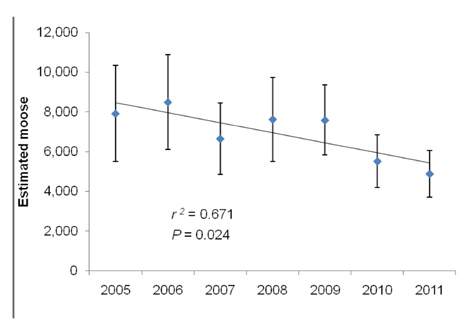
Figure 2. Point estimates, 90% confidence intervals, and trend line of estimated moose numbers in northeastern Minnesota, 2005-2011.
and the cow/calf ratio has dropped to below 10%.
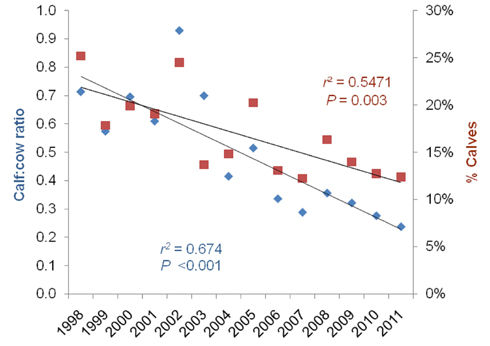
Figure 3. Estimated calf:cow ratio and % calves from aerial moose surveys in northeastern Minnesota.
As a rule of thumb, cow/calf ratios must be above 20% to maintain population levels. The current ratio portends continued moose decline. Indeed, the report states, “Estimated recruitment from this year’s survey was at an all time low.”
Surprisingly, the Moose Advisory Committee (MAC) report makes absolutely no mention of wolves or other predators. None, zip, zero, nada. This despite the fact that there are now over 3,500 wolves in Minnesota [here], ten times the population in 1974.
Restoring Rural American Rights and Prosperity
by Jim Beers
As this is being written:
* Union rioters are seizing State Capitol buildings in Wisconsin, Indiana, and Ohio.
* State legislators are fleeing their states to avoid the wrath of their Union supporters.
* Chronic national unemployment is on everyone’s mind.
* National and State debts threaten to bankrupt and even destroy government.
* National and State Budgets cause hostility everywhere as calls for comity abound.
* Budget Cuts v. Tax Increases reflect the deep political division emerging everywhere.
* Unfunded entitlements from government pensions to social and medical promises loom.
* Housing prices and construction are in the worst shape since the 1930’s.
* Banks, loans, business futures, insurance costs, and federal funds are all questionable.
* Middle East and African governments are falling with unknowable future rulers.
* Oil and energy prices are exploding as federal policies are unclear and threatening.
Additionally, Rural America is depressed and reeling from ±40 years of federal government policies that treat federal lands as distinct from the states and local communities wherein they are located (i.e. Wilderness Declarations, Road Closures, abandonment of renewable natural resource management and use, revenue-generating and revenue-sharing management practices from grazing and timber management to wildlife uses, “Travel Management” Plans, Permits requirements, etc.); from the effects of steadily expanded and unconstitutional federal powers under the Endangered Species Act (ESA); from Taking Without Compensation and disregard for both state authorities and private property; from administrative takeover of state agencies and changing the ESA from “saving species” to selectively restoring species anywhere at will and even mortally endangering human safety with “GI” (Government Introduced) wolves; and an arrogant disregard for those affected.
more »
Wolves in Oregon
by Senator Doug Whitsett (Klamath Falls, District 28), Feb. 18, 2011 [here]
Russian news media is reporting the extreme end-game that results from the introduction and failure to control timber wolves. They report that a Siberian town of 1,400 people has been terrorized for the past three weeks by a pack of 400 wolves. Residents are describing the siege as an “animal apocalypse”. In the Verkhoyansk region, “everyone who can hold a rifle is mobilized to fight wolves”.
Starting February 18, 2011, authorities in Slettas, Norway are currently providing free transportation for school children who live more than 800 yards from their bus stop in order to protect them from wolves. Their representative in Parliament said “it has gone too far when we have to drive children to school for fear they will meet a wolf pack on the road”.
An experimental population of Canadian Gray Wolves was introduced into Montana’s Yellowstone Park in 1995. They were subsequently listed as endangered species, functionally preventing their unrestricted reproduction and migration.
During the past 15 years, they have reproduced and migrated to populate Montana, Wyoming, Idaho and parts of Utah with several thousand of these vicious, imported predators. In those states they have decimated the elk, deer and moose populations as well as causing extensive mortality and other related losses to their livestock industry.
Most recently the Canadian Gray Wolves have migrated into northeastern Oregon.
Last Tuesday an Enterprise cattle rancher found two of his cows that had been killed by wolves in the most cruel way imaginable. The wolves had dragged the heavily pregnant cows down by their hamstrings without inflicting a killing bite wound. These sadistic creatures had then proceeded to eat the still living cows from behind, ripping their live calves from their reproductive tract, and partially consuming the still living fetuses. Wildlife Services, U. S. Fish and Wildlife Services and the Oregon Department of Fish and Wildlife have all confirmed that the cows and their calves were killed by wolves.
The interaction with wolves began in Oregon starting back in March of 2010. Agencies have confirmed at least 11 cattle kills in Oregon. Another 23 calves and 9 cows are missing and presumed lost to predation. It is difficult to document livestock killed by wolves on rangeland because these cattle are often not seen by their owners for weeks at a time. If the remains are found the evidence required to confirm a wolf kill is usually long gone.
more »
Debt for Nature — Financing American Endangered Species on Foreign Soil
by Karen Budd-Falen, Karen Budd-Falen Law Offices LLC, Cheyenne WY [here]
See also: Western Legacy Alliance [here]
Let me see if I have gotten this straight:
1. President Obama has stated that America is going to be more restrained in foreign internal affairs.
2. Yet the U.S. federal government has listed 568 foreign species on the Endangered Species Act (“ESA”). These are species who never set one paw or foot or leg on American soil, ever.
3. And once listed, the ESA authorizes the U.S. Treasury to spend American taxpayer money acquiring foreign land, water and other property interests to “protect” these species.
4. As one way for America to spend money on foreign property, Congress and the federal bureaucracy have also authorized several “Debt for Nature swaps” which allow the U.S. Treasury to forgive (“trade”) foreign debt or loans made by the American taxpayers to foreign countries with the hope that the foreign country will stop property use and development to protect species on the American endangered species list.
5. Some of these Debt for Nature swaps include non-governmental organizations like The Nature Conservancy or World Wildlife Fund buying the foreign debt to the U.S. for “pennies on the dollar.”
There are several types of Debt for Nature programs which are being used to exert the opinions of a small group of radical environmentalists that “nature is more important than people.” Debt for Nature was modeled after a program started in the early 1990s called Enterprise for the Americas Initiative (“EIA”). Under that program, the U.S. restructured, and in one case sold, debt owed to the American taxpayers by Latin American countries equivalent to a face value of nearly $1 billion. Basically the U.S. Treasury forgave or restructured monetary debt owed to American taxpayers for the Latin American country’s adoption of certain social and property use goals related to environmental, natural resources, health protection, and child development projects.
An official governmental “Debt for Nature” bill was passed by Congress in 1998 called the Tropical Forest Conservation Act (“TFCA”). Since passage of the TFCA, although the reports are somewhat conflicting, at least $128.4 million has been used to fund 15 separate transactions which allegedly “conserve” tropical forests within 13 debtor foreign countries.
MT Governor Notifies Interior of New Wolf Management Directives
News Release, governor.mt.gov, 2/16/2011 [here]
(HELENA) – Governor Brian Schweitzer today sent a letter to Department of Interior Secretary Ken Salazar notifying Interior of new directives regarding wolf management in Montana. Text of the letter below (and attached):
February 16, 2011
To: The Honorable Ken Salazar
Secretary
U.S. Department of the Interior
1849 C Street NW
Washington, D.C. 20240
Dear Secretary Salazar:
I write to you today regarding wolf management in Montana.
While almost everyone acknowledges that the Northern Rocky Mountain gray wolf population is fully recovered, as the Governor of Montana I am profoundly frustrated by the lack of any actual results that recognize Montana’s rights and responsibilities to manage its wildlife. Montana has for years done everything that has been asked: adopting a model wolf management plan; enacting enabling legislation; and adopting the necessary implementing rules. Our exemplary efforts have been ignored. I cannot continue to ignore the crying need for workable wolf management while Montana waits, and waits, and waits. Therefore, I am now going to take additional necessary steps to protect the interests of Montana’s livestock producers and hunters to the extent that I can within my authorities as governor.
First, for Montana’s northwest endangered wolves (north of Interstate 90), any livestock producers who kill or harass a wolf attacking their livestock will not be prosecuted by Montana game wardens. Montana Department of Fish, Wildlife, and Parks (FWP) wardens will be directed to exercise their prosecutorial discretion by not investigating or citing anyone protecting their livestock.
Further, I am directing FWP to respond to any livestock depredation by removing whole packs that kill livestock, wherever this may occur.
Still further, to protect the elk herds in Montana’s Bitterroot Valley that have been most adversely affected by wolf predation, I am directing FWP, to the extent allowed by the Endangered Species Act, to cull these wolves by whole-pack removal to enable elk herds to recover.
At this point, I can do nothing less and still maintain my commitment as Governor to uphold the rights of our citizens to protect their property and to continue to enjoy Montana’s cherished wildlife heritage and traditions.
Sincerely,
Brian Schweitzer
GOVERNOR, State of Montana
pdf is [here]
Wolfish Judicial Games
by Mike Dubrasich, Exec Dir W.I.S.E.
The latest twist in the judicial wolf saga [here] is complicated and merits some discussion of the history vis the courts and wolves. We offer a partial history as follows:
On Aug. 7, 2008 US District Court Judge Donald W. Molloy issued a wolf decision [here] that began with his usual flowery though unintelligible verbosity:
This case, like a cloud larger than a man’s hand, will hang over the northwest states of Montana, Idaho, and Wyoming until there has been a final determination of the complex issues presented.
In that case (CV 08-56-M-DWM) the Defenders of Wildlife et al. challenged the February 27, 2008 US Fish and Wildlife Service delisting of the northern Rocky Mountain gray wolf distinct population segment (DPS). The USFWS RM wolf DPS included all of Idaho, Montana, Wyoming, eastern Washington, eastern Oregon, and northern Utah.
Molloy reinstated (relisted) wolves as endangered because, as he reasoned, the USFWS had made “no plausible showing of genetic exchange” between wolves in Yellowstone and wolves in Montana and Idaho.
This was a strange finding, since the Canadian gray wolves in Montana and Idaho were direct descendants of the Canadian gray wolves the USFWS dumped in Yellowstone in 1995. They were the exact genetic strain. Was Molloy saying that brother and sister wolves were failing to mate, or first cousins, or what? It was difficult to decipher his irrational rationale, but he did mention “genetic exchange” no less than 67 times in that decision and concluded:
Absent genetic exchange, the wolf will not likely be able to withstand future environmental variability and stochastic events. 1994 EIS, App. 9. Plaintiffs therefore have demonstrated a possibility of irreparable harm.
The reaction to this nonsense was swift and loud, and more than a little bit derisive [here, here]. Obviously there was genetic exchange. The wolves were one big happy family. They not only interbred, they mongrelized with dogs, coyotes, and attempted to do so with whatever they came across that looked half way mate-worthy, successfully or not.
Wolverine Madness
The new “charismatic” predator of the month is the wolverine. Wolverine news is popping up all over. For instance:
Wolverine population threatened by climate change
NCAE & UCAR News, February 03, 2011 [here]
BOULDER—The aggressive wolverine may not be powerful enough to survive climate change in the contiguous United States, new research concludes.
Wolverine habitat in the northwestern United States is likely to warm dramatically if society continues to emit large amounts of greenhouse gases, according to new computer model simulations carried out at the National Center for Atmospheric Research (NCAR). The study found that climate change is likely to imperil the wolverine in two ways: reducing or eliminating the springtime snow cover that wolverines rely on to protect and shelter newborn kits, and increasing August temperatures well beyond what the species may be able to tolerate. …
Peacock’s research focused on mountainous regions of the Northwest, the primary habitat of the wolverine population in the contiguous United States. The study did not look into the impacts of climate change on regions where wolverines are more numerous, such as Canada, although other research has indicated those areas will likely warm significantly as well. …
The study was published last week in Environmental Research Letters. It was funded by the National Science Foundation, NCAR’s sponsor.
Note that “computer model simulations” are the source of this alarming news. In actual fact, winter temperatures in wolverine country have been trending downwards for the last 20 years at a rate of -.53°F per decade, and a whopping -5.24°F over the last 10 years.
NCDC Climate Services and Monitoring Division, Climate At A Glance [here]
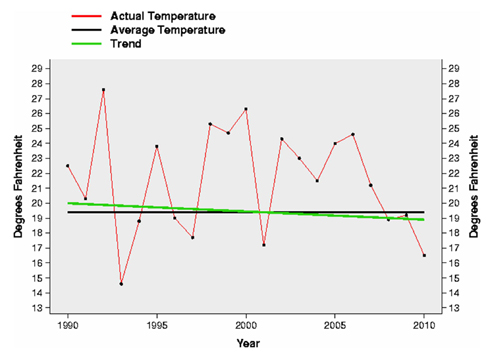
Winter (Dec-Feb) Temperatures, West North Central Region, Winter (Dec-Feb) 1990 - 2010 Trend = -0.53 degF / Decade
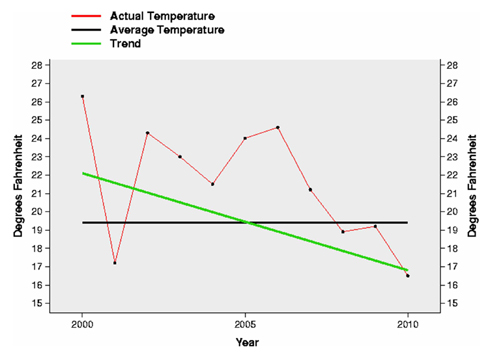
Winter (Dec-Feb) Temperatures, West North Central Region, Winter (Dec-Feb) 2000 - 2010 Trend = -5.24 degF / Decade
Evidently nobody told the computer making the simulations. The wolverine alarmists don’t care about the actual facts, however, and are content to spew insane tales of horror no matter what the facts are.
More government promulgated insanity: all citizen visits to the Sawtooth National Recreation Area are to be banned because of wolverines. Wildlife pseudo-biologists have determined that the mere presence of a human being causes wolverines to curl up and die.
The Boise, Payette, and Sawtooth National Forests are developing “Wildlife Conservation Strategies” that will eliminate recreational use of their “Recreation Areas” and wildernesses because of the fragile sensitivities of wolverines [here].
Note that all three Forests have deliberately and with malice aforethought promulgated megafires over the last five years. The fires have eliminated almost all recreational use across thousands of square miles, but not affected the wolverines in the slightest (evidently). A crown fire ripping through 100,000 acres is no great burden to wolverines, but the presence of human being on that same tract of land is fatal to them, according to the USFS and USFWS.
The hidden objective is to de-humanize vast tracts of public and private land, in accord with the Wilderness Project dreamed up and promulgated by Earth First!. The former radical underground eco-terrorist group is now mainstream and has taken over the US Forest Service.
The wolverine is not endangered. They are doing quite nicely in Canada, and the US population is growing. The fur trapping days are over. That’s what mainly caused wolverine population declines over the last 200 years. Not human sighting.
De-humanizing the West will not do anything for wolverines. Pseudoscience notwithstanding.
The radical anti-humanists are not retreating, however, despite their failure to get wolverines listed:
Wolverines denied federal protection
Given ‘candidate species’ designation
By Katherine Wutz, Idaho Mountain Express, Dec. 15, 2010 [here]
Even though wolverines are threatened with extinction [BS Alert - false statement by a journo-lista], they will not receive federal protection, the U.S. Fish and Wildlife Service announced Monday.
Wolverines will be listed as a “candidate species,” meaning that they are eligible for protection under the Endangered Species Act. However, the service said there are other, more high-priority species on the same list, and listing wolverines under federal protection will have to wait for now, though the species will undergo an annual review.
“There are reasons to be concerned about the long-term persistence of wolverines,” said Robin Garwood, a wildlife biologist with the Sawtooth National Recreation Area. “Even though wolverines won’t be protected by ESA for now, I think it highlights the importance of ensuring that remaining habitat, including habitat on the Sawtooth Forest, is kept as intact as possible.”
To the Sawtooth NF, “intact” means keeping the public out, with armed federal agents if necessary. You might disturb a wolverine, so you are forbidden to go upon federal land. You are requested, however, to pay the salaries of the federal agents like Mr. (or Ms.) Garwood, or else go to jail. That’s how the System works.
It’s not your land, it’s not my land. The land belongs to the Government and that means not you and not me. Only certified federal agents and eco-terrorists are allowed. Exclusion of the public is necessary to “save” the non-endangered wolverines.
Grizzly Bear Cognitive Dissonance
For decades the US Fish and Wildlife Service and state fish and game departments have promoted grizzly bear worship. Now they seem to be sliding into apostasy.
The allegedly “iconic and charismatic” predators have been placed on the high altar of the Endangered Species Act, even though they are in no way, shape, or form endangered. Anti-human rights groups have used grizzlies to scam hundreds of $millions out of little old ladies burdened with liberal guilt, and the agencies have milked that cow for all it’s worth.
The latest insult to intelligence was Judge Molloy’s refusal to delist grizzly bears because of global warming! That’s right sports fans, da judge said that gloooobal waaaaarrming is gonna kill off da bears, and so they must remain sacrosanct wards of the State [here].
The judge based his decision on the junk pseudoscience that spews from our wonderful wildlife agencies, the same folks who drug grizzlies and them leave them to wake up grouchy in your back yard [here]. If you get attacked, killed, and eaten, it’s your fault.
There is no accounting or audit of what the taxpayers have forked out for decades so that gummit employees can live like kings while spewing junk science and pagan grizzly bear worship, and packing your neighborhood with 1,000 pound man-eaters. Just another public service from a government that’s here to help. And as usual with helpful gummit services, money is no object.
Despite the fact that grizzlies kill elk as well as humans, sportsman groups are far more concerned about wolves, and Rocky Mountain gray wolves in particular. As we reported [here], a move is afoot to delist wolves by Congressional action. The rest of the ESA atrocities (bears, owls, smelt, etc.) will have to wait for some other time.
The assumption is that US Congress will possibly (doubtful) do something about wolves, but are too anti-human liberal to fix the ESA, an Act that was promulgated by the UN during the Vietnam War and is perhaps the most anti-American un-Constitutional law in existence.
Gaia forbid we should sully the altar of pagan iconic animals that kill citizens in their back yards. When the Founding Fathers came up with the nutty notion that human rights are unalienable, they were smoking crack.
To be fair, more than fair, some government employee wildlife biologists are now questioning whether grizzly bears should be allowed to multiply like rabbits and freely roam the countryside in Fly-Over Land. They don’t question their own junk pseudoscience, and are still fully invested in numerous hoaxes like glooooobal waaaarming, but they are toying with the idea that wildlife management might be preferable to wildlife worship.
Grizzly bears moving out of core habitats, changing management message
By ROB CHANEY, the Missoulian, January 22, 2011 [here]
If we care about keeping grizzly bears alive, perhaps we should worry less about how they die.
The idea won a serious listen at last week’s Interagency Grizzly Bear Committee work session in Missoula. Since 1983, when the group of state and federal bear managers started meeting, grizzly survival has been the top job. Now science and public opinion may be heading in a new direction.
“We need to rethink our grizzly messages for the Greater Yellowstone area,” Steve Schmidt of the Idaho Fish and Game Department told the committee. “This population is recovered. We are now transitioning into management. Some bears are gonna die. That is a natural consequence of bears expanding their distribution.”
Schmidt chairs the IGBC’s Yellowstone grizzly committee, which oversees bear recovery in one of the two largest bear habitats in the continental United States. Between 2004 and 2008, grizzlies have stretched their active range around Yellowstone National Park by 34 percent. And most of their conflicts with livestock, hunters and cars are now taking place on the developed fringes of that range.
“The bears in the Yellowstone area are filling up their logical habitat,” Schmidt said. “We also believe as a committee that bears have met or exceeded their social carrying capacity. The public appetite for further expanding this bear population is very small. And the political appetite is nil.”
Scott Talbot of the Wyoming Game and Fish Department agreed.
“Last year we moved 65 bears,” Talbot said. “Our average is 28. And we are seeing a significant increase of bears outside socially acceptable areas. There used to be large amount of public support for bears. Now we’re seeing a big decline, plus growing legislative interest. That’s very concerning to us.”
Montana’s Legislature has already put forward five bills aimed at bear management, compared to just one so far on wolves. ..
“The public views these as ‘federal bears,’” Schmidt said. “They have no ownership of these bears because they’re still listed. Without state management and a chance to participate in how they’re managed, and the opportunity to harvest once in a while, they will oppose all the conservation efforts we’ve worked on so hard in the past.”
“We’ve gone from 200 bears (in the Greater Yellowstone Ecosystem) in 1983 to over 600 today,” Schmidt said. “We need to focus on the health of this population and less on the bears that need to be removed. Bears on the fringe aren’t essential to the health of the population. We need to start communicating that idea now.”
Hold the presses, the message is changing, maybe. Yes sports fans, the old propaganda is going to be replaced by new propaganda, possibly, or possibly not. So be prepared to undergo cognitive dissonance yet again. Or possibly not. Big Brother is confused.
Meanwhile, when you go shopping, or work in your garden, or when the kids are waiting for the school bus to ferry them to our valued government Indoctrination Centers, carry a gun. A big gun. One capable of killing a grizzly bear. Or a wolf.
Unless, of course, Big Brother has seized your guns, in which case huddle in the cold and dark and wait for your opportunity to serve the State by becoming bear chow.
Molloy Strikes Again
District Court Judge Donald Molloy has ordered parties to the gray wolf delisting/relisting lawsuit [here] to show cause why the case should not be dismissed due to the absence of a population meeting the statutory requirements for 10(j) status.
Judge’s ruling could threaten state’s ability to kill wolves
Lewiston Tribune, January 28, 2011 [here]
A federal judge in Montana is asking parties to a lawsuit over gray wolves if the animals should lose their experimental, nonessential designation and revert to a fully endangered or threatened designation.
Such a move could torpedo Idaho’s request to kill wolves in the Lolo Zone.
The order, issued this afternoon by District Court Judge Donald Molloy of Missoula, Mont., stems from a lawsuit filed in 2008 by environmental groups over new rules issued by the U.S. Fish and Wildlife Service making it easier for states to kill wolves for the purpose of protecting deer, elk and moose herds. States like Idaho can petition the federal wildlife agency for permission to kill wolves if they are found to be harming wild ungulate herds. The petitions are allowed under the designation of wolves in Idaho and parts of Montana as an experimental nonessential population.
Wolves were reintroduced to the Northern Rockies in 1995 and 1996 under that designation, known as 10(j). To qualify as an experimental population, the wolves must be “wholly separate geographically from nonexperimental populations of the same species.”
Molloy said that was the case at the time of reintroduction. However, he wrote the federal government documented in another lawsuit that wolves in the Northern Rockies are now breeding with wolves from Canada and a portion of Montana where they are not designated as an experimental population.
Molloy issued an eight-page order to show cause asking parties to the case to file briefs showing why the case “should not be dismissed as moot due to the absence of a population meeting the statutory requirements for 10(j) status.” … [more]
I disagree with the interpretation of the Lewiston Tribune. Elimination of the 10(j) status will not necessarily do away with wolf hunts. It could have just the opposite effect. Let me explain.
Recall that in 2008 Molloy ordered wolves relisted because, in his view, there was insufficient evidence that RM wolves were genetically connected [here]. He was wrong in his science. Wolves can travel thousands of miles and breed like rabbits when they get there. There was and is ample evidence of genetic connectivity.
Last year Molloy admitted his error, sort of [here, here]. The machinations are too many to list, but wolves have been delisted and relisted like yo-yos since 2002. Suffice it to say that last August Molloy relisted wolves for the third or fourth time on the grounds that “the Endangered Species Act does not allow the U.S. Fish & Wildlife Service to list only part of a ’species’ as endangered, or to protect a listed distinct population segment only in part…”.
The implication was that Molloy finally recognized that all Rocky Mountain wolves were indeed genetically connected and one population. The USFWS could not, Molloy ruled, delist woves in Idaho and Montana but not in Wyoming. They couldn’t carve off a “distinct population segment” based on state lines.
His ruling hinged on the way the USFWS subdivided the wolf population into DPS’s — illogical, unscientific, and political chicanery that the USFWS has indulged in with many species.
Molloy relisted the wolves because the USFWS was still claiming that some portion of their population was endangered. The USFWS didn’t like Wyoming’s wolf management plan, but they approved Idaho’s and Montana’s. The USFWS delisted wolves in the latter two states, declaring those wolves to be 10(j) experimental, nonessential populations, but retained full endangered status for Wyoming wolves.
No can do, said Molloy.
If Rocky Mountain wolves are genetically connected, then there are no distinct populations that are “wholly separate geographically”. Wolves in Wyoming, Oregon, Montana, and elsewhere are all one population. Either that population is endangered in its entirety, or it isn’t, in its entirety.
Last week Molloy ordered the parties to brief him on all that. When he gets their briefs, he will rule yet again.
Molloy could rule that Rocky Mountain wolves are endangered throughout their range, or that they are not endangered throughout their range. We don’t know how he will rule.
But the scientific evidence is strong that wolves are not endangered, and are in fact breeding like rabbits and expanding their population as much as 25% per year. They have spread out from the original infection center in Yellowstone NP (where Canadian gray wolves were illegally dumped by the USFWS in 1995) across five states.
The offspring of those wolves have decimated elk, deer, and moose populations, killed livestock and pets, and threatened people hundreds and even thousands of miles away from Yellowstone.
If Molloy applies the best available science, then he must rule that Rocky Mountain wolves are not endangered. Whether he will or not remains to be seen.
It is easy to point the finger at Molloy. He has relisted wolves again and again. The direct result has been the tragic destruction of game herds, livestock depredation, etc. But the finger should also be pointed at the USFWS, which engendered this crisis through illegal actions during the Clinton Administration. The USFWS is a political hornets nest, and their science has been (and still is) atrociously bad. And if we are placing blame, it all rests on Congress for creating a horrible law (the ESA) and failing to repeal or revise it for nearly 40 years.
Bill Introduced in U.S. House to Delist the Gray Wolf
by Ryan Benson, Big Game Forever [here]
The House announced the introduction of new national wolf delisting legislation today. The bill is attached and included below. The original cosponsors of the legislation this year are: Jim Matheson (D-UT), Cynthia Lummis (R-WY), Mike Ross (D-AR), Rob Bishop (R-UT), Leonard Boswell (D-IA), Dan Boren (D-OK), Paul Broun (R-GA), Dennis Cardoza (D-CA), Jason Chaffetz (R-UT), Dean Heller (R-NV), John Kline (R-MN), Raul Labrador (R-ID), Mike Simpson (R-ID), Greg Walden (R-OR) and Don Young (R-AK). We have commitments from several other co-sponsors that appear to not be listed primarily due to timing issues. Thank you to each of these 15 cosponsors from 12 states for their willingness to work on a bipartisan basis.
Thanks to everyone who has been working so hard to make return of wolf populations to state wildlife managers a reality. The list of wildlife groups who have officially endorsed national wolf delisting continues to grow. I would encourage all of us to reach out personally to these Congressman and thank them for getting in the fight for responsible wildlife management.
You will notice that the language is a bit different from 2010. The effect is largely the same as both HR 6028 and S.3919. We anticipate that the Senate will introduce a similar bill early next week. We don’t have a final list of cosponsors, but here are the Senate cosponsors from last year. Risch (Idaho), Crapo (Idaho), Barrasso (Wyoming), Enzi (Wyoming), Hatch (Utah), McCain (Arizona). We expect Lee (Utah) will join the bill as well. We are also in conversations with a number of other potential cosponsors but have not seen any final lists.
We have seen the politics of divisiveness used to pit sportsmen against sportsmen, multiple use group against multiple use group, state against state, and party against party in the past. I strongly urge us all to recognize that we must avoid politics, stick together and avoid all efforts from wolf delisting opponents to divide and conquer.
Administrative attempts to delist have been and will continue to be blocked due to numerous lawsuits to use federal laws to block any wolf management. Returning balance to our ecosystems and our wildlife populations simply cannot wait any longer. We strongly feel that Congressional wolf delisting, pursuant to agreements with the Federal Government and wolf advocates, is the right course to protect our rights to manage wildlife responsibly.
Working together as a nation of united sportsmen to support our friends in Congress we can be successful in this important endeavor.
*****
112TH CONGRESS
1ST SESSION H. R. ____
To amend the Endangered Species Act of 1973 to provide that Act shall not apply to the gray wolf (canis lupus).
IN THE HOUSE OF REPRESENTATIVES, Mr. REHBERG introduced the following bill; which was referred to the Committee on _____________
A BILL
To amend the Endangered Species Act of 1973 to provide that Act shall not apply to the gray wolf (canis lupus).
Be it enacted by the Senate and House of Representatives of the United States of America in Congress assembled,
SECTION 1. EXEMPTION OF GRAY WOLF FROM ENDANGERED SPECIES ACT OF 1973.
Section 4 of the Endangered Species Act of 1973 (16 6 U.S.C. 1533) is amended by adding at the end the following:
“(j) EXEMPTION OF GRAY WOLF.—This Act shall not apply to the gray wolf (canis lupus).”
Endangered Specious Homo sapiens Third World wildlife and people Wildlife Agencies
by admin
1 comment
Foreign and Domestic Train Wreck in the Making - More of the ESA
by Karen Budd-Falen, Karen Budd-Falen Law Offices LLC, Cheyenne WY [here]
See also: Western Legacy Alliance [here]
As the New Year opens, the use and abuse of the Endangered Species Act (“ESA”) continues to provide a significant hardship to private property, private rights, and land use both within this country and even in countries of which most people have probably never heard. Despite President Obama’s proclamation that “America will play a more restrained role on the international stage,” the U.S. Fish and Wildlife Service (“FWS”) does not seem to be restraining from listing species as threatened or endangered, despite the fact that many species on the American list have NEVER traveled to American soil. In fact, by January 3, 2011, the FWS had listed 568 foreign species on the American threatened or endangered species list. These species are from places like China, Mongolia, Kyrgyzstan, Pakistan, Afghanistan, India, Palau, and of course Canada and Mexico. The latest additions were seven birds from Brazil on December 28, 2010.
There are a lot of alleged reasons given that the U.S. should be spending American tax dollars to research, study and list foreign species under the ESA. One of the biggest reasons, so they say, is so that America can stop foreign import of endangered and threatened species. I thought that was fair until I did some simple research online and found out that you can buy some of these listed threatened and endangered species on E-bay. Does any one want to buy a Goliath Frog, from West Africa? It was going for $150.00 on E-bay on January 20, 2011, despite the fact it was listed on the American ESA list in 1994.
The more shocking research however is that once a foreign species is listed on the U.S. threatened or endangered species list, the ESA gives the American government the authority to buy “land or water or interests therein” in foreign countries. In other words, the ESA gives the U.S. government authority, with the consent of the foreign government, to use foreign currency to buy foreign land in the name of the United States. With the current budget and deficit drowning American workers, why is the U.S. government even thinking of buying foreign land and water? And once we do buy it, who manages it and what does that cost the American taxpayer?
If America is playing a more restrained role internationally, the FWS does not seem to agree. In relation to the December 28, 2010 foreign species ESA listing, the FWS press release states:
All seven species face immediate and significant threats primarily from the threatened destruction and modification of their habitats from conversion of agricultural fields (e.g., soybeans, sugarcane, and corn), plantations (e.g., eucalyptus, pine, coffee, cocoa, rubber, and bananas), livestock pastures, centers of human habitation, and industrial developments (e.g., charcoal production, steel plants, and hydropower reservoirs).
Although there is limited information on the specific nature of potential impacts from climate change to the species included in this final rule, we [FWS] are concerned about projected climate change, particularly the effect of rising temperatures in combination with the potential loss of genetic diversity, and population isolation; and cumulative effects including El Niño events. Furthermore, we have determined that the inadequacy of existing regulatory mechanisms is a contributory risk factor that endangers each of these species’ continued existence.
So America is dictating what property in foreign countries can be used for and American businesses have to wait for the completion of ESA section 7 consultation based on “climate change” for birds in Brazil?
Wolf Forum at Upcoming SRM Meet
The Society for Range Management will host its 64th Annual Meeting in Billings, MT February 6-10, 2011 [here].
Of particular interest is the Wolves on the Landscape session on Thursday, Feb 10th. Lectures include:
8:00 am Predicting Wolf (Canis lupus)- Cattle (Bos taurus) Encounters and Consequential Effects on Cattle Resource Selection Patterns by Patrick Clark1, D. Joseph Chigbrow2, Kelly Crane2, John Williams3, Larry Larson4, Douglas Johnson5; 1USDA Agricultural Research Service, Boise, ID, United States, 2University of Idaho, Moscow, ID, United States, 3Oregon State University, Enterprise, OR, United States, 4Oregon State University, La Grande, OR, United States, 5Oregon State University, Corvallis, OR, United States
8:30 am Wolf Diets and Depredation Patterns in Southwestern Alberta by Andrea Morehouse; University of Alberta, Edmonton, Alberta, Canada
9:00 am Wolf Reintroduction: A Montana Perspective by Jaala Wickman; Montana Sportsmen for Fish and Wildlife, Missoula, Montana, United States
9:30 am Alberta’s Wolf Report: Quantifying the Impacts by Callum Sears; Flying E Ranche, Stavely, Alberta, Canada
10:30 am Ranch-Level Economic Impacts of Predation in a Range Livestock System by Benjamin S. Rashford, Thomas Foulke, David T. Taylor; Department of Agriculture & Applied Economics, University of Wyoming, Laramie, Wyoming, United States
11:00 am Wolf Damage Management in Minnesota by John Hart; USDA-APHIS-Wildlife Services, Grand Rapids, Minnesota, United States
11:30 am Crossings, Corridors and Trophic Cascades: Wolves and Woody Vegetation in Banff National Park by Clifford A. White; Scientist Emeritus, Parks Canada, Banff, Alberta, Canada
1:00 pm Wolf Management in Alberta, Canada by Mark Boyce; University of Alberta, Edmonton, Alberta, Canada
1:30 pm The Rise and Fall of Western USA’s Great Elk Herds by David Allen; Rocky Mountain Elk Foundation, Montana, USA
2:00 pm Wolves & The Natural Law by Jim Beer, Eagan, Minnesota, USA
2:30 pm Wolf Recovery: An Independent Analysis by Charles E. Kay; Utah State University, Logan, Utah, United States
3:00-4:00 pm Panel Discussion, Chaired by Kevin France, Sustainable Resource Development, Alberta Govt, Lethbridge, Alberta
Also of interest to students of anthropogenic fire are two lectures in The Role of Fire in Sustainable Rangeland Ecosystems session:
8:20 am “Burn early, burn often” - Contrasting Aboriginal Versus Modern North American Fire Management Regimes by Cliff White; Parks Canada, Banff, Alberta, Canada
8:40 am Aboriginal Burning and Keystone Predation: A New Paradigm for Range Management by Charles Kay; Utah State University, Logan, UT, USA
Endangered Specious Homo sapiens Third World wildlife and people Wildlife Agencies
by admin
leave a comment
Who Are the Real Predators?
Note: The following is excerpted from “It’s Time for Elected Officials to Take the Blinders Off and Admit Their State F&G’s Real Agenda”, the lead article in The Outdoorsman, Bulletin Number 41, Sept-Dec 2010. The entire issue is [here]. Back issues are available at Idaho For Wildlife [here].
By George Dovel
States’ F&G Lobbyist, IAFWA, Abandons Hunters
State F&G Directors in both Wyoming and Idaho insisted “the public” wanted them to provide opportunities to enjoy watching species that were not harvested by hunters and fishermen – but that was not the truth. The truth is, in 1990 the International Association of Fish and Wildlife Agencies (IAFWA) in Washington, D.C. hired bird watcher Naomi Edelson to run nongame programs in the 50 States and changed its #1 priority from providing wild game and fish for hunters and fishermen to harvest, to promoting non-consumptive wildlife recreation.
Twenty or even 10 years ago, anyone who dared to tell the truth about this was branded a “conspiracy theorist” or an “alarmist” by our state wildlife managers. Nearly two years ago, after I had carefully documented the step-by-step process in several Outdoorsman issues, Idaho F&G Commissioner Tony McDermott admitted they did what AFWA (formerly IAFWA) told them to but said even if my claims were true I couldn’t do anything about it.
My Challenge to Elected Officials
If you are one of several hundred elected officials in several states who receive this publication, you have internet access. I challenge you to take five minutes and “get it straight from the horse’s mouth” [here]:
The paper titled, “Finding Our Wings: The Payoff of a Decade of Determination” was written by Edelson and presented to a national convention of bird watchers in 2003. It is also Forest Service General Technical Report PSW-GTR-191 dated 2005, and spells out how the IAFWA priority was changed and how millions of dollars have been diverted by Congress from perpetuating game and fish harvests to promoting the nongame agenda beginning in 2001 with what is called “State Wildlife Grants”. …
The next step in the state F&G Agencies’ alien agenda, dictated by the IAFWA and the powerful Nature Conservancy (TNC), was to use sportsmen’s license money to help “Teaming With Wildlife” lobby for passage of CARA (the Conservation and Reinvestment Act). Passage of this Act would have provided a billion dollars from offshore oil drilling fees to support the non-consumptive agenda, and would have given wildlife managers authority to implement the radical UN Convention on Biodiversity (”Wildlands”) that was never ratified by Congress.
It would also have bypassed the legislative and judicial branches of both our state and federal governments and allowed both state and federal wildlife bureaucrats to condemn and acquire $450 million worth of private property each every year. With its massive federal “pork” money for every state, the 2000 version of CARA easily passed the House and was approved by the Senate Committee on Energy and Natural Resources 13-7.
But thanks to private property rights advocates and Western senators who continued to oppose CARA, it was never sent to the floor for a vote by the full Senate. President Clinton strongly supported the UN Wildlands Agenda, so the Teaming With Wildlife (TWW) activists were desperate to get something passed implementing that agenda while Clinton was still in office.