Endangered Specious Homo sapiens Jackalopes Wildlife Agencies Wolves
by admin
leave a comment
Otter Signs Wolf Disaster Bill
Begrudgingly, Promises NOT to Abide By It
Idaho Gov. Butch Otter yesterday signed the Wolf Disaster Bill [here, here, here, here]. (Note: we previously reported that he signed it last week, which was incorrect and we redacted that mistaken report. Now we are convinced Otter has actually signed the bill, based on numerous sources).
The full text of the Bill (now law) is [here].
Gov. Otter penned a letter [here] to Idaho Sec. State Ben Ysura explaining his reasoning.
Otter claimed in his letter that Idaho citizens do not need him to declare any “state of disaster” before they are legally allowed to protect themselves and their properties from wolves. As we all know, that is false. Massive depredations of livestock and pets have occurred in Idaho while armed state troopers stand idly by, in fact threatening the victims of wolf attacks with arrest and prosecution if they attempt to defend themselves from wolves.
Otter claimed that the phony Simpson-Tester-Baucus budget wolf rider [here] will solve all the wolf problems. That is also patently false.
Otter also expressed concern that the Legislature’s declaration of a disaster usurps his “right” as governor to do all the disaster declaring in Idaho. But then, Otter didn’t do his job and has failed to declare any wolf disaster to date.
Otter concludes his letter by stating that “portions of the bill may prove useful in the future, if state management is revoked and the wolf is relisted in the future”.
Hello, Governor. The Idaho Dept. of Fish and Game has NEVER managed wolves in Idaho, has repeatedly violated the 2002 Wolf Plan approved by the Legislature, and has worked hand-in-glove with the USFWS to promulgate wolves and destroy elk, deer, and moose populations. Nor have wolves ever been “delisted” successfully, nor will the Simpson-Tester-Baucus rider delist them.
But at least Otter signed the Disaster Bill. He will not enforce it, though, so what’s the point?
Budget Wolf Rider a Farce
The budget wolf rider which is getting ample hysteria in the always-hysterical MSM (here, for instance) is actually a farce.
The rider [here] was proposed by Sen. Jon Tester (D-Mont.), Sen. Max Baucus (D-Mont.), and Rep. Mike Simpson (R-Idaho). It has been attached to the (eighth) emergency budget agreement necessary to fund the government for the rest of the fiscal year (because the Democrat-majority Congress last year failed to pass a budget for 2011). The emergency spending bill is expected to be approved this week.
The rider is a fake, a fraud, and will not accomplish what the sponsors claim. The rider allegedly reinstates the 2009 USFWS partial delisting of wolves (only in Idaho and Montana) that was thrown out by Judge Donald Molloy [here].
The USFWS’ 2009 partial delisting was fraught with multiple Catch-22’s. It set new, higher lower limits for the wolf population. It divided wolf populations along state lines. It forced impossible restrictions on all states. It was based on faulty science. Judge Molloy was right to throw it out.
The budget wolf rider not only reinstates a defective delisting, it is based on language that forbids the Judiciary from review of the new law. That is unconstitutional. The Legislative and Executive Branches do not tell the Judicial Branch what laws they may or may not review. Not under our Constitution. Congress has tried that trick before, and the judges laugh at them for it. It’s a challenge to the judges, one they jump at. It will not take “unparalleled legal maneuvering” to get a judge, any Federal judge, to throw it out.
The enviro-litigious groups are not scared; they are enthused about it. Don’t be fooled by their PR rhetoric. They are not known for their honesty. They create false crises to attract donations. The budget wolf rider is a false crisis.
Already the USFWS is ratcheting up the minimum wolf numbers. They are about to be given carte blanche to do so. They are now shielded from Congress, although not from Federal judges. Let’s not forget that USFWS caused the wolf crisis in the first place.
Yesterday the USFWS declared Great Lake wolves to be a different species. The more species there are, the fewer individuals in each, and therefore they are all more “endangered” than they were day before yesterday. Many of us tried to warn against exactly that outcome. It’s not scientific. There is only one species of wolf. But the USFWS doesn’t care about valid science. They care about money, and all their money comes via one of the worst laws ever enacted in this country, the ESA.
Congress had another bill in the hopper, HR509 [here]. It would have simply declared all wolves to be not endangered. It was simple and direct. It had equivalency to the ESA. It did not need a special “no review” clause. In effect, it modified the ESA, and since Congress created the ESA in the first place, that modification was eminently constitutional. HR509 was supported by a majority of state delegations. The budget wolf rider effectively kills HR509.
Note that the new budget wolf rider does not modify the ESA. It modifies a court ruling, and attempts (ineffectually) to modify the U.S. Constitution by limiting the powers of the Judiciary. Note that Sen. Tester is very clear on that point [here]:
“We didn’t amend the Endangered Species Act,” Tester said in an interview with E&E Daily.
Congress could (and should) amend or rescind the ESA. The ESA is the source of a host of problems. It is a weapon used to wage war on the West. It does not “save species”. It does, however, cause untold suffering, hardships, and violations of human rights.
I understand that many feel the budget wolf rider is a “victory” for rational wildlife management. I disagree. It is a setback.
A “wolf hunt” will not control the wolf population. They breed faster than sport hunters can reduce them. The wolf population will continue to grow, and prey populations will continue to shrink.
Wolf populations need to be controlled with effective predator control methods. That means comprehensive hunts, trapping, and probably poisoning as well. If comprehensive methods are not employed, wolf numbers will continue to grow. The real solution is to rescind or modify the ESA so that species which are not actually endangered of going extinct do not get special protections.
Tester, Baucus, and Simpson jury-rigged the law. Their budget wolf rider is a farce. It is a slap in the face to folks who demand responsible wildlife management. I hope the Tea Party takes notice. We do not want any more backstabbing from liberals and RINO’s. Congress has failed on this issue. We need to throw the frauds and failures out next election.
Molloy Rejects Suckling Wolf Fraud Deal
District Court Judge Donald Molloy has rejected the fraudulent “compromise agreement” [here] proposed by Kieran Suckling of the Center for Biological Diversity.
Judge blocks deal on protections for wolves
By Keith Ridler, AP, April 10, 2011 [here]
BOISE, Idaho (AP) — A federal judge has blocked a proposal to lift the endangered species protections for wolves in Montana and Idaho that had been hammered out by U.S. wildlife officials and conservation groups. …
In the 24-page decision, U.S. District Judge Donald Molloy in Missoula, Mont., cited the court’s lack of authority to put part of an endangered species population under state management and expose that population to hunting, noting “Congress has clearly determined that animals on the ESA (Endangered Species Act) must be protected as such,” and the court couldn’t “exercise its discretion to allow what Congress forbids.”
He also said he couldn’t approve the settlement proposed in March because not all the parties involved in the case agreed with it. …
We will pursue the 24-page opinion/decision, and read it, and link to it after we corral it. If you have a copy, please forward it to us by email. Thank you.
Idaho Enacts Wolf Bill
Yesterday Idaho Governor Butch Otter signed the Idaho Wolf Disaster Bill [here].
Correction: As of Sunday afternoon, Otter has NOT yet signed the bill. Rumors that he had already were wrong, and I was wrong to rely on them. He is expected to sign the bill soon. I will report the signing when (and if) it occurs.
On Tuesday the bill passed the Idaho House by a vote of yes 64, no 5. On Wednesday the Senate approved on a 27-8 vote. Saturday, Gov. Otter signed it into law.
The full text of the Bill (now law) is [here].
The new Law directs the Governor to declare a “state of disaster” with regard to wolves, and to order actions to resolve the crisis, including wolf removal (specifically, the eradication of wolf packs) by the USDA-APHIS Wildlife Services and/or County Sheriffs.
The new Law also reasserts Idaho’s federally-approved 2002 Wolf Conservation and Management Plan (ILWOC 2002). That plan, drawn eight years after the USFWS illegally dumped Canadian gray wolves in Idaho, calls for retention of 15 breeding pairs (150 wolves).
There are currently between 800 and 1,500 wolves in Idaho [here].
Of interest is that the new Law designates the Governor´s Office of Species Conservation [here] as the primary implementer, rather than the Idaho Department of Fish & Game (IDFG).
The Idaho Legislature is fed up with the IDFG and no longer trusts that agency to do anything right, and with good cause [here, here, here].
The test now is whether the Feds and the courts will allow Idaho to exterminate wolves or will instead put up legal roadblocks. This issue is nowhere near resolution, but Idaho has made a significant step forward.
Idaho Wolf Disaster Bill To Be Considered
Next week the Idaho Legislature’s Senate Resources Committee will consider a “wolf disaster bill”. The bill declares an emergency and authorizes the Governor to direct state agencies and sheriffs to control gray wolves.
The full text of the draft Bill is [here]. It reads in part:
LEGISLATIVE FINDINGS AND INTENT.
(1) Section 1, Article I, of the constitution of the state of Idaho provides: “All men are by nature free and equal, and have certain inalienable rights, among which are enjoying and defending life and liberty; acquiring, possessing and protecting property; pursuing happiness and securing safety.” It is the duty and right of the legislature and the governor to protect the state, its citizens and property.
Section 36-103(a), Idaho Code, provides: “All wildlife, including all wild animals, wild birds, and fish, within the state of Idaho, is hereby declared to be the property of the state of Idaho.” The state of Idaho therefore has the responsibility to manage the big game animals of the state.
(2) The Idaho legislature finds and declares that the state’s citizens, businesses, hunting, tourism and agricultural industries, private property and wildlife, are immediately and continuously threatened and harmed by the sustained presence and growing population of Canadian gray wolves in the state of Idaho. The Idaho legislature, therefore, finds the population of gray wolves in Idaho, having been introduced into the state in 1995, over the united objection of the Idaho congressional delegation, Idaho legislature, Idaho governor, Idaho counties and numerous Idaho agricultural groups who were gravely concerned with the negative effects this action would impose on Idaho and Idahoans, is now many times exceeding the target number originally set by the federal government and the number set in Idaho’s federally-approved 2002 wolf management plan. The U.S. Fish and Wildlife Service (USFWS) has delisted the gray wolf in Idaho in 2008 and 2009 returning management to the state, only to be sued both times by environmental groups forcing the wolf to be relisted as endangered.
As a result of all the above, the legislature finds that public safety has been compromised, economic activity has been disrupted and private and public property continue to be imperiled. The uncontrolled proliferation of imported wolves on private land has produced a clear and present danger to humans, their pets and livestock, and has altered and hindered historical uses of private and public land, dramatically inhibiting previously safe activities such as walking, picnicking, biking, berry picking, hunting and fishing. The continued uncontrolled presence of gray wolves represents an unfunded mandate, a federal commandeering of both state and private citizen resources and a government taking that makes private property unusable for the quiet enjoyment of property owners.
An emergency existing therefore, it is the intent of the legislature to reg1ulate the presence Canadian gray wolves in Idaho in order to safeguard the public, wildlife, economy and private property against additional devastation to Idaho’s social culture, economy and natural resources, and to preserve the ability to benefit from private and public property within the state and experience the quiet enjoyment of such property. …
The draft Bill was carefully written to avoid challenges under the Supremacy Clause of the U.S. Constitution. Idaho attorney John L. Runft of Runft & Steele Law Offices in Boise writes:
In drafting this act, one objective was to avoid the claim that this bill was attempting to “nullify” a federal act (the ESA), thereby violating the Supremacy Clause (Art VI of the U .S. Constitution) aka “federal preemption”. The recitations and findings of fact were to demonstrate that this matter had transcended from a federal matter under the ESA and had become an emergency affecting the welfare of the citizens of the State of Idaho.
The express objectives of the wolf “reintroduction” under the ESA, enacted pursuant to the Commerce Clause (Art I, 8 of the U .S. Constitution), have long since been achieved. When mismanagement of a federal program creates a disaster emergency that remains unconstrained, the Commerce Clause and Supremacy Clause do not work to shelter the results of such federal mismanagement from action by a state to protect the welfare of its citizens. Article 1 Section 1 of the Idaho Constitution provides that the State of Idaho is “mandated” (pursuant to its “police powers”) to protect the rights of its citizens, among which are “enjoying and defending life and liberty; acquiring possessing and protecting property; pursuing happiness and securing safety.”
The preemption doctrine derives from the Supremacy Clause of the Constitution which states that the “Constitution and the laws of the United States… shall be the supreme law of the land… anything in the constitutions or laws of any State to the contrary notwithstanding.” This means that any federal law-even a regulation of a federal agency-trumps any conflicting state law. Federal “occupation of the field” occurs, according to the U.S. Supreme Court in Pennsylvania v Nelson, 350 U.S. 497 (1956), when there is “no room” left for state regulation. Courts are to look to the pervasiveness of the federal scheme of regulation, the federal interest at stake, and the danger of frustration of federal goals in making the determination as to whether a challenged state law can stand.
The police powers of a state (those inherent powers exercised by a state for the order and welfare of its citizens) are not automatically superseded by acts of Congress. From the standpoint of federal constitutional law, states have general police powers except where restricted by the federal Constitution. Because the Congress has limited powers granted in the Constitution, the Federal government does not have a general police power, as the states do. The exceptions are laws regarding Federal property and the military. On the other hand, Congress was granted by the New Deal Court a broad quasi-police authority from its power to regulate interstate commerce and raise and spend revenue.
Nevertheless, as stated by Justice Stevens in Levine v Wyeth, 555 U.S. ___ (2009), “We start with the assumption that the historic police powers of the States were not to be superseded by the Federal Act unless that was the clear and manifest purpose of Congress.” The U.S. Supreme Court ruled, 6 to 3, in Levine v Wyeth, 555 U.S. ___ (2009) that state juries may award damages for harm from unsafe drugs even though their manufacturers had satisfied federal regulators. (See also, Silkwood v Kerr-McGee, 464 U.S. 238, (1984) In Gonzales v Oregon, 546 U.S. 243 (2006) the Court considered whether Congress, in enacting the Controlled Substances Act, intended to pre-empt state laws such as that of Oregon’s which authorized physicians (under strictly controlled circumstances) to prescribe lethal doses of controlled drugs for terminally ill patients. The Court, ruling 5 to 4, held that the Act did not authorize pre-emption of Oregon’s Death with Dignity Act.
This proposed act does not intrude into federal management of wolves. In fact the act abjures management, and lists wolves as a “predator.” The proposed act focuses on the results of federal mismanagement. he measures taken by the state in this act are analogous to measures that might be taken to control a disease that was negligently released from federal experiments in a federal laboratory that was under federal control and management; and especially, as in this case, where the federal government has failed to control the outbreak.
The federal government has already repeatedly acknowledged that the objectives of the wolf “reintroduction” has been met and greatly exceeded. This proposed legislation is not in conflict with those objectives.
Inquiry under the Supremacy Clause begins with a presumption that the state law is valid. (Pacific Gas and Electric Co. v State Energy Resources Conservation and Development Commission, 461 U.S. 190, (1983)) The Pacific Gas case stands for the proposition that a state act will not be preempted if the federal and state interests and objectives are distinct. Here, the interests are clearly distinct and different. The federal law’s objectives are preservation of species (an objective achieved in this instance) and the state’s objectives are the protection of the rights and welfare of its citizens from the continuing federal mismanagement of the federal program. Moreover, the federal law and regulations relating to wolves contain no “police power” provisions for the protection of the state’s citizens or for the reimbursement to said citizens for property loss arising from said federal program. Therefore there is a personable presumption that there exists no conflict and no preemption.
Gray wolves are not endangered; they are rife. The USFWS recognizes that fact and has twice attempted to remove wolves from the endangered species list (under two different administrations). Federal judges, however, at the behest of eco-litigious lobby groups, have refused to allow the delisting on specious technical grounds.
Now the Idaho legislature hopes to assert its rights under the US Constitution to protect the health and safety of Idahoans. While the blood-thirsty, anti-human eco-lobby may protest, the US Constitution provides for states’ rights.
It is interesting to note that the legal foundation of the ESA rests on the Commerce Clause (Article I, 8 of the U .S. Constitution) which gives the federal government the privilege of regulating “interstate commerce”. Rabid, spree-killing wolves are not “commerce”, although they have crossed state lines in search of prey. The confounding of commerce with vermin movement is one of the ridiculous and hurtful abuses of language that our judges and legislators are famous for. Orwell called it “newspeak” — language that deliberately disguises, distorts, or reverses the meaning of words in order to violate and usurp fundamental human rights. The lying liars that lie lie for a reason: to do grievous harm to their fellow men.
Rehberg Doubts Wolf Settlement Will Solve the Problem
by Rep. Denny Rehberg (MT), 03/18/11 [here]
WASHINGTON, D.C. – Montana’s Congressman, Denny Rehberg, today released the following statement in response to a short-term incomplete settlement hatched by the Department of Interior and a few environmental obstructionist groups.
Here we go again. Fool us once, shame on you – fool us twice shame on us. But I’m not going to sit around and wait for them to fool us a third time with another lawsuit that once again removes Montana’s right to manage our own wildlife. My bill will fix this mess once and for all, which is why it has broad bipartisan support from around the country. Wolf management needs to be left to the states.
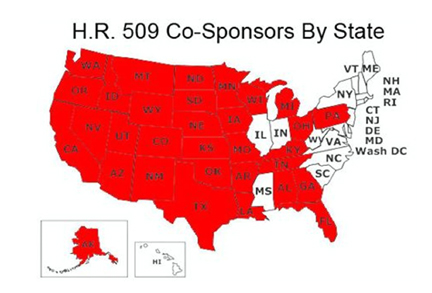
Endorsed by the American Farm Bureau, American Sheep Industry Association, Big Game Forever, Boone and Crockett Club, Congressional Sportsmen’s Foundation, Mule Deer Foundation, National Association of Conservation Districts, National Cattlemen’s Beef Association, National Rifle Association, National Shooting Sports Foundation, National Trappers Association, Public Lands Council, Rocky Mountain Elk Foundation, Safari Club International, Sportsmen for Fish and Wildlife, U.S. Cattlemen’s Association, U.S. Sportsmen’s Alliance, and the Wild Sheep Foundation.
H.R. 509 has also been endorsed by the following state groups: Arizona Cattle Feeders Association, Arizona Cattle Growers’ Association, Arizona Wool Producers Association, Arizona Desert Bighorn Sheep Society, Arizona Elk Society, Arizona Sportsmen for Wildlife, California Cattlemen’s Association, California Public Lands Council, California Wool Growers Association, Citizens for Balanced Use, Colorado Cattlemen’s Association, Colorado Wool Growers Association, Florida Cattlemen’s Association, Friends of the Northern Yellowstone Elk Herd, Georgia Cattlemen’s Association, Idaho Cattle Association, Idaho Wool Growers Association, Independent Cattlemen’s Association of Texas, Kansas Livestock Association, Lobo Watch, Maryland Sheep Breeders Association, Michigan Cattlemen’s Association, Minnesota Farm Bureau Federation, Minnesota Lamb and Wool Producers Association, Minnesota State Cattlemen’s Association, Montana Association of Conservation Districts, Montana Association of State Grazing Districts, Montana Farm Bureau Federation, Montana Outfitters and Guides Association, Montana Public Lands Council, Montana Sportsmen for Fish and Wildlife, Montana Stockgrowers Association, Montana Trail Vehicle Riders Association, Montana Woolgrowers Association, Montanans for Multiple Use, Nebraska Sheep and Goat Association, Nevada Cattlemen’s Association, North Carolina Sheep Producers Association Inc., Oregon Cattlemen’s Association, Oregon Hunters Association, Oregon Sheep Growers Association, Treasure State ATV Association, Utah Cattlemen’s Association, Utah Wool Growers Association, Virginia Cattlemen’s Association, Washington Cattlemen’s Association and the Wyoming Stock Growers Association.
Judge’s decision unfairly punishes ranching community
By Sens. Ted Ferrioli, Doug Whitsett, Frank Morse, and Fred Girod
Note: Sen. Ted Ferrioli (R-John Day) can be reached at sen.tedferrioli(at)state.or.us. Sen. Doug Whitsett (R-Klamath Falls) can be reached at sen.dougwhitsett(at)state.or.us. Sen. Frank Morse (R-Albany) can be reached at sen.frankmorse(at)state.or.us. Sen. Fred Girod (R-Stayton) can be reached at sen.fredgirod(at)state.or.us.
The Statesman-Journal, March 18, 2011 [here]
U.S. District Court Judge Ancer Haggerty’s decision — to enjoin seven Grant County ranchers from using their forest service grazing allotments — is truly a case of justice gone blind, because it tries to force federal bureaucrats to follow the law by punishing ranching families who had no control over agency failures that brought on the lawsuit.
Cattle ranching in Oregon is already an iffy proposition because of rising costs of fuel and feed and unnecessarily draconian water standards enforced by the Oregon Department of Environmental Quality and U.S. Environmental Protection Agency. Add to these all the special requirements of the Endangered Species Act and ranchers face the toughest performance standards of any agricultural enterprise.
Does Oregon need its ranchers? You bet! Today, cattle production is one of Oregon’s top income producers and a mainstay of Eastern Oregon rural communities. With the near-collapse of the Eastside timber industry, ranching is the only thing keeping the services and supply sector (mostly small family-owned operations) alive.
Because federal permits are required to authorize grazing in upland areas where snow and rainfall create the headwaters of salmon-bearing streams, a U.S. government document called a Biological Opinion must be prepared to demonstrate that grazing on the allotment will not degrade salmon habitat.
Grazing practices are structured so that cattle are continuously moved to prevent overgrazing and damage to stream banks. Both ranchers and forest service range managers are responsible for monitoring grazing operations. The Biological Opinion describes the protocols, actions and practices that protect endangered species habitat.
Judge Haggerty concludes that the Biological Opinion written by federal bureaucrats is inadequate. He has determined that it will not withstand scientific review and fails to meet the requirements of the Endangered Species Act.
Accordingly, Judge Haggerty has ordered the forest service to prepare a new Biological Opinion. But in our opinion, he has wrongly enjoined the use of grazing allotments until a legally sufficient Biological Opinion is prepared.
In effect, Judge Haggerty is holding the ranching community hostage for the failures of federal bureaucrats, transferring all of the financial and social harm to families that had no control over the agency that so miserably failed to perform its duties under the law to craft an opinion that preserves both cattle grazing and salmon habitat.
While federal bureaucrats suffer no consequences for their poor performance, ranching families face financial ruin. This must not become the model for justice under the Endangered Species Act.
Perhaps it would have been wiser for Judge Haggerty to have ordered the forest service to rewrite the Biological Opinion before June 1, 2011, and to issue temporary “take” permits to the ranchers pending approval of the Biological Opinion.
By doing so, Haggerty would have held the agency accountable for protecting salmon runs without destroying what’s left of rural economies.
Additional Notes:
1. Yesterday Judge Ancer Haggerty modified his ruling to allow 15 of 19 ranchers involved in the case to use their alloments for one more season [here].
2. The lawsuit was brought by the Oregon Natural Desert Association and the Western Watersheds Project. Those eco-litigious sue-sue-sue groups were recently gifted $22 million by the El Paso Corp who are building the Ruby (natural gas) Pipeline. See [here, here, here, here, here]. The “deal” was an extortion payment [here]. The sue-happy eco-monkey-wrencher groups agreed to not tie up the pipeline project in court in return for the huge payoff.
3. Eco-litigious groups also receive huge windfalls in return for suing the government through the “Judgment Fund” and the Equal Access to Justice Act (EAJA) [here, here, here]. $Billions have been funneled to sue-happy monkey-wrencher groups, much of it directly from Federal land management agency budgets.
4. The Oregon Natural Desert Association is also supported by corporations that include Patagonia, Trader Joe’s, and Bank of the Cascades [here]. Their Board, staff, advisors, and “consultants” are exclusively white liberals with no background in ranching or forestry. In fact, along with WWP, ONDA is virulently anti-ranching and anti-forestry. Their roots go back to monkey-wrencher eco-terrorist groups.
5. More damage to streambanks is done by government protected feral horses and donkeys than by cattle [here].
6. The endangered species allegedly at risk is the steelhead, aka rainbow trout (Oncorhynchus mykiss). The species has been introduced for food or sport to at least 45 countries, and every continent except Antarctica [here]. The species is in no way, shape, or form “endangered”. In fact, it is considered (by the USFWS) to be a pest and a competitor to other fish in other watersheds.
Radicals Join Simpson, Tester, Baucus in Wolf Delisting Fraud
In an article prepared by the radical enviro cult and printed in the Main Stream Government Press (MSGP), eco-litigious pro-wolf-anti-everything-else groups have proposed a “compromise agreement” for consideration by retiring Wolf Judge Donald Molloy.
We will parse the news article for your edification.
Feds, wildlife groups agree to delist Montana wolves
By the Associated Press, March 18, 2011 [here]
BILLINGS - Facing mounting pressure from Congress over gray wolves, wildlife advocates reached an agreement with the U.S. Department of Interior on Friday to lift the species’ federal protections in Montana and Idaho and allow hunting to resume. …
Note that there is no author given other than AP. That’s a ruse. Of course somebody authored the article; they just don’t want their name used. And the MSGP accommodates, because they don’t their readers to know who authored the article, either.
It came straight from the radical eco-litigious groups. They write the articles and AP distributes them as “news”. The MSGP newspapers print them as if they were the work of independent “fair and balanced” journalists, whereas in fact they are pure propaganda written by the most extremely biased.
Note also that the radical pro-wolfers are called (call themselves) “wildlife advocates” whereas in fact they hate wildlife and want most species slaughtered to extinction. That’s why they promoted the introduction of exotic wolves in the first place — to slaughter elk, deer, moose, rabbits, and everything that moves, and livestock, and pets, and human children. They don’t advocate for those other wildlife species because some species are more equal than others, in their eyes.
The settlement agreement - opposed by some environmentalists - is intended to resolve years of litigation that have shielded wolves in the Northern Rockies from public hunting, even as the predator’s population has sharply expanded.
That’s false. The so-called “agreement” [here] does not resolve litigation. The eco-litigants promise only to forestall litigation on certain esoteric points of law regarding wolf delisting and only for a period of three to five years:
10. Settling Plaintiffs agree that they will not, either collectively or individually, file a lawsuit, raise claims against, or otherwise challenge in court before March 31, 2016 any final delisting or reclassification rule issued pursuant to paragraph 5, above.
11. Settling Plaintiffs agree that they will not, either collectively or individually, petition Federal Defendants to list either the NRM DPS (as defined by the 2009 Rule), or any wolf population or subpopulation located within the NRM DPS (as defined by the 2009 Rule), for a period of three years after this Agreement becomes operative pursuant to paragraph 1, above.
Read it carefully. The signers promise not to sue for five years over “paragraph 1 above” which is a restatement of Judge Molloy’s August 5, 2010 Order and only that portion of the Order that threw out the USFWS’s 2009 delisting rule in the States of Idaho and Montana. For Judge Molloy’s entire August 2010 ruling see [here]. In addition the signers promise not to sue for three years over “paragraph 5 above” which calls for Wyoming to come up with new wolf management plan. They will sue at the drop of a hat over every other point of law having to with wolves. And their promises aren’t worth spit.
In his August 2010 ruling, peppered with phrases such as “stentorian agitprop” and “Talmudic disagreement”, Judge Molloy wrote:
The Endangered Species Act does not allow the U.S. Fish & Wildlife Service to list only part of a “species” as endangered, or to protect a listed distinct population segment only in part as the Final Rule here does; and
the legislative history of the Endangered Species Act does not support the Service’s new interpretation of the phrase “significant portion of its range.” To the contrary it supports the historical view that the Service has always held, the Endangered Species Act does not allow a distinct population segment to be subdivided.
Clearly the Judge ruled that the USFWS may NOT separate wolves into an Idaho-Montana sub-population and a Wyoming-Utah-Washington-Oregon sub-population. But that’s exactly what the proposed “agreement” proposes to do.
If Judge Molloy accepts the “agreement,” then his August 2010 ruling isn’t worth the paper it was written on. He would have to do a complete about-face, a backwards flip-flop as it were.
In November of 2011 United States District Judge Alan B. Johnson ruled that the United States Fish and Wildlife Service’s (USFWS) rejection of the Wyoming Wolf Management plan was arbitrary and capricious [here].
Judge Johnson is in District of Wyoming, subject to the United States Court of Appeals for the Tenth Circuit. Judge Molloy is in the District of Montana, subject to the United States Court of Appeals for the Ninth Circuit.
Molloy cannot overrule Johnson. It’s beyond his jurisdiction. Molloy cannot agree to special strictures on Wyoming because Wyoming is not in his District.
The Obama Administration lawyers know all this. The apparent acquiescence by the USFWS to the “agreement” is just more legal worm food. They know the “agreement” is a crooked one and cannot be endorsed or enforced by Molloy. It’s just more Full Employment for Lawyers. It solves nothing and does not reduce litigation — it expands it.
Those niceties did not stop the Obamaloids, in the form of political operatives Deputy Secretary David J. Hayes, Acting Service Director Rowan Gould, and you guessed it, Mr. Tamper himself, Secretary of the Interior Ken Salazar from signing on to the “agreement” [here].
ALL the eco-litigants did NOT sign on, however. From the AP article:
Attorneys for Earthjustice previously represented most of the plaintiffs in the case. They withdrew this week citing “ethical obligations” …
“We’re going to defend the judge’s ruling,” said Tom Woodbury with the Western Watersheds Project, referring to Molloy’s 2010 order that reinstated protections for wolves in Idaho and Montana.
Get that? The biggest and richest eco-litigious law firm in the world, Earthjustice (formerly Sierra Club Legal Defense) had some “ethical” pangs and refused to sign. Another refuser was the Western Watersheds Project, now flush with $22 million they extorted from the El Paso Corp over the Ruby Pipeline [here].
There is no honor among thieves, and some of the thieves are already giving the other thieves the finger. Meaning that eco-litigation will proceed apace, regardless of what the “agreement” promises and whether Molloy accepts it or not.
Speaking of thieves, the “agreement” is exactly the trick that RINO Mike Simpson, Holocauster Jon Tester, and Porkulus Max Baucus are trying to pull in Congress [here].
It’s all a fraud. The only rational and fair thing to do is to take wolves off the ESA list because they ARE NOT ENDANGERED, something that everybody involved now agrees about.
HR509 and S249, the “State Sovereignty Wildlife Management Act,” are supported by Representatives and Senators from over 30 states [here]. The SSWMA removes gray wolves from the ESA:
Notwithstanding any other provision of law (including regulations), the inclusion of the gray wolf (Canis lupus) (including any gray wolf designated as “non-essential experimental”) on any list of endangered species or threatened species under section 4(c)(1) of the Endangered Species Act of 1973 (7 U.S.C. 1533(c)(1)) shall have no force or effect.
Good-bye, adios, so sorry, that’s it.
HR509 and S249 are what engendered all this fraudulent foo-fraw by the radical eco-litigious crowd and their lapdog comrades in the Obama Administration. Because if the SSWMA passes, then the wolfish legal games are over. And it will pass, because majorities in both Houses of Congress have already signed on. And because if it doesn’t, Tea Party-ers will gang up and throw the recalcitrant wolf-lovers out (and they know it).
The game is coming down to the final minute, and rads are too far behind to win.
Simpson, Tester, Baucus Seek To Undermine Judge Johnson’s Ruling on Wyoming Wolves
Note: the following is excerpted from a March 17, 2011, letter written to members of the Wyoming Wolf Coalition by their able attorney, Harriet Hageman. The full text is [here].
Alert! High Priority! Call to Action!
Please ask Congress to stop throwing Wyoming to the wolves
by Harriet M. Hageman
Executive Summary
We reported to you earlier this week that the Federal Defendants in the above-referenced actions have voluntarily withdrawn their appeal to the Tenth Circuit Court of Appeals. We were a bit surprised by the agencies’ move in that regard, but now believe that we have uncovered the reasoning behind it.
* Judge Johnson’s decision has now “gone final” in favor of Wyoming’s Wolf Management Plan, and has the full force and effect of law.
* There are troubling efforts afoot in Congress that are designed to reverse this important victory for Wyoming, to “undo” Judge Johnson’s decision, and to nullify the rights of all States to manage their wildlife resources.
The purpose of this letter is to describe those activities, and to issue a call to action for all of you who have fought this battle over the last several decades.
Ruling in Favor of Wyoming’s Wolf Management Plan Becomes Law of the Land
On November 18, 2010, the Honorable Alan B. Johnson, the Federal District Court Judge for the District of Wyoming, issued his “Order Setting Aside Agency Decision in Part and Remanding Agency Decision in Part,” finding that the Defendants (the Department of Interior (DOI), the Fish and Wildlife Service (USFWS), Ken Salazar, Rowan Gould, and Stephen Guertin) had acted “arbitrarily and capriciously” in rejecting the Wyoming Wolf Management Plan [here]. More specifically, Judge Johnson concluded (among other things) that the Defendants violated the Endangered Species Act (ESA) when they rejected Wyoming’s proposal to designate wolves as trophy game animals in certain areas, and predators in others. …
Key testimony provided by the top federal wolf biologist (Ed Bangs) concluded that the “2007 Wyoming wolf plan is a solid science-based conservation plan that will adequately conserve Wyoming’s share of the GYA wolf population so that the NRM wolf population will never be threatened again.” Id. at 032183. As you know, Wyoming has since adopted even more safeguards that what existed in the 2007 Plan.
The Defendants initially appealed Judge Johnson’s decision to the Tenth Circuit Court of Appeals. On Monday of this week, however, they voluntarily dismissed that appeal. Such action resulted in Judge Johnson’s decision “going final,” thereby ensuring that it is not subject to collateral attack. In other words, Judge Johnson’s decision is now “the law of the land” and cannot be attacked by either the federal agencies or any environmental groups. We are pleased that this common-sense result affirms the science-based reality that Wyoming’s Plan provides adequate protections to Wyoming’s wolf population.
Judge Johnson’s decision was a great victory for all of the citizens of the State of Wyoming, including our livestock producers, our sportsmen groups, and our outfitters. It was a great victory for those cities and counties in Wyoming that have suffered the economic impacts of an ever-expanding wolf population. Judge Johnson’s decision, and the dismissal of the 10th Circuit Appeal, will also allow Wyoming to protect its historically-abundant wildlife species, including those elk and moose populations that have suffered so tremendously as the result of the federal agencies’ intransigence associated with the “wolf experiment.” …
TROUBLING EFFORTS BREWING IN CONGRESS AS IT SEEKS TO REVERSE WYOMING’S VICTORY
I am now writing to you with great disappointment, as I fear that our victory in the wolf saga is now at risk. Once again it appears that politics may prevail over science and good public policy. Wyoming’s Wolf Management Plan and our victory before Judge Johnson are now at risk as the direct result of an amendment that has been introduced by Representative Mike Simpson, a Republican from Idaho, and Senators John Tester and Max Baucus, Democrats from Montana. The amendment would either be added to the “continuing resolutions” that have been in the news lately (to keep the federal government running as the House and Senate seek to hammer out the 2011 budget), or to the budget bill itself.
The purpose of the Simpson/Tester/Baucus amendment is as simple as it is troubling. It is designed to delist the wolf populations in Idaho and Montana, as well as parts of Oregon, Utah and Washington, while the remainder of the States –- including Wyoming -– are left to fend for themselves. Most importantly, however, the very wording of the proposed amendment appears to be designed to nullify Judge Johnson’s decision in its entirety.
Mr. Simpson’s amendment works by reinstating the USFWS’s 2009 Final Rule (the one rejected by Judge Molloy in Montana). There are two sections of the 2009 Rule that are important here, both of which would become law if the Simpson/Tester/Baucus amendment passes. As you remember, the first portion of that Rule approved the then-existing Montana and Idaho Wolf Management Plans, both of which allowed the States to assume management authority over their wolves (although with federal permission and involvement). The second part of the 2009 Final Rule rejected Wyoming’s Wolf Management Plan, stating that “the Wyoming portion of the range represents a significant portion of range where the species remains in danger of extinction because of inadequate regulatory mechanisms.” 74 Fed.Reg. 15123.
Considering the language of the 2009 Rule, if Congressman Simpson and Senators Tester and Baucus were to be successful in including their proposed language as part of either a short-term “continuing resolution,” or the 2011 budget, and such bill passes both the U.S. House and the Senate, we can fully expect that the federal agencies and the environmental groups will argue that Judge Johnson’s decision has been congressionally nullified. Even more troubling is the fact that their amendment includes language that is intended to then block Wyoming from challenging the statute: “Such reissuance [of the Final Rule] shall not be subject to judicial review.” HR 1, Sec. 1713. To state that this is a real and immediate threat to Wyoming’s ability to assume management of the wolf population is an understatement.
You may ask: “why would Simpson, Tester and Baucus seek to impose a rule from 2009 when, from the States’ rights standpoint, and from the standpoint of wolf management, Judge Johnson’s decision is much more favorable to every State in the Union?” I have asked the same question, and none of the answers are favorable.
The actions of Representative Simpson and Senators Tester and Baucus are beyond troubling, and should be cause for concern for anyone who seeks to protect our wildlife populations, our livestock producers, and our States’ rights. Perhaps as significantly (and of grave concern), there are four groups that have endorsed Congressman Simpson’s efforts, and appear to be willing to sacrifice Wyoming’ interests:
* National Rifle Association (NRA)
* Safari Club International (SCI)
* Congressional Sportsmen Foundation (CSF)
* Boone and Crockett
By supporting only limited delisting in just a few of the affected States, these four so-called sportsmen groups have essentially sold out everyone else that has been affected by this issue. While these groups also support all of the wolf delisting bills, including some very good legislation (discussed below), their actions in supporting HR 1 (with Congressman Simpson’s amendment) has allowed the Representatives and Senators to “race for the bottom” in order to take the weakest stand possible on the issue.
While these groups publicly claim that they support delisting in all western States, as well as in Wisconsin, Michigan and Minnesota, their actions are counterproductive. Their support of the amendment described above will likely undermine other pending wolf litigation that will protect all States. Their actions will also have a more dire outcome: the important victory that is represented by Judge Johnson’s decision, and that resulted from years of hard-fought battles and the investment of tens of thousands of dollars, could be lost. This does not hurt only Wyoming, but will hurt every State in the nation that seeks to manage its own wildlife without the federal agencies’ unlawful (and often-times destructive) micro-management out of Washington, D.C.
There are two other bills currently pending in Congress - HR509 and S249, both of which would return management of wolves to all of the affected States. The Simpson/Tester/Baucus approach not only undermines our ability to get either one of these bills passed, but will likely make it more difficult to obtain any additional Congressional action into the foreseeable future. In other words, the actions of Simpson/Tester/Baucus, along with the NRA, SCI, CFS, and Boone and Crocket, have enabled those who seek to prevent the passage of any other bill that would actually provide for legitimate and effective delisting of the wolves.
Passage of the Simpson/Tester/Baucus amendment is not an incremental victory as some would claim. This is not an incremental victory for ensuring that States have the right to manage their own wildlife populations, or an incremental victory under the ESA. Judge Johnson’s decision was a victory. The Simpson/Tester/Baucus effort is designed to take that victory away.
By supporting a weak piece of legislation, these groups have allowed several of the Congressional Representatives and Senators to play both sides of the aisle -– to argue that they support delisting when such claims suit their political aspirations, and to argue that they fought against delisting when such a position will garner them votes from the so-called “environmental” groups. In other words, this amounts to nothing more than obtaining only the slightest and short-term moral victory for a limited number of people, and at the same time ensuring a very troubling defeat for the citizens of Wyoming and for the States’ right to manage wildlife. While we recognize that political compromises are sometimes necessary, I cannot support legislation that is specifically designed to undo Judge Johnson’s finding that the Wyoming Wolf Management Plan is biologically and scientifically sound. This is simply not good science, good public policy or even good politics. …
We fully and whole-heartedly support delisting in Idaho and Montana (and all of the States where wolves exist). Such delisting, however, cannot be done so that Wyoming is sacrificed at the alter of environmental extremism.
Judge Johnson’s decision must stand. We must fight against this effort to use the promise of delisting in Idaho and Montana (and portions of Oregon, Utah, and Washington) as a ruse to nullify the most important decision that the States have obtained in the last seventeen (17)+ years of wolf battles, as well as the rights of States to control their own destiny in terms of wildlife management.
Please contact the offices of Congressman Simpson, and Senators Tester and Baucus and ask them to support only HR 509 and S249. Please request that they not re-introduce the Wyoming-busting amendment described above.
Please contact Representative Lummis’ office and thank her for her strength and continued efforts to fight this battle on your behalf. Please call the offices of Senators Enzi and Barrasso and thank them for their hard work in supporting the right bills on this issue, while fighting against the bad ones. Our Congressional Delegation has stood strong on this issue, and we need to commend them for their efforts on our behalf.
Please contact the NRA, SCI, CFS and Boone and Crocket and ask them to stop their support of an amendment that is specifically designed to undo our important and hard-fought victories. Ask them to instead focus their efforts on passing a solution that protects all of the States that have been plagued by this predator. Ask them to stop throwing Wyoming to the wolves.
Please distribute this letter to anyone you believe could help us to expose what is going on in Congress.
Sincerely,
Harriet M. Hageman
Restoring Rural American Rights and Prosperity
by Jim Beers
As this is being written:
* Union rioters are seizing State Capitol buildings in Wisconsin, Indiana, and Ohio.
* State legislators are fleeing their states to avoid the wrath of their Union supporters.
* Chronic national unemployment is on everyone’s mind.
* National and State debts threaten to bankrupt and even destroy government.
* National and State Budgets cause hostility everywhere as calls for comity abound.
* Budget Cuts v. Tax Increases reflect the deep political division emerging everywhere.
* Unfunded entitlements from government pensions to social and medical promises loom.
* Housing prices and construction are in the worst shape since the 1930’s.
* Banks, loans, business futures, insurance costs, and federal funds are all questionable.
* Middle East and African governments are falling with unknowable future rulers.
* Oil and energy prices are exploding as federal policies are unclear and threatening.
Additionally, Rural America is depressed and reeling from ±40 years of federal government policies that treat federal lands as distinct from the states and local communities wherein they are located (i.e. Wilderness Declarations, Road Closures, abandonment of renewable natural resource management and use, revenue-generating and revenue-sharing management practices from grazing and timber management to wildlife uses, “Travel Management” Plans, Permits requirements, etc.); from the effects of steadily expanded and unconstitutional federal powers under the Endangered Species Act (ESA); from Taking Without Compensation and disregard for both state authorities and private property; from administrative takeover of state agencies and changing the ESA from “saving species” to selectively restoring species anywhere at will and even mortally endangering human safety with “GI” (Government Introduced) wolves; and an arrogant disregard for those affected.
more »
Wolves in Oregon
by Senator Doug Whitsett (Klamath Falls, District 28), Feb. 18, 2011 [here]
Russian news media is reporting the extreme end-game that results from the introduction and failure to control timber wolves. They report that a Siberian town of 1,400 people has been terrorized for the past three weeks by a pack of 400 wolves. Residents are describing the siege as an “animal apocalypse”. In the Verkhoyansk region, “everyone who can hold a rifle is mobilized to fight wolves”.
Starting February 18, 2011, authorities in Slettas, Norway are currently providing free transportation for school children who live more than 800 yards from their bus stop in order to protect them from wolves. Their representative in Parliament said “it has gone too far when we have to drive children to school for fear they will meet a wolf pack on the road”.
An experimental population of Canadian Gray Wolves was introduced into Montana’s Yellowstone Park in 1995. They were subsequently listed as endangered species, functionally preventing their unrestricted reproduction and migration.
During the past 15 years, they have reproduced and migrated to populate Montana, Wyoming, Idaho and parts of Utah with several thousand of these vicious, imported predators. In those states they have decimated the elk, deer and moose populations as well as causing extensive mortality and other related losses to their livestock industry.
Most recently the Canadian Gray Wolves have migrated into northeastern Oregon.
Last Tuesday an Enterprise cattle rancher found two of his cows that had been killed by wolves in the most cruel way imaginable. The wolves had dragged the heavily pregnant cows down by their hamstrings without inflicting a killing bite wound. These sadistic creatures had then proceeded to eat the still living cows from behind, ripping their live calves from their reproductive tract, and partially consuming the still living fetuses. Wildlife Services, U. S. Fish and Wildlife Services and the Oregon Department of Fish and Wildlife have all confirmed that the cows and their calves were killed by wolves.
The interaction with wolves began in Oregon starting back in March of 2010. Agencies have confirmed at least 11 cattle kills in Oregon. Another 23 calves and 9 cows are missing and presumed lost to predation. It is difficult to document livestock killed by wolves on rangeland because these cattle are often not seen by their owners for weeks at a time. If the remains are found the evidence required to confirm a wolf kill is usually long gone.
more »
Wolfish Judicial Games
by Mike Dubrasich, Exec Dir W.I.S.E.
The latest twist in the judicial wolf saga [here] is complicated and merits some discussion of the history vis the courts and wolves. We offer a partial history as follows:
On Aug. 7, 2008 US District Court Judge Donald W. Molloy issued a wolf decision [here] that began with his usual flowery though unintelligible verbosity:
This case, like a cloud larger than a man’s hand, will hang over the northwest states of Montana, Idaho, and Wyoming until there has been a final determination of the complex issues presented.
In that case (CV 08-56-M-DWM) the Defenders of Wildlife et al. challenged the February 27, 2008 US Fish and Wildlife Service delisting of the northern Rocky Mountain gray wolf distinct population segment (DPS). The USFWS RM wolf DPS included all of Idaho, Montana, Wyoming, eastern Washington, eastern Oregon, and northern Utah.
Molloy reinstated (relisted) wolves as endangered because, as he reasoned, the USFWS had made “no plausible showing of genetic exchange” between wolves in Yellowstone and wolves in Montana and Idaho.
This was a strange finding, since the Canadian gray wolves in Montana and Idaho were direct descendants of the Canadian gray wolves the USFWS dumped in Yellowstone in 1995. They were the exact genetic strain. Was Molloy saying that brother and sister wolves were failing to mate, or first cousins, or what? It was difficult to decipher his irrational rationale, but he did mention “genetic exchange” no less than 67 times in that decision and concluded:
Absent genetic exchange, the wolf will not likely be able to withstand future environmental variability and stochastic events. 1994 EIS, App. 9. Plaintiffs therefore have demonstrated a possibility of irreparable harm.
The reaction to this nonsense was swift and loud, and more than a little bit derisive [here, here]. Obviously there was genetic exchange. The wolves were one big happy family. They not only interbred, they mongrelized with dogs, coyotes, and attempted to do so with whatever they came across that looked half way mate-worthy, successfully or not.
Wolverine Madness
The new “charismatic” predator of the month is the wolverine. Wolverine news is popping up all over. For instance:
Wolverine population threatened by climate change
NCAE & UCAR News, February 03, 2011 [here]
BOULDER—The aggressive wolverine may not be powerful enough to survive climate change in the contiguous United States, new research concludes.
Wolverine habitat in the northwestern United States is likely to warm dramatically if society continues to emit large amounts of greenhouse gases, according to new computer model simulations carried out at the National Center for Atmospheric Research (NCAR). The study found that climate change is likely to imperil the wolverine in two ways: reducing or eliminating the springtime snow cover that wolverines rely on to protect and shelter newborn kits, and increasing August temperatures well beyond what the species may be able to tolerate. …
Peacock’s research focused on mountainous regions of the Northwest, the primary habitat of the wolverine population in the contiguous United States. The study did not look into the impacts of climate change on regions where wolverines are more numerous, such as Canada, although other research has indicated those areas will likely warm significantly as well. …
The study was published last week in Environmental Research Letters. It was funded by the National Science Foundation, NCAR’s sponsor.
Note that “computer model simulations” are the source of this alarming news. In actual fact, winter temperatures in wolverine country have been trending downwards for the last 20 years at a rate of -.53°F per decade, and a whopping -5.24°F over the last 10 years.
NCDC Climate Services and Monitoring Division, Climate At A Glance [here]
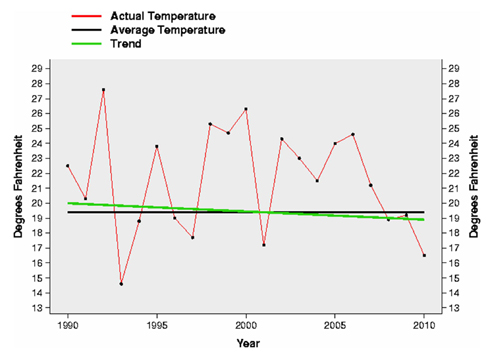
Winter (Dec-Feb) Temperatures, West North Central Region, Winter (Dec-Feb) 1990 - 2010 Trend = -0.53 degF / Decade
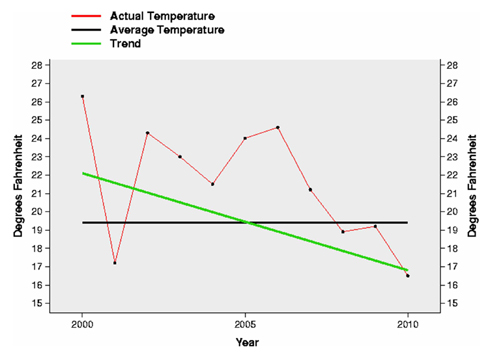
Winter (Dec-Feb) Temperatures, West North Central Region, Winter (Dec-Feb) 2000 - 2010 Trend = -5.24 degF / Decade
Evidently nobody told the computer making the simulations. The wolverine alarmists don’t care about the actual facts, however, and are content to spew insane tales of horror no matter what the facts are.
More government promulgated insanity: all citizen visits to the Sawtooth National Recreation Area are to be banned because of wolverines. Wildlife pseudo-biologists have determined that the mere presence of a human being causes wolverines to curl up and die.
The Boise, Payette, and Sawtooth National Forests are developing “Wildlife Conservation Strategies” that will eliminate recreational use of their “Recreation Areas” and wildernesses because of the fragile sensitivities of wolverines [here].
Note that all three Forests have deliberately and with malice aforethought promulgated megafires over the last five years. The fires have eliminated almost all recreational use across thousands of square miles, but not affected the wolverines in the slightest (evidently). A crown fire ripping through 100,000 acres is no great burden to wolverines, but the presence of human being on that same tract of land is fatal to them, according to the USFS and USFWS.
The hidden objective is to de-humanize vast tracts of public and private land, in accord with the Wilderness Project dreamed up and promulgated by Earth First!. The former radical underground eco-terrorist group is now mainstream and has taken over the US Forest Service.
The wolverine is not endangered. They are doing quite nicely in Canada, and the US population is growing. The fur trapping days are over. That’s what mainly caused wolverine population declines over the last 200 years. Not human sighting.
De-humanizing the West will not do anything for wolverines. Pseudoscience notwithstanding.
The radical anti-humanists are not retreating, however, despite their failure to get wolverines listed:
Wolverines denied federal protection
Given ‘candidate species’ designation
By Katherine Wutz, Idaho Mountain Express, Dec. 15, 2010 [here]
Even though wolverines are threatened with extinction [BS Alert - false statement by a journo-lista], they will not receive federal protection, the U.S. Fish and Wildlife Service announced Monday.
Wolverines will be listed as a “candidate species,” meaning that they are eligible for protection under the Endangered Species Act. However, the service said there are other, more high-priority species on the same list, and listing wolverines under federal protection will have to wait for now, though the species will undergo an annual review.
“There are reasons to be concerned about the long-term persistence of wolverines,” said Robin Garwood, a wildlife biologist with the Sawtooth National Recreation Area. “Even though wolverines won’t be protected by ESA for now, I think it highlights the importance of ensuring that remaining habitat, including habitat on the Sawtooth Forest, is kept as intact as possible.”
To the Sawtooth NF, “intact” means keeping the public out, with armed federal agents if necessary. You might disturb a wolverine, so you are forbidden to go upon federal land. You are requested, however, to pay the salaries of the federal agents like Mr. (or Ms.) Garwood, or else go to jail. That’s how the System works.
It’s not your land, it’s not my land. The land belongs to the Government and that means not you and not me. Only certified federal agents and eco-terrorists are allowed. Exclusion of the public is necessary to “save” the non-endangered wolverines.
Grizzly Bear Cognitive Dissonance
For decades the US Fish and Wildlife Service and state fish and game departments have promoted grizzly bear worship. Now they seem to be sliding into apostasy.
The allegedly “iconic and charismatic” predators have been placed on the high altar of the Endangered Species Act, even though they are in no way, shape, or form endangered. Anti-human rights groups have used grizzlies to scam hundreds of $millions out of little old ladies burdened with liberal guilt, and the agencies have milked that cow for all it’s worth.
The latest insult to intelligence was Judge Molloy’s refusal to delist grizzly bears because of global warming! That’s right sports fans, da judge said that gloooobal waaaaarrming is gonna kill off da bears, and so they must remain sacrosanct wards of the State [here].
The judge based his decision on the junk pseudoscience that spews from our wonderful wildlife agencies, the same folks who drug grizzlies and them leave them to wake up grouchy in your back yard [here]. If you get attacked, killed, and eaten, it’s your fault.
There is no accounting or audit of what the taxpayers have forked out for decades so that gummit employees can live like kings while spewing junk science and pagan grizzly bear worship, and packing your neighborhood with 1,000 pound man-eaters. Just another public service from a government that’s here to help. And as usual with helpful gummit services, money is no object.
Despite the fact that grizzlies kill elk as well as humans, sportsman groups are far more concerned about wolves, and Rocky Mountain gray wolves in particular. As we reported [here], a move is afoot to delist wolves by Congressional action. The rest of the ESA atrocities (bears, owls, smelt, etc.) will have to wait for some other time.
The assumption is that US Congress will possibly (doubtful) do something about wolves, but are too anti-human liberal to fix the ESA, an Act that was promulgated by the UN during the Vietnam War and is perhaps the most anti-American un-Constitutional law in existence.
Gaia forbid we should sully the altar of pagan iconic animals that kill citizens in their back yards. When the Founding Fathers came up with the nutty notion that human rights are unalienable, they were smoking crack.
To be fair, more than fair, some government employee wildlife biologists are now questioning whether grizzly bears should be allowed to multiply like rabbits and freely roam the countryside in Fly-Over Land. They don’t question their own junk pseudoscience, and are still fully invested in numerous hoaxes like glooooobal waaaarming, but they are toying with the idea that wildlife management might be preferable to wildlife worship.
Grizzly bears moving out of core habitats, changing management message
By ROB CHANEY, the Missoulian, January 22, 2011 [here]
If we care about keeping grizzly bears alive, perhaps we should worry less about how they die.
The idea won a serious listen at last week’s Interagency Grizzly Bear Committee work session in Missoula. Since 1983, when the group of state and federal bear managers started meeting, grizzly survival has been the top job. Now science and public opinion may be heading in a new direction.
“We need to rethink our grizzly messages for the Greater Yellowstone area,” Steve Schmidt of the Idaho Fish and Game Department told the committee. “This population is recovered. We are now transitioning into management. Some bears are gonna die. That is a natural consequence of bears expanding their distribution.”
Schmidt chairs the IGBC’s Yellowstone grizzly committee, which oversees bear recovery in one of the two largest bear habitats in the continental United States. Between 2004 and 2008, grizzlies have stretched their active range around Yellowstone National Park by 34 percent. And most of their conflicts with livestock, hunters and cars are now taking place on the developed fringes of that range.
“The bears in the Yellowstone area are filling up their logical habitat,” Schmidt said. “We also believe as a committee that bears have met or exceeded their social carrying capacity. The public appetite for further expanding this bear population is very small. And the political appetite is nil.”
Scott Talbot of the Wyoming Game and Fish Department agreed.
“Last year we moved 65 bears,” Talbot said. “Our average is 28. And we are seeing a significant increase of bears outside socially acceptable areas. There used to be large amount of public support for bears. Now we’re seeing a big decline, plus growing legislative interest. That’s very concerning to us.”
Montana’s Legislature has already put forward five bills aimed at bear management, compared to just one so far on wolves. ..
“The public views these as ‘federal bears,’” Schmidt said. “They have no ownership of these bears because they’re still listed. Without state management and a chance to participate in how they’re managed, and the opportunity to harvest once in a while, they will oppose all the conservation efforts we’ve worked on so hard in the past.”
“We’ve gone from 200 bears (in the Greater Yellowstone Ecosystem) in 1983 to over 600 today,” Schmidt said. “We need to focus on the health of this population and less on the bears that need to be removed. Bears on the fringe aren’t essential to the health of the population. We need to start communicating that idea now.”
Hold the presses, the message is changing, maybe. Yes sports fans, the old propaganda is going to be replaced by new propaganda, possibly, or possibly not. So be prepared to undergo cognitive dissonance yet again. Or possibly not. Big Brother is confused.
Meanwhile, when you go shopping, or work in your garden, or when the kids are waiting for the school bus to ferry them to our valued government Indoctrination Centers, carry a gun. A big gun. One capable of killing a grizzly bear. Or a wolf.
Unless, of course, Big Brother has seized your guns, in which case huddle in the cold and dark and wait for your opportunity to serve the State by becoming bear chow.
Molloy Strikes Again
District Court Judge Donald Molloy has ordered parties to the gray wolf delisting/relisting lawsuit [here] to show cause why the case should not be dismissed due to the absence of a population meeting the statutory requirements for 10(j) status.
Judge’s ruling could threaten state’s ability to kill wolves
Lewiston Tribune, January 28, 2011 [here]
A federal judge in Montana is asking parties to a lawsuit over gray wolves if the animals should lose their experimental, nonessential designation and revert to a fully endangered or threatened designation.
Such a move could torpedo Idaho’s request to kill wolves in the Lolo Zone.
The order, issued this afternoon by District Court Judge Donald Molloy of Missoula, Mont., stems from a lawsuit filed in 2008 by environmental groups over new rules issued by the U.S. Fish and Wildlife Service making it easier for states to kill wolves for the purpose of protecting deer, elk and moose herds. States like Idaho can petition the federal wildlife agency for permission to kill wolves if they are found to be harming wild ungulate herds. The petitions are allowed under the designation of wolves in Idaho and parts of Montana as an experimental nonessential population.
Wolves were reintroduced to the Northern Rockies in 1995 and 1996 under that designation, known as 10(j). To qualify as an experimental population, the wolves must be “wholly separate geographically from nonexperimental populations of the same species.”
Molloy said that was the case at the time of reintroduction. However, he wrote the federal government documented in another lawsuit that wolves in the Northern Rockies are now breeding with wolves from Canada and a portion of Montana where they are not designated as an experimental population.
Molloy issued an eight-page order to show cause asking parties to the case to file briefs showing why the case “should not be dismissed as moot due to the absence of a population meeting the statutory requirements for 10(j) status.” … [more]
I disagree with the interpretation of the Lewiston Tribune. Elimination of the 10(j) status will not necessarily do away with wolf hunts. It could have just the opposite effect. Let me explain.
Recall that in 2008 Molloy ordered wolves relisted because, in his view, there was insufficient evidence that RM wolves were genetically connected [here]. He was wrong in his science. Wolves can travel thousands of miles and breed like rabbits when they get there. There was and is ample evidence of genetic connectivity.
Last year Molloy admitted his error, sort of [here, here]. The machinations are too many to list, but wolves have been delisted and relisted like yo-yos since 2002. Suffice it to say that last August Molloy relisted wolves for the third or fourth time on the grounds that “the Endangered Species Act does not allow the U.S. Fish & Wildlife Service to list only part of a ’species’ as endangered, or to protect a listed distinct population segment only in part…”.
The implication was that Molloy finally recognized that all Rocky Mountain wolves were indeed genetically connected and one population. The USFWS could not, Molloy ruled, delist woves in Idaho and Montana but not in Wyoming. They couldn’t carve off a “distinct population segment” based on state lines.
His ruling hinged on the way the USFWS subdivided the wolf population into DPS’s — illogical, unscientific, and political chicanery that the USFWS has indulged in with many species.
Molloy relisted the wolves because the USFWS was still claiming that some portion of their population was endangered. The USFWS didn’t like Wyoming’s wolf management plan, but they approved Idaho’s and Montana’s. The USFWS delisted wolves in the latter two states, declaring those wolves to be 10(j) experimental, nonessential populations, but retained full endangered status for Wyoming wolves.
No can do, said Molloy.
If Rocky Mountain wolves are genetically connected, then there are no distinct populations that are “wholly separate geographically”. Wolves in Wyoming, Oregon, Montana, and elsewhere are all one population. Either that population is endangered in its entirety, or it isn’t, in its entirety.
Last week Molloy ordered the parties to brief him on all that. When he gets their briefs, he will rule yet again.
Molloy could rule that Rocky Mountain wolves are endangered throughout their range, or that they are not endangered throughout their range. We don’t know how he will rule.
But the scientific evidence is strong that wolves are not endangered, and are in fact breeding like rabbits and expanding their population as much as 25% per year. They have spread out from the original infection center in Yellowstone NP (where Canadian gray wolves were illegally dumped by the USFWS in 1995) across five states.
The offspring of those wolves have decimated elk, deer, and moose populations, killed livestock and pets, and threatened people hundreds and even thousands of miles away from Yellowstone.
If Molloy applies the best available science, then he must rule that Rocky Mountain wolves are not endangered. Whether he will or not remains to be seen.
It is easy to point the finger at Molloy. He has relisted wolves again and again. The direct result has been the tragic destruction of game herds, livestock depredation, etc. But the finger should also be pointed at the USFWS, which engendered this crisis through illegal actions during the Clinton Administration. The USFWS is a political hornets nest, and their science has been (and still is) atrociously bad. And if we are placing blame, it all rests on Congress for creating a horrible law (the ESA) and failing to repeal or revise it for nearly 40 years.