Wisconsin Turmoil — Lessons for Oregon
Rep. Richardson’s Newsletter, February 25, 2011
I am State Representative Dennis Richardson and this newsletter is for Oregonians interested in learning more about the economic issues that affect our state. Today’s newsletter begins with an overview on Oregon’s budget crisis, and then compares and contrasts Oregon with Wisconsin to see what we can learn from Wisconsin’s current turmoil.
Oregon’s Economic Crisis
I would like to actually speak with you about Oregon’s Budget — what it is and what economic factors will influence most the preparation of the 2011-13 two year (“biennial”) budget.
Please turn up your computer’s volume, sit back and watch this week’s budget presentation on YouTube. I hope you find it informative. [Click here]
Wisconsin and Oregon — Comparison and Contrast
If you have been watching the action in Wisconsin, you know of the public employee outrage, orchestrated demonstrations and partisan controversy over their Governor’s response to Wisconsin’s budget crisis.
Are there lessons for Oregon to learn from what is transpiring in Wisconsin?
Consider the following facts:
* Wisconsin has a population of 5.7 million.
* Oregon has a population of 3.8 million.
* Wisconsin has a budget shortfall of at least $3.6 billion over the next two years.
* Oregon has a budget shortfall of at least $3.5 billion over the next two years.
* Wisconsin State workers currently pay 6% of their health benefit costs and are being asked to increase the employee’s portion and pay 12% of their health care premiums. (Kaiser Family Foundation states the national average contribution toward healthcare policies among government and private workers is nearly 30%.)
* Oregon State workers currently pay nothing (0%) toward their health benefits. (Oregon is the only state in the USA that pays 100% of its employee health benefit and PERS costs.)
* Wisconsin State workers currently pay 1% of their retirement plan costs and they are being asked to increase employee contributions to 5.8%. (The national average for government worker contributions toward retirement plans is 6.3%.)
* Oregon State workers currently pay nothing (0%) toward their retirement plan (PERS) costs. [Click here]
* Wisconsin’s proposal includes prohibiting most government workers from (1.) collectively bargaining for anything other than their salaries, and (2.) demanding pay increases above the Consumer Price Index measure of inflation. To bypass the salary cap would require voter approval. Additionally, Wisconsin’s proposal would stop unions from requiring public employees to pay union dues.
* Oregon has no limitations on public employee unions or their ability to collectively bargain, and Oregon collects union dues from state employee paychecks. (Oregon’s public employee unions are free to continue negotiating for the State to pay 100% of both health and PERS retirement benefits for all State workers. [Wisconsin information source click here]
How have Wisconsin’s citizens responded to the on-going partisan clash between its Governor and the public employee unions?
A just-released poll of Wisconsin citizens reveals the following:
* By 74-18, Wisconsin voters support making state employees pay more for their health insurance.
* By 79-16, Wisconsin voters support requiring state workers to contribute more toward their retirement/pension plan.
* By 54-34, Wisconsin voters support ending the automatic deduction of union dues from state workers’ paychecks, and support making unions collect dues from each member.
* By 66-30, Wisconsin voters support limiting state workers’ pay increases to the rate of inflation unless voters approve a higher raise by a public referendum.
* By 41-54, Wisconsin voters oppose limiting collective bargaining to wage and benefit issues.
* By 58-38, Wisconsin voters support limiting collective bargaining on matters relating to educational issues such as, (1.) giving schools flexibility to modify tenure, (2.) paying teachers based on merit, and (3.) discharging bad teachers and promoting good ones. [To see poll, click here]
Is Wisconsin’s turmoil a precursor for Oregon? You decide.
Sincerely,
Dennis Richardson
State Representative
Gadarene Swine
From the Gospel of Luke:
8:26 And they arrived at the country of the Gerasenes, which is over against Galilee.
8:27 And when he was come forth upon the land, there met him a certain man out of the city, who had demons; and for a long time he had worn no clothes, and abode not in any house, but in the tombs.
8:28 And when he saw Jesus, he cried out, and fell down before him, and with a loud voice said, What have I to do with thee, Jesus, thou Son of the Most High God? I beseech thee, torment me not.
8:29 For he [Jesus] was commanding the unclean spirit to come out from the man. For oftentimes it had seized him: and he was kept under guard, and bound with chains and fetters; and breaking the bands asunder, he was driven of the demon into the deserts.
8:30 And Jesus asked him, What is thy name? And he said, Legion; for many demons were entered into him.
8:31 And they [the demons] entreated him [Jesus] that he would not command them to depart into the abyss [Hell].
8:32 Now there was there a herd of many swine feeding on the mountain: and they [the demons] entreated him [Jesus] that he would give them [the demons] leave to enter into them [the swine]. And he gave them leave.
8:33 And the demons came out from the man, and entered into the swine: and the herd rushed down the steep into the lake [the Sea of Galilee], and were drowned.
Gadarene swine are thus demon-possessed pigs that drown themselves. Sort of like lemmings with serious delusions. The term is sometimes applied to mass panic.
The Gadarene Swine Fallacy is a type of logical fallacy [here].
The GSF is the fallacy of supposing that because a group is in the right formation, it is necessarily on the right course; and conversely, of supposing that because an individual has strayed from the group and isn’t in formation, that he is off course. The individual may seem lost to the group but not off course to an ideal observer.
The group may be demon-possessed and rushing to commit group suicide. The individual who departs from the group may be the only sane one.
We offer these literary and philosophical references to those who need them. Just in case you were looking for a term to describe certain social movements. The terms “Luddite”, “enviro-loony”, “Global Warming Alarmist”, and “Congressperson” are overworked, and we have been guilty of that, and are fatigued of those terms.
“Gadarene swine” is a handy substitute. Now, if we happen to use it in the future, you will know what we’re talking about.
Thank You for Your Generosity
We at W.I.S.E are deeply grateful for your generous donations that have helped to make our multi-site web institute the premier online library and source for cutting-edge science in forestry, fire, wildlife, and other environmental sciences.
Nearly fifty book reviews and original articles have been added this year, including works by Stephen J. Pyne, William Woods, William Denevan, Charles E. Kay, Roger Underwood, Bob Zybach, Charles C. Mann, Ken Schlichte, M. Kat Anderson, Travis C. Cork, and many others.
Once again we tracked large fires at W.I.S.E. Fire Tracking and posted news clippings at W.I.S.E. Forest, Wildlife, and Climate News. We have three Commentary sub-sites now, SOS Forests, Wildlife and People, and News From the Salmon Front, and we posted many voices discussing responsible, scientific stewardship of forests and wildlife.
We are very appreciative to all those who have provided news tips and content for our subsites, including the authors of the books and papers reviewed in the Colloquia and the numerous guest authors of posts in the Commentary sub-sites.
Please join us [here] in a New Years resolution to ask your friends who have not donated to do their part.
Thank you very much for all your help. We couldn’t do it without you.
Best Wishes to You and Yours,
Mike Dubrasich, Exec Dir W.I.S.E.
The Western Institute for Study of the Environment is a 501(c)(3) non-profit educational corporation and a collaboration of environmental scientists, resource professionals and practitioners, and the interested public.
Our mission is to further advancements in knowledge and environmental stewardship across a spectrum of related environmental disciplines and professions. We are ready, willing, and able to teach good stewardship and caring for the land.
W.I.S.E. provides a free, on-line set of post-graduate courses in environmental studies, currently fifty topics in eight Colloquia, each containing book and article reviews, original papers, and essays. In addition, we present three Commentary sub-sites, a news clipping sub-site, and a fire tracking sub-site. Reviews and original articles are archived in our Library.
More New Colloquia Posts
New Colloquia papers are always announced on the W.I.S.E. Home Page [here] and listed in our Library [here]. But some SOSF readers never visit the home page, so for you folks (you know who you are) here are the latest titles:
The Anthropogenic Greenhouse Era Began Thousands of Years Ago by William F. Ruddiman in Paleobotany and Paleoclimatology
Empirical Evidence for a Celestial Origin of the Climate Oscillations and Its Implications by Nicola Scafetta in Paleobotany and Paleoclimatology
Changes in Snowfall in the Southern Sierra Nevada of California Since 1916 by John R. Christy and Justin J. Hnilo in Paleobotany and Paleoclimatology
Large Variations in Southern Hemisphere Biomass Burning During the Last 650 Years by Z. Wang, J. Chappellaz, K. Park, and J. E. Mak in Paleobotany and Paleoclimatology
Traditional and local ecological knowledge about forest biodiversity in the Pacific Northwest by Susan Charnley, A. Paige Fischer, and Eric T. Jones in Forest and Fire Sciences
Holiday Thoughts from Bear Bait
Years ago, due to end of fiscal quarter issues, the time between Christmas and New Years was full of USFS timber auction sales that needed my attention. Lots of snowy traipses in the woods, chaining up the pickmeup truck. I would guess now the timber staff and the business offices are empty, with employees off to the far corners of the country and the earth, taking is easy and some time off from sitting in front of computers creating scenarios never to be carried out, scenarios that are only conjecture at best.
The real issue to pound into the ground is the stake through the heart of Oregon’s once enviable economy. Oregon is now a colony, even having been abandoned by the MegaPulps and the TimberGiants. REIT and TIMO business plans do not include log processing. I had occasion to drive up the freeway to Wilsonville and passed several log trucks hauling nice looking second growth export logs with Weyerhaeuser tags on them. Gotta supply the new industrial nations of the world with raw material.
And a trucking outfit, that I once knew as a log hauler for Longview Fiber gyppo loggers, passed me dragging a Schnitzer Salvage trailer full of scrap metal. That, too, will be sliced and diced and shipped off the Far East in containers to be hand gleaned for metal other than ferrous, and then smelted to make that doodad you can’t live without which Walmart carries. Colony USA feeding the machinery of the former third world.
So we don’t use our Federal timber, and we really don’t have the building industry or dollars needed to build homes, so it does not matter at this time. We have logs on private land in surplus, and the need for quarterly profits to feed the shareholders of the REITS and TIMOs. Ergo, export logs are rolling down the highways. That is a blessing, you know, because it does represent domestic jobs from the woods to the cargo dock and onto ships. The ships and sailors are not American, though.
The place where the trees once grew is now a contact zone for the sun with the soil, and soon the herbicides will have killed all the plant life and through that dead zone will be planted new conifers, free of competition for several years, and the trees will flourish and grow and soonn be an unhealthy, crowded forest due to regulatory overplanting to avoid fines and poor publicity. Regulated forestry requires successful replanting of Douglas-fir and total tree cover in a set number of years. None of those nasty opening in the canopy for meadows, fens, brakes, prairies. Total tree cover. Non-diverse total tree cover. Think about it.
So not cutting and preserving is like buying the best cottage cheese and putting it in the refrigerator. Sooner than later the cottage cheese will grow mold and then slowly turn to slimy sludge. Forests do the same, but over a longer time frame.
Oregon deserves better than a jobless recovery
Note: This Guest Comment first ran in the Salem Statesman Journal [here]. Posted by permission of the author, a stalwart voice for Oregon forests and active management.
By Bill J.Kluting
These were the backbone of Oregon’s industrial work sector who were the primary state, county and city taxpayers. During the 1980 recession, our industrial facilities and jobs were still in place; and when these workers returned from layoffs or curtailed hours, Oregon had no problem pulling out of the recession.
Oregon’s unemployed number more than 200,000. One out of five Oregonians is receiving food stamps. Oregon is the third-highest for home foreclosures. Oregon needs to put 150,000 people back to work earning decent wages now. We can’t wait three to four years as some experts project for a jobless recovery.
We’re projected to have a $2 billion to $4 billion revenue shortfall for the next state budget. Oregon has become a welfare state. We are waiting in line for additional monies from the federal government for schools and human services. Our federal government can’t afford to keep financing states that can’t control their wasteful spending.
This state needs to look at restructuring our K-12 school financing. Too much is wasted at the administrative levels and not getting to the classroom.
Oregon is in the top five in the nation for cost per student and bottom five for graduating high school seniors. This has to change and our re-elected superintendent of schools and elected legislators have to find a solution. We need to dismantle the 21 education service districts and form a group of six to do the same job more efficiently. Do these two things alone and you’re saving a half billion dollars that could go directly to the classroom.
This state has to look at every agency, see what they do, eliminate the ones not necessary and phase out positions where not needed. Bring the costs of the health and retirement plans down to the national average. Cut the waste of our tax dollars. Until Oregon’s revenue problem goes away (which is years down the road, if ever), these things have to be done.
Almost half of Oregon’s counties will be losing the O&C federal timber monies they have received through the years, amounting to hundreds of millions of dollars, causing some counties to become bankrupt. This problem could be solved by having a national forest management plan that allows an annual sustainable harvest, creating thousands of jobs and revenue.
The first step to put Oregon back to work is to form a task force of business and labor folks to form ideas to create jobs and make sure our elected officials understand this needs to be done and done now.
We need to start the new Interstate 5 bridge and build the new mental hospital at Junction City. We need the new ocean cargo container facility and LNG plant in Coos Bay. These projects alone will create tens of thousands of new jobs.
Again, Oregonians deserve better than a jobless recovery. The only recovery plan that will work is to put unemployed Oregonians back to work now.
Bill J. Kluting of Monmouth worked in the timber and milling industry for 39 years. He represents the Carpenters Industrial Council as legislative affairs representative
Ancient Siberia-America Connection
A linguistic link [here] has been confirmed between New and Old World language groups. The Athabaskan language group, which includes Navajo, Apache, and Coquille in Oregon, is related to the language spoken by the Ket people of Western Siberia [here] despite 10,000 years of separation.
Words for ‘canoe’ point to long-lost family ties
Canwest News Service, July 8, 2010 [here]
An obscure language in Siberia has similarities to languages in North America, which might reshape history, writes Randy Boswell.
A new book by leading linguists has bolstered a controversial theory that the language of Canada’s Dene Nation is rooted in an ancient Asian tongue spoken today by only a few hundred people in Western Siberia.
The landmark discovery, initially proposed two years ago by U.S. researcher Edward Vajda, represents the only known link between any Old World language and the hundreds of speech systems among First Nations in the Western Hemisphere.
The collection of articles by Vajda and other experts details a multitude of clear connections — nouns, verbs and key grammatical structures — between the language spoken by the Ket people of Russia’s Yenisei River region and dozens of languages used by North American aboriginal groups.
The newly recognized link has prompted the Yukon-based Arctic Athabaskan Council to begin forging cultural and political ties with Russia’s tiny population of Ket speakers. They live 8,000 kilometres west of Whitehorse and are separated from their linguistic cousins in North America by some 10,000 years of history. …
A special issue of the Anthropological Papers of the University of Alaska (APUA) is devoted to The Dene-Yeniseian Connection [here]. Papers cover three related topics:
* The Evidence for Dene-Yeniseian
* The Interdisciplinary Context for Dene-Yeniseian
* Commentaries on the Dene-Yeniseian Hypothesis
The Anthropological Papers of the University of Alaska focuses on research in the circumpolar north and consists of original papers on a variety of topics related to arctic or subarctic anthropology. Produced by the University of Alaska Fairbanks Department of Anthropology since 1951, APUA offers a collection of scholarly, often rare papers written by noted authorities in the field.
Thanks and kudos for this history news (oxymoron?) tip go to Dr. Victor H. Mair, Professor of Chinese Language and Literature at the University of Pennsylvania, and curator of the amazing and esoteric-knowledge-laden website, the Sino-Platonic Papers [here], which is worth a visit just to read the titles of the scholarly works archived there.
Work Break
I will be away from the Command Console for a few days. Got to make some dough. Back soon.
In the meantime, please contemplate the following:
Our “wildlands” are not truly wild. They have been homelands to people who have resided there for the past 10,000 years or so, and are owned, managed, and the responsibility of the landowner, the Federal government.
Nobody in this country should be subjected to catastrophic uncontrolled fires caused by negligence on the part of a neighbor, especially if that neighbor is a public land management agency.
Some of the farms, ranches, homes, and businesses subjected to the runaway Federal fires have been there for 150 years or more. They are not “new” impositions into a wild landscape.
Numerous towns are at certain risk of catastrophic fire. Without fuels management of surrounding public lands, they will burn fiercely someday, despite bans on new homes and/or the existing homeowners raking their pine needles.
The elimination of inhabitants and of fire suppression will not put out a single fire. Those oft proffered “solutions” solve nothing. In fact, those eliminations will make fires bigger. Modern megafires have traveled as much as 30 miles or more to burn private land far, far away from designated Wilderness.
Fire is not a special benefit that Mother Nature graces us with, but rather a very destructive force that needs to be managed for the health and safety of the populace and the landscape.
We need not live jam-packed into urban bomb shelters, surrounded by wolves and holocausts. There is a better way.
It’s called stewardship.
Taking a Break
I’ll be taking a short break from blogging while I earn some much needed funds. See you next Monday.
Copyright Rip-Offs Are Uncool
It has come to my attention that a for-profit magazine has printed and published an essay of mine:
* without my knowledge
* without my permission
* without remuneration
* without any editorial control on my part
* without any link to this site
The Oregon Fish & Wildlife Journal ripped off my work without so much as a phone call to me to let me know. Now my essay appears in their journal with their copyright stamped on it.
That is so uncool.
Really sloppy, unprofessional, and probably actionable, should I choose to take legal tort action against that magazine and their publisher.
Really, really uncool.
For whatever they might be worth, my words, essays, photographs, etc. are my property. They are not free for the taking, especially not for somebody else’s financial gain.
If you want to repost in full something you see here, please ask permission. Chances are I will grant it, with the condition that proper attributions and links are included. If it’s just a few lines, you don’t even need to ask — but you should still include a link to this site.
If you want to print something of mine in your for-profit magazine, please do me the courtesy of contacting me before you do and requesting my permission. Understand that in such a case I may expect to be PAID for my art.
If you are the publisher, a subscriber, or an advertiser in Oregon Fish & Wildlife Journal, you owe me.
One appropriate course of action you could take is to make a donation to W.I.S.E. [here]. If you do, I will consider your debt to me to be paid in full.
Thank you for your support!
Mike Dubrasich, Exec Dir W.I.S.E.
The Good Neighbor Extravaganza
Coming April 17, 2010
Where in the world…can you have a blast discussing soup to nuts with a hydro climatologist, rodeo clown, astrophysicist, renewable energy expert, education’s whistle blower, auctioneer, three attorneys and a comedian?
In Denver! At the Good Neighbor Forum, April 17, 2010 at Casselman’s Bar and Venue 26th & Walnut
From 12:00 - 5:00 PM — Public welcome ($25.00 - GNL members free) — Doors open at 11:00 AM.
and the
Good Neighbor of the Year Recognition Dinner
Hamburger Buffet & *Benefit Auction, April 17, 2010, from 6:30 - 9:30 PM — Public welcome ($75.00 - GNL members $50.00)
Co-hosts: Colonel Mark Trostel, Lea Marlene, Scott Shuman
Master of Ceremonies - Hadley Barrett (Premier Rodeo Announcer)
Recognition of Kevin McNicholas (Owner/partner K.M. Concessions) as Good Neighbor Of The Year.
Book Signing Jim Keen Photographer, author - Great Ranches Of The West, and Colorado Rocky Mountain Wide.
Music throughout forum and evening event provided by Curt Blake (Rodeo music spinner extraordinaire)
Percentage of proceeds benefit Colorado Boys Ranch.
For details, to join GNL, and to purchase tickets click [here] or [here]
***************
Good Neighbor Forum Program
12:00 Scott Shuman, Auctioneer: “This will be the most exciting thing to hit downtown Denver since the Rockies made the playoffs!”
12:00 Lea Marlene, Comedian, Actress, Writer: “Come to Casselman’s Saturday! Be super cool and make reservations in advance. It’s the classy thing to do! See you then!”
12:05 Michael Shaw, Attorney: Agenda 21 - “There are a thousand points of darkness that are now wafting upon us. What are Americans supposed to do, fight a thousand battles?”
12:35 Beverly Eakman, Education’s whistle blower: “Our psychologized classrooms are producing a nation of sitting ducks.”
1:05 Leon Coffee, bullfighter/rodeo clown: “America’s economy has changed, but God’s economy never changes.”
1:20 Dr. Howard Hayden, Retired Professor of Physics, expert on renewable energy: “People will do anything to save the world… except take a course in science.”
1:50 Robert Nagel, C.U. Rothgerber Professor of Constitutional Law, Author of The Implosion of American Federalism: “The fact that so many of the hopes and fears [over federalism] should be riveted on this supremely unlikely institution is itself a discouraging sign of implosion.”
2:20 Karen Budd-Falen, Attorney exposing taxpayer funded lawsuit racket of radical environmentalists: “Non-profit tax exempt environmental organizations receive millions of tax paid dollars from the federal government, so that they can sue the federal government to challenge the legitimate use of the land by ranchers, employers and other citizens.”
2:50 Dr. David R. Legates, Associate Professor of Geography at the University of Delaware: “We are being brainwashed. This whole discussion is not a climate discussion, it is a controlling discussion. I think there are other ulterior motives. Carbon dioxide is NOT a pollutant. It is NOT harmful to life on earth. If you think it’s only carbon dioxide that drives climate, you really don’t understand how the climate system works”.
3:20 Dr. Willie Soon, Astrophysicist and geoscientist at the Solar, Stellar, and Planetary Sciences Division of the Harvard-Smithsonian Center for Astrophysics: “Saying the climate system is completely dominated by how much carbon dioxide we have in the system is crazy — it’s completely wrong.”
3:50 Michael Shaw — Closing remarks
4:20 Q & A Debate
5:00 Forum done. Reset for evening event.
6:30 Good Neighbor of the Year Recognition Dinner
Hamburger Buffet — Benefit Auction — Recognition of Kevin McNicholas as Good Neighbor of the Year.
*Auction items include: 1997 NFR/PRCA directors jacket, shotgun, antique wheelbarrel full of wine & roses, Breyer & Stone horses, CSU logo jewelry, Turkey & Antelope hunts, “Know Bull” limited edition posters (Leon Coffee will autograph) Coors Art Show posters, 1 day Veterinarian service, 2 NFR Tix, custom built hat, handmade boot mirror, “The Maunder Minimum and the Variable Sun-Earth Connection” by Willie Wei-Hock Soon & Steven H. Yaskell, “Taken By Storm” by Christopher Essex & Ross McKitrick.
Door Prizes include: “Ol’ Satan’s Hide” Poems by Quinn Griffin [Jack Kisling composed on the Intertype in 12-point Garamond and hand printed on the Chandler & Price], and “Air Con” by Ian Wishart.
The 4th Annual Good Neighbor Forum
ANNOUNCING:
The 4th Annual Good Neighbor Forum
April 17, 2010 at Casselman’s Bar & Venue - 26th & Walnut in Denver
A day of internationally known speakers…an evening of pure fun!
Doors Open 11:00 AM. Forum begins 12:00 PM sharp!
(2010 Members FREE - Non-members $25.00)
You may join online or by sending an email to: GoodNeighborLaw at msn.com
Please indicate in your email if you are attending forum: Yes___ No____.
Good Neighbor of the Year Recognition Dinner
April 17, 2010
Dinner begins 6:30 PM
(2010 Members $50.00 - Non-members $75.00)
BUY TICKETS
Seating limited. Reservations a must. Please register today at:
http://www.casselmans.com
A percentage of net proceeds will go to benefit the Colorado Boys Ranch (Youth Connect).
Download brochure [here]
——————————————————————————
FORUM SPEAKERS INCLUDE:
Karen Budd-Falen, Attorney
Subject: Taxpayers fund environmental lawsuits — Congressional Action on Exposing Taxpayer Funded Lawsuit Racket of Radical Environmentalists
Dr. Willie Soon, Astrophysicist at the Solar, Stellar and Planetary Sciences Division of the Harvard-Smithsonian Center for Astrophysics
Subject: The Milky Way, the Sun & the CO2 monster — Avoiding CO2 Myopia
Dr. David Legates, Associate Professor at the College of Earth, Ocean, and Environment, University of Delaware and Delaware State Climatologist.
Subject: Climatology and hydrology — Avoiding CO2 Myopia
Robert F. Nagel, Attorney
Subject: Constitution - Static vs. Living
Michael Shaw, Attorney and CPA, Director of Freedom Advocates
Subject: Agenda 21
Dr. Howard Hayden, Physicist, author of The Solar Fraud: Why Solar Energy Won’t Run the World, and A Primer on CO2 and Climate
Subject: Renewable energy
Beverly K. Eakman, Educator/Author
Subject: Numbing, Dumbing America
Leon Coffee, Rodeo Clown
Subject: Political correctness and behavior modification
Book signing: Jim Keen - Author/Photographer: “Colorado Rocky Mountain Wide”, and “Great Ranches of the West”
Silent/Live Auction items will also showcase Antiques
Curt Blake (Music spinner extraordinaire!) to provide sound affects and music throughout the day/night!
——————————————————————————
Separate from the Forum will be the Good Neighbor of the Year Recognition Dinner - which begins 6:00 PM.
Kevin McNicholas, owner/partner K.M. Concessions, will be honored as “Colorado Good Neighbor Of The Year”
Hadley Barrett, Rodeo Announcer, Master of Ceremonies
Entertainer: Lea Marlene, LA Comic, Actor, Writer
——————————————————————————
Good Neighbor Law is a Colorado For-Profit Corporation.
Good Neighbor Law is dedicated solely to the purpose of helping people learn how to be a good neighbor.
For matters pertaining to protecting your private property rights, constitution, land and water, please go to: http://LandAndWaterUSA.com
A Dark Day for America
The virtue of the American system was rule by mutual agreement, tempered by unwavering protection of individual rights. The job of our representatives was to find compromise that all could live with, even if some were not enthusiastic about it, but always within the confines of the Constitution.
That spirit of mutual agreement has been lost. We have devolved to tyranny of a bare majority, the very thing Alexis de Tocqueville warned against.
It is no secret that “progressive” means progression toward Marxist enslavement, the impoverishment of the masses, and enrichment of the ruling class.
This is a very dark day for America, not just because of the health care bill, not just because of the soaring deficit and attendant economic collapse, but more tragically, the end of the America system of governance of, by, and for the people. We the people, and we do exist as sovereign individuals, were once the masters of our own fates. Now we are chained in servitude to a powerful elite who govern us without our consent.
The Democrats gained power through slander and lies. They duped the electorate and sowed fear in the hearts of voters. Now they have turned on those who elected them, and proved their duplicity and ferocity.
Like wolves. Like wildfire.
There is a pestilence upon the land, and it is the Democrat Party.
This is not a political blog. We don’t campaign, we don’t recommend candidates, we don’t favor one party over another. But the foundation of America is crumbling, and we would be remiss not to point it out. Vote for whomever you want to, but know this: your vote means nothing anymore. By itself, voting will not cure the evil that has befallen this country.
Freedom isn’t free. Only those who are willing to pay the price will ever enjoy its fruits.
W.I.S.E. Luncheon
Last week the Western Institute for Study of the Environment held our first Annual Luncheon in the Columbia River Gorge. A wonderful time was had by all. Some photos:
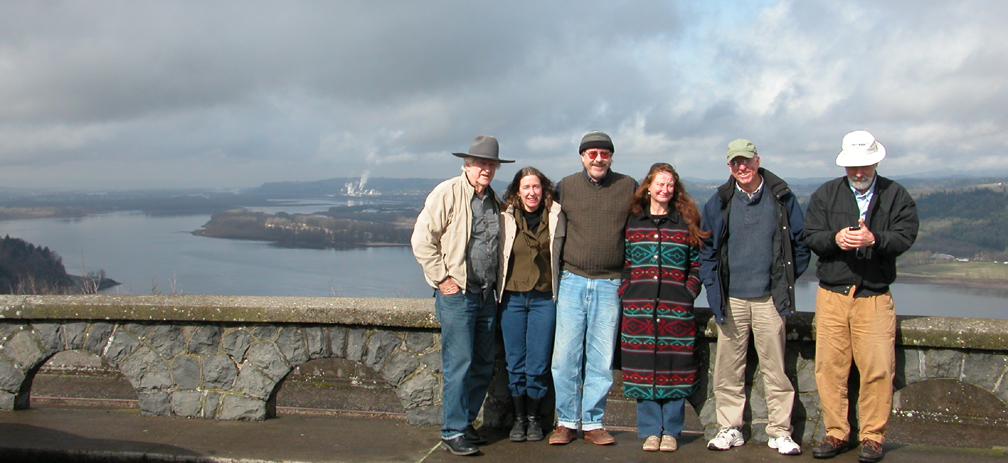
At Crown Point. Left to right: Carl, Kat, Mike, Melissa, Steve, Dan. Click for larger image.
Searching This Site
A commenter requested that he would like to see some posts about anthropogenic fire regimes in the Pacific Northwest.
By my count there have been 40 posts about anthropogenic fire in Oregon, and over 100 on anthropogenic fire in general.
Also, at the W.I.S.E. Colloquium: History of Western Landscapes, we have posted at least 25 scientific papers on the topic.
There is a method to help you search this site and all the sub-sites at W.I.S.E. for topics of interest to you. That method is to use the Search Applet in the upper right hand corner of every page. To use the Search Applet, follow these simple rules:
1. First, go to the root home of the sub-site you wish to search. You can do that by clicking on the large type, bold header at the top of the page.
On this sub-site, the large type, bold header is “SOS Forests“. Click on that. To insure that you are at the root home, check the URL. It should say:
https://westinstenv.org/sosf/
2. Type your search words into the little box that says “search”.
The word “search” will disappear. Your search terms will replace it.
3. Push *Enter*. That is, tap the *Enter* key on your keyboard.
You should see a new URL that will look something like this:
https://westinstenv.org/sosf/?s=anthropogenic+fire
Notice that your search terms will appear in the URL. That is the way to check and see if you completed all the above instructions correctly.
4. All the posts that contain your search terms will appear. It happens very quickly, so you might not notice it at first. But scroll down the page and you will see all the posts that contain your search terms.
5. If your search returned more than 15 posts, at the bottom of the page you will see a hot link that says “Next Page ->“. Click on that. Another page will appear with a URL that looks something like:
https://westinstenv.org/sosf/page/2/?s=anthropogenic+fire
Notice that “page/2″ in there? That tells you that you have found the second set of 15 posts containing your search terms.
Scroll to the bottom again. If you see the hot link that says “Next Page ->” again, that tells you that more than 30 posts meet your criteria. You can click on the hotlink again and see the third set of 15 posts. And so on. If there is no “Next Page ->” hot link at the bottom of the page, you have reached the end and found all the posts with your search terms.
6. To perform a new search (you may wish to try some other search words, for instance), be sure to click on the large type, bold header first. That will take you back to the root home. If you don’t do that, you may inadvertently search within your old search results.
7. All the sub-sites at W.I.S.E. are their own, stand alone databases. You cannot search multiple sub-sites from one location.
8. However, you may perform an author search at the W.I.S.E. Library by going to that subsite and typing the author’s name into the search applet. All the authors of papers posted in the W.I.S.E. Colloquia are listed at the Library.
Important: the Library lists the Colloquia posts, not the Commentary posts. To find authors at the Commentary sub-sites, you must visit the appropriate Commentary sub-site and do your search there.
The Library may be accessed by clicking on the hotlink that says “Library” in the upper lefthand corner of every page.
Any questions?