Latest Climate News Too Ludicrous For Words Tramps and Thieves
by admin
leave a comment
Department of Homeland Security goes off the deep end
Janet Incompetano plans to battle “climate change” in addition to terrorists
Watts Up With That, December 20, 2010 [here]
Not content to keep to the terrorism prevention mission for which they were founded, DHS’s Janet Napolitano now plans to battle a religious war of “climatic jihad”. … [T]he last time Washington DC took on weather in February 2010 (but not climate), the capital was shut down of course [here]. Now that’s “environmental justice”. Look for pat downs at airports soon for those carrying concealed carbonated beverages. …
See also:
Napolitano Says DHS to Begin Battling Climate Change as Homeland Security Issue
By J. Brady Howell, CNS News, December 17, 2010 [here]
At an all-day White House conference on “environmental justice,” Homeland Security Secretary Janet Napolitano announced that her department is creating a new task force to battle the effects of climate change on domestic security operations.
Speaking at the first White House Forum on Environmental Justice on Thursday, Napolitano discussed the initial findings of the department’s recently created “Climate Change and Adaptation Task Force.”
Napolitano explained that the task force was charged with “identifying and assessing the impact that climate change could have on the missions and operations of the Department of Homeland Security.” …
Arctic freeze to last another month
AA warns of ‘worst driving conditions imaginable’ for Christmas getaways
By Paul Sims, the Daily Mail, 18th December 2010 [here]
The Big Freeze will hold us in its grip for at least another month, forecasters warn.
Arctic conditions are expected to last through the Christmas and New Year bank holidays and beyond.
With temperatures expected to fall to -15c (5f), the Met Office said this is ‘almost certain’ to become the coldest December since records began in 1910. … [more]
Eco-Diplomacy, The Chicago Way
Investors Business Daily, 12/06/2010 [here]
International Relations: Leaked embassy dispatches show an America bribing some and threatening others to get support for a climate change accord, revealing just how weak the case for such a treaty really is.
Sometimes it is worth seeing how the sausage — or in the case of climate change, the baloney — is made. While the WikiLeaks focus has been on the leaking of classified documents, the content of some of them is revealing.
David Carrington in Britain’s Guardian shows how the U.S., after failing to get a successor treaty to the failed Kyoto Protocol in Denmark, bribed, threatened and cajoled nations to get support for a “Copenhagen accord” under which nations would pledge to meet individual goals in the absence of a binding one-size-fits-all treaty.
In one instance, Hillary Clinton’s State Department, acting on a request from the CIA, sent a secret cable on July 31, 2009, seeking “human intelligence” from U.N. diplomats on which nations were being naughty and which were being nice on climate change and which might be making deals to circumvent Copenhagen goals.
We were essentially seeking dirt on nations opposed to the administration’s approach to fighting alleged global warming, and we were not above blackmail to get nations to comply with our position or threats that involved the cutting off of financial assistance promised to poorer nations said to be impacted by climate change. …
Confronted with a demonstrably cooling planet and a corrupt and fraudulent global climate-change bureaucracy, our government is reduced to bribes and coercion to cobble together a new agreement. In the absence of sound science and a rationale for committing global economic suicide, we are quite simply trying to make the world an offer it can’t refuse. … [more]
WikiLeaks Climate Revelations Spark Fury, Gloating
Written by Alex Newman, NewAmerican, 16 December 2010 [here]
After a series of secret U.S. cables released by WikiLeaks exposed American and European officials plotting bribery, blackmail, threats, and even espionage to advance their “climate” agenda, the reaction to the revelations around the world has been enormous.
Among the revelations: the U.S. State Department, acting on a request from the Central Intelligence Agency, ordered American diplomats to spy on officials and governments. The American regime was seeking compromising information, Internet passwords, credit-card numbers, DNA and biometric data, evidence of non-cooperation with international climate decrees, and much more. The cables also show U.S. and European Union officials discussing and using bribery and blackmail to get poorer regimes to sign on to the COP15 climate deal in Copenhagen.
The leaked diplomatic documents, which were publicized during the United Nations COP16 global-warming summit in Cancun, have caused a severe backlash against the tactics and negotiations among media outlets worldwide — on all sides of the debate. From statist publications and governments to talk-radio personalities and climate-change “skeptics,” everybody is seizing on the revelations. Except, of course, the embarrassed governments that were exposed. … [more]
States Diverting Money From Climate Initiative
By MIREYA NAVARRO, New York Times, November 28, 2010 [here]
In New York, government officials found $90 million to pay for schools by dipping into money generated by a multistate greenhouse gas initiative.
In New Hampshire, the state took $3.1 million from a similar environmental fund. And in New Jersey, the government diverted its whole share: $65 million.
At least three financially troubled states have discovered in the Regional Greenhouse Gas Initiative, a cap-and-trade system, a convenient pool of money that can be drawn on to help balance state budgets.
In just over two years, the initiative, known as RGGI, has generated more than $729 million for the 10 states that have participated. Each state is supposed to use its share of the money raised to invest in renewable energy and to promote energy efficiency and consumer benefits, like programs that help low-income electricity customers pay their utility bills.
But the money is proving too much of a temptation for states not to use in other ways.
Critics say that diverting money from the fund for general spending, instead of using it on emissions control and energy savings, makes the initiative little more than a hidden tax on electricity. … [more]
CLIMATE: South Sound was warmer 5,000 years ago
by Ken A. Schlichte, Letter to the Editor, Tacoma News Tribune, November 22, 2010 [here]
Re: “As world warms, delegates again try talking” (TNT, 11-21).
The last time the world warmed was 120,000 years ago and that warming was 1.8 degrees Fahrenheit, according to the article about the United Nations climate conference in Cancun. The author has apparently not read about the Holocene Maximum, the global climatic period from about 10,000 to 5,000 years ago that was 2 degrees Fahrenheit or more warmer than present-day temperatures.
The warmer temperatures of the Holocene Maximum were responsible for replacing forests with prairies on many gravelly and droughty glacial outwash deposits in the South Sound Region. These prairies, including the large prairies on and around Joint Base Lewis-McChord, were then maintained against naturally advancing forests through the thousands of years of cooler temperatures that followed the Holocene Maximum by the Native American prairie- burning activities that ended late in the 1800s.
Prairie vegetation is now gradually being replaced by naturally advancing forest vegetation throughout the South Sound region because of the cooler temperatures since the Holocene Maximum and the lack of Native American prairie-burning activities.
###
See also: Glacier melt adds ancient edibles to marine buffet [here]
“Forests that lived along the Gulf of Alaska between 2,500 to 7,000 years ago were subsequently covered by glaciers. The crushed organic matter is being expelled by the glaciers there today.”
US judge orders Obama administration to clarify polar bears’ Bush-era ‘endangered’ status
By Matthew Daly, Canadian Press, Oct. 20, 2010 [here]
WASHINGTON — A federal judge ordered the Obama administration on Wednesday to review whether polar bears, at risk because of global warming, are endangered under U.S. law.
U.S. District Judge Emmet Sullivan wants the Interior Department to clarify a decision by the administration of former President George W. Bush that polar bears were merely threatened rather than in imminent danger of extinction.
Sullivan’s request, made at a hearing Wednesday in federal court, keeps in place the 2008 declaration by the Bush administration.
Former Interior Secretary Dirk Kempthorne said in May 2008 that the bears were on the way to extinction because of the rapid disappearance of the Arctic Sea ice upon which they depend. But he stopped short of declaring them endangered, which had it been declared would have increased protections for the bear and make oil and gas exploration more difficult.
[Some] Scientists predict sea ice will continue to melt because of global warming.
Along with the listing, Kempthorne created a “special rule” stating that the Endangered Species Act would not be used to set climate policy or limit greenhouse gas emissions, which contribute to global warming and melting ice in the Arctic Ocean.
The Obama administration upheld the Bush-era policy, declaring that the endangered species law cannot be used to regulate greenhouse gases emitted by sources outside of the polar bears’ habitat. If the bears are found to be endangered, however, that could open the door to using the Endangered Species Act to regulate greenhouse gases.
Sullivan said he would issue a written order shortly, but said Wednesday that the government is likely to have about 30 days to explain how it arrived at its decision. … [more]
Legal Defeat for Global Warming in Kiwigate Scandal
In the climate controversy dubbed Kiwigate, New Zealand skeptics inflict shock courtroom defeat on climatologists implicated in temperature data fraud.
By John O’Sullivan, Suite 101, Oct 6, 2010 [here]
New Zealand’s government via its National Institute of Water and Atmospheric Research (NIWA) has announced it has nothing to do with the country’s “official” climate record in what commentators are calling a capitulation from the tainted climate reconstruction. The story is also covered at ICECAP.com [here]
NIWA’s statement of defense claims they were never responsible for the national temperature record (NZTR).The climb down is seen as a legal triumph for skeptics of the New Zealand Climate Science Coalition (NZCSC) who had initiated their challenge last August when petitioning the high court of New Zealand to invalidate the weather service’s reconstruction of antipodean temperatures. The NZCSC Petition may be read [here].
According to the August official statement of the claim from NZCSC, climate scientists cooked the books by using the same alleged ‘trick’ employed by British and American scientists. This involves subtly imposing a warming bias during what is known as the ‘homogenisation’ process that occurs when climate data needs to be adjusted.
The specific charge brought against the Kiwi government was that its climate scientists had taken the raw temperature records of the country and then adjusted them artificially with the result that a steeper warming trend was created than would otherwise exist by examination of the raw data alone.
Indeed, the original Kiwi records show no warming during the 20th century, but after government sponsored climatologists had manipulated the data a warming trend of 1C appeared. … [more]
Carbon cuts leave Chinese factories in chaos
by John Garnaut, The Age (AU), September 9, 2010 [here]
AN ABRUPT command from Beijing to follow through with ”iron-fisted” energy and carbon emission cuts has thrown China’s industrial heartland into chaos.
Steel factories across the country are slashing production - implying a rocky outlook for key Australian commodities such as iron ore - while smaller Chinese plants have been arbitrarily plunged into darkness.
“We had no water to flush the toilet, we couldn’t use the fridge and of course production stopped,” said an office manager at Wanxing wire mesh factory in Anping, Hebei province.
He said he had struggled through 10 days of randomly imposed blackouts - some as long as 22 hours - and the water supply and electrical appliances had just come back on. “We often didn’t hear the power cut notices, partly because we couldn’t watch TV,” he said.
This energy-efficiency drive reflects Beijing’s last-minute lunge to make good on a pledge to reduce energy use per unit of economic output by 20 per cent over the five years ending this December.
More than a quarter of that improvement has to be achieved in the last months of this year, after earlier energy-efficiency gains were blown by Beijing’s successful economic stimulus program.
Chinese advisers say achieving the widely publicised energy target is seen as crucial for maintaining the government’s policy credibility, as well as China’s longer-term pledge to reduce the intensity of carbon emissions by 40-45 per cent per unit of GDP by 2020.
But Pan Jiahua, a climate change policy expert who directly advised the Politburo earlier this year, told The Age that this was not an efficient way to achieve the goal of energy efficiency.
“The 20 per cent target is compulsory, so the central government mandated the provincial governments to have their energy cuts, and the provincial governments passed this requirement to county level governments, and local government officials have no choice but to implement,” said Professor Pan, who heads the Urban Development and Environment Centre at the Chinese Academy of Social Sciences.
“It’s crazy,” he said… [more]
Don’t Panic – The Arctic has survived warmer temperatures in the past
by Tom Moriarty, ClimateSanity, October 15, 2008 [here]
Since we are in the season of comparing charts, graphs and interpretations of the summer Arctic ice melt, it may be useful to pause and consider the history of Arctic temperatures in the Holocene. There is an abundance of data compiled by hardworking field researchers over the years. Before everybody got so excited about global warming, it was understood that the Arctic was considerably warmer in earlier parts of the Holocene than in the present. The evidence for these warmer periods seems to have been forgotten in an age when satellite data causes us to fixate on the last thirty years.
I have collected a short list of papers that indicate times during the mid-Holocene, and places in or near the Arctic, when it was warmer than the present. Some of these papers may also indicate warmer periods in the early or late Holocene, but I am concentrating primarily on the mid-Holocene in this post. Figure 1, below, shows the spatial distribution of areas covered by these papers. Click on the image to get a larger view. Figure 2 shows the times in the mid-Holocene that each paper says it was warmer than the present. …
San Rafael nonprofit pits AmeriCorps interns against climate change
Richard Halstead, Marin Independent Journal, 09/07/2010 [here]
A San Rafael nonprofit is the manager of a new AmeriCorps program that will place 30 interns for one year in local governments, public agencies and nonprofits throughout the Bay Area to assist in implementing greenhouse gas emissions reduction programs. …
Strategic Energy convinced AmeriCorps to partially fund the internships as a way of meeting two related needs, said Kif Scheuer, a Strategic Energy program manager. AmeriCorps, a federal program often referred to as the domestic Peace Corps, was created under President Bill Clinton and expanded by President George W. Bush.
“One thing that we saw was that local governments are really struggling to respond to climate change,” Scheuer said. “They want to take action but they lack the resources to implement the programs they need to bring their emissions down.
“At the same time,” he said, “a lot of young people are really wanting to get into climate change as a professional direction. They’re passionate about it. But they don’t have a chance to get field experience.”
In Marin, some interns will assist with a climate change education program in Marin County schools. The program motivates students and their families to take voluntary energy efficiency actions to reduce their carbon footprint through educational activities such as school assemblies, school plays and the dissemination of coupons. … [more]
Note: Obama Youth proselytizing the Global Warming Hoax in Marin schools. And disseminating coupons, too (for what it doesn’t say but we’re guessing condoms). How utterly fitting. Almost poetic in its multiple ironies.
Charles Manson: Global Warming Prophet
by Paul Joseph Watson, Prison Planet.com, September 7, 2010 [here]
Charles Manson, the man who masterminded the brutal murders of nine people in the summer of 1969 in an effort to spark a race war in America, has adopted a new cause from his prison cell in California – he is a prophet for the global warming movement – sharing common ground with top academics, environmentalists and even the White House science czar in calling for large numbers of human beings to be exterminated in the name of saving the Earth.
A study of Manson’s belief system is an alarming exercise in understanding the roots of the modern day eugenicist movement, which is propagated via the notion that overpopulation is killing the planet and causing global warming.
The infamous “Manson family” were responsible for the barbaric slayings of actress Sharon Tate and her unborn baby, as well as Rosemary LaBianca and her husband Leno, murders that sent shock waves through America and marked a sudden and crashing halt to the “free love” hippy movement of the 60’s. Manson himself shot and wounded one man, Bernard Crowe, and directed his cult-like followers in the murders of nine other victims.
Manson masterminded the murders in a bid to precipitate a race war between whites and blacks which he dubbed “Helter Skelter,” a term he took from the Beatles song of the same name. Manson and his followers were arrested for the murders in October, November and December of 1969 and all received life sentences.
Preaching the same cause as James Jay Lee, the crazed eco-warrior who stormed a Discovery Channel building last week armed with guns and explosives, Manson continues to attract a loyal following from new members of his “family” who share the notorious killer’s obsession with the need to exterminate humans in order to save the Earth from global warming. … [more]
Climate change not linked to African wars
Claims that global warming can drive civil unrest are hotly disputed
by Quirin Schiermeier, NatureNews, Sept. 6, 2010 [here]
Does climate change make conflict in Africa more likely?ISMAIL TAXTA/Reuters/CorbisIn his popular 2008 book Climate Wars, the US journalist and military historian Gwynne Dyer laid out a daunting scenario. Climate change would put growing pressure on fresh water and food over the coming century, he wrote, triggering social disorder, mass migration and violent conflict.
But is there real proof of a link between climate change and civil war — particularly in crisis-ridden parts of Africa — as many have claimed?
No, says Halvard Buhaug, a political scientist with the Peace Research Institute Oslo in Norway. In research published today in Proceedings of the National Academy of Sciences1, he finds virtually no correlation between climate-change indicators such as temperature and rainfall variability and the frequency of civil wars over the past 50 years in sub-Saharan Africa — arguably the part of the world that is socially and environmentally most vulnerable to climate change. “The primary causes of civil war are political, not environmental,” says Buhaug. … [more]
Latest Climate News Latest Fire News Latest Forest News Tramps and Thieves
by admin
leave a comment
More ‘Climate Change” Ripoffs
Researchers study link between climate, wildfire
The Associated Press, Oregonian, September 01, 2010 [here]
Scientists from universities in Montana, Colorado and Idaho announced today the start of a 5-year, $3.85 million research project into how a changing climate will influence wildfires.
The project is being pursued in partnership with the U.S. Forest Service and researchers in Australia and New Zealand. The goal is to identify how human activities and climate change drive fires.
“One thing is clear: The frequency and severity of fires have increased around and world and this is considered to be one of the signs of global climate change,” Montana State University professor Cathy Whitlock, the lead investigator for the project, said in a statement. … [more]
Note: The temperature data for 1983-2009 from the National Climatic Data Center [here] for the West North Central Region (Idaho, Montana, the Dakotas, Wyoming).
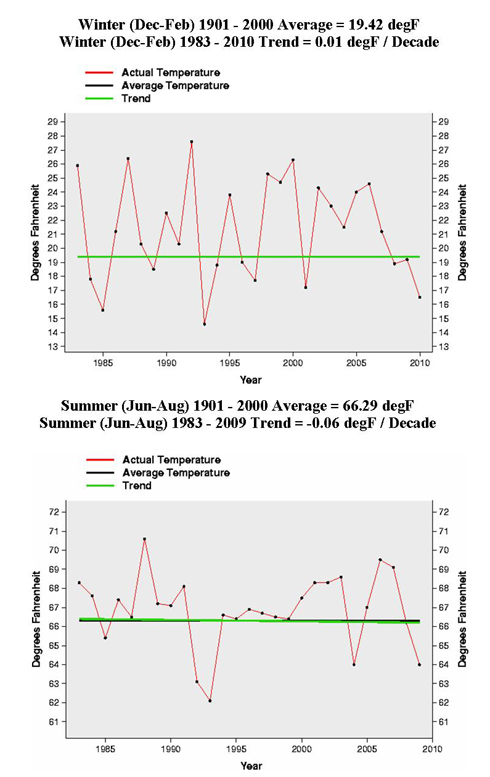
Note that there has been no significant warming for the last 20 years. If there has been no warming, how can warming be the cause of anything????
Giving tax money to hoaxers is a phenomenal waste of resources.
Latest Climate News Too Ludicrous For Words Tramps and Thieves
by admin
leave a comment
Chicago Climate Exchange drops 50%, new record low
by Anthony Watts, Watts Up With That, August 31, 2010 [here]
The only lower price than today’s closing price on a ton of carbon is ZERO
Perhaps reacting to the news yesterday about the IPCC getting taken to the woodshed [here], the growing number of stories in the MSM about the IPCC failure, and the recent layoffs at CCX [here], carbon trading has once again been devalued by the market. …
The CCX [Chicago Climate Exchange] end of day table really says it all, 50% off, from a dime to a nickel [per ton] in a day. …
Charcoal briquettes and coal have more value than a ton of CCX carbon instruments these days. [By the way, the spot price for Central Appalachia 12,500 Btu, 1.2 SO2 coal this week was $69.50 per ton. Compare that 5 cents per ton for fiat "market" carbon futures.]
Unless CCX starts making adjustments in single cents, the next downward adjustment is zero. The latest CCX advisory says they will be closed for labor day, and will reopen for trading September 7th. One wonders.
See also: The $10 Trillion Climate Fraud [here]
ICE buying Climate Exchange for over $600 million [here]